Summary
Picture your best account executive pulling together a research brief with AI before a big call. Company background, leadership changes, business signals, sharp talking points, all in minutes. Now picture a different employee doing the identical task next week. Different model, less context, a lower quality bar. Both are using AI well. Neither one has given you a dependable way to get the work done.
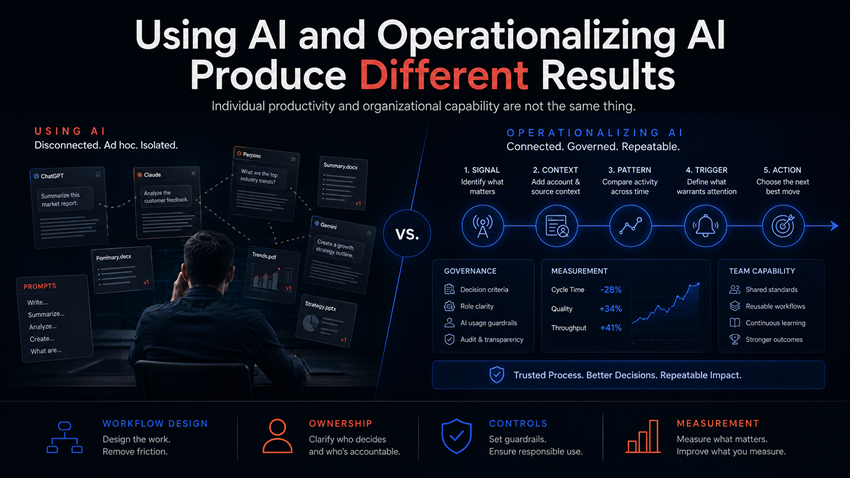
Using artificial intelligence (AI) can make one person faster at a task. Operationalizing AI changes how a team produces a business result. A capable employee can use AI to research an account, draft content, or prepare a customer response. Their individual output can improve immediately while the surrounding workflow runs exactly as it did before. The same queues, handoffs, approvals, and manual transfers continue. Other employees see no benefit, and your company keeps no reusable knowledge once that person moves to a different role.
Deloitte found that 66 percent of surveyed organizations had achieved productivity or efficiency gains from AI, while only 20 percent reported increased revenue. Massachusetts Institute of Technology research argues that AI creates greater value when companies redesign complete task sequences and human-machine handoffs. Value does not follow from leaving the surrounding process untouched. Both findings point the same direction: the gap between individual use and real value closes in the workflow, not in the tool.
Know that where the work begins decides what you get
Individual AI use starts with a person and a task. Someone opens a tool, enters instructions, and decides what to do with the response. The process often works because that person supplies missing context from experience: which sources to trust, which assumptions to correct. A different employee doing the identical task might use a different model, provide less context, and apply a different quality bar entirely. Both are using AI well. Neither has given your organization one dependable way to get the work done.
Operationalization begins the moment the workflow stops depending on whoever happens to be doing it that day. Your team documents the trigger, the inputs, the decisions, the review points, and the destination. Employees can then follow one approved process while still contributing judgment exactly where the work needs it.
Recognize that a prompt and a workflow solve different problems
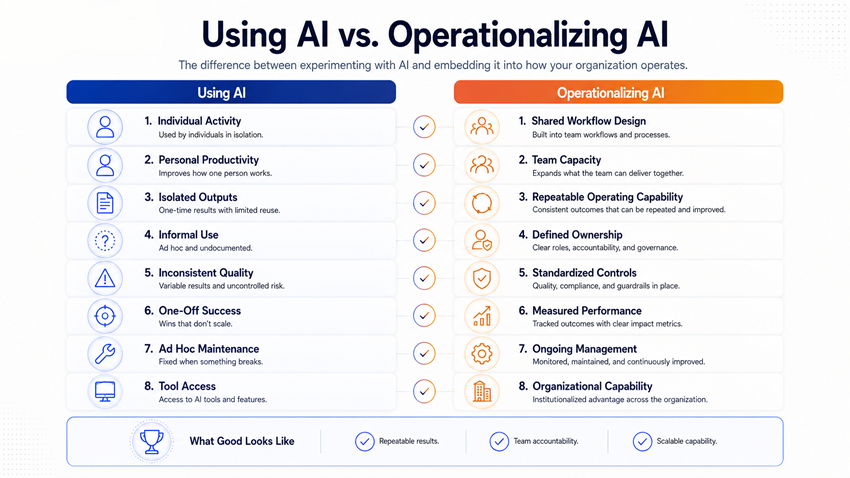
A prompt tells a system what one user wants at one moment. A workflow defines how your organization completes a recurring body of work. Both have real value, and they answer completely different questions.
An employee can write an excellent prompt for researching a target account: company information, leadership changes, business signals, recommended talking points. That brief can genuinely help prepare for one sales conversation. It cannot answer which accounts deserve this research in the first place, or which sources are approved. It also cannot say what needs verification, or where the finished brief should live once it is done. A workflow answers those questions by design. It can trigger when an account crosses an approved signal threshold, then retrieve information from selected sources and generate a structured brief. It can route uncertain claims for review and create an assigned action inside the customer system once the brief is complete. The prompt stays a component. The workflow produces the actual operating result.
A prompt typically specifies the task, the context, the sources, the format, and the quality bar the system should follow. All of that still depends on someone choosing the right prompt and supplying the right information every time. A workflow has to specify more: the event that starts the work, who may initiate it, and the required inputs and approved sources. It also needs which decisions change the path, where a person reviews the output, and how exceptions escalate. It needs where the completed work lands too, and who maintains the whole thing after launch. That operating logic is what lets the work continue past one employee’s personal method.
Know that an output only creates value once it reaches a destination
Artificial intelligence produces outputs easily: drafts, summaries, recommendations, classifications, plans. An output becomes valuable once someone uses it to complete an appropriate action, not before. An account brief sitting inside one conversation has limited value. A customer response stays unfinished until someone verifies, approves, sends, and records it. A campaign plan creates no demand until a team assigns resources and launches the work it describes.
Operationalized AI connects every output to a destination, an owner, and a next action. Your workflow should say plainly whether that output is a draft, a recommendation, an approved record, or an authorized action. Each status requires something different from the employee who receives it. A draft needs editing or approval. A recommendation needs a decision. An authorized action can proceed within its defined limits. Never let your employees have to guess which one they are holding.
Turn judgment into a standard, not a private habit
Experienced employees make individual AI use look far more dependable than it is, because they correct problems quietly and never document the correction. The finished work looks strong because the employee supplied the judgment the system alone could not. Your organization cannot assume every employee will make the same corrections, or even notice the same problems.
Operationalization requires turning that professional judgment into a written standard: required evidence, tone, completeness, and decision criteria specific to the workflow. A marketing standard might require current sources, approved claims, and a defined call to action. A sales standard might require account fit, real buying signals, and an assigned next step. Have your subject experts write these standards, since they already know which failures matter and which do not.
Scale governance with how much the system can touch
An employee using AI manually controls what goes in and what gets accepted, so the risk usually stays contained inside one task. An operational workflow can retrieve customer data, create records, send communications, and initiate transactions across several systems at once. Greater integration expands value and exposure together. Get more specific with governance exactly as autonomy increases, not stay at one fixed setting regardless of what the workflow can do.
The National Institute of Standards and Technology organizes this through govern, map, measure, and manage functions. Those functions translate into a short set of operating questions every workflow needs answered before launch. Who owns the workflow and its consequences? Which data may enter the system, and which actions can it complete without a person present? Which outputs need human review, and which conditions trigger escalation? How will you detect a failure, and when does the workflow come up for formal review? A policy becomes useful the moment its principles turn into permissions, controls, and response rules an employee can act on mid-task.
Know that not every productive method deserves the conversion
Operationalizing a workflow costs real design, integration, governance, and maintenance work, and the expected value has to justify that cost. A use case becomes a strong candidate when demand repeats often enough to justify a shared method. It is also a strong candidate when several people already perform similar work independently. The same holds when the output feeds a meaningful business action rather than personal convenience. It is a stronger candidate still when the current process contains obvious friction, or when inputs can become dependable and predictable. The same holds when acceptable quality can be described in writing and a business leader is willing to own the outcome against a real baseline.
One-off work, rare requests, and highly variable judgment calls often stay better suited to individual assistance indefinitely. Let operationalization follow business need, not enthusiasm for the tool that happens to be popular this quarter.
Convert one method into one workflow
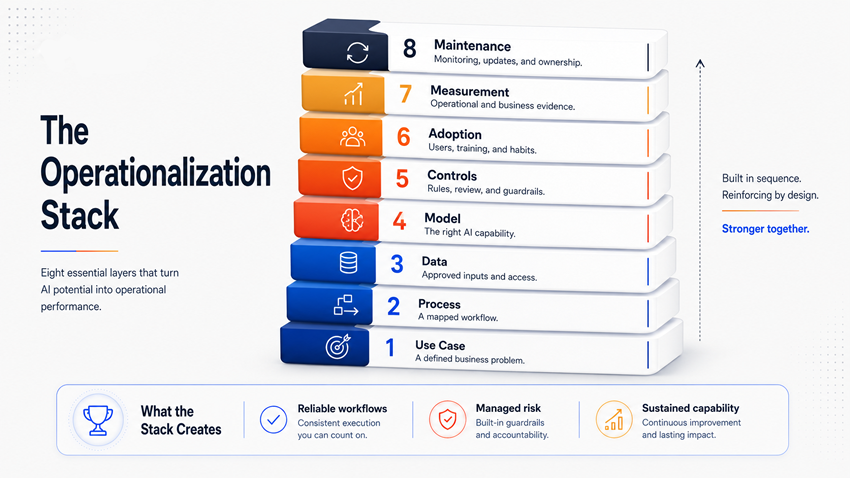
The transition works best starting from one proven individual method and one recurring workflow, not a company-wide transformation announcement. Find an employee who gets a genuinely repeatable benefit from AI, and observe their complete process rather than only collecting their prompt. Define the business result the conversion is for, and establish the current baseline before changing anything. Map the complete workflow, including the surrounding work the employee does around the AI task, since that surrounding work usually holds the real expertise. Capture that expertise as written examples, decision rules, and exception criteria rather than leaving it inside one person’s head.
Design the shared method next: approved instructions, input requirements, and review rules, deciding deliberately where employees can still adapt and where consistency has to hold. Connect the workflow to the business systems it touches, so completed work moves into its approved destination without manual copying. Name every owner, from the business owner through the measurement owner, before testing begins. Test with normal work, including common exceptions and realistic volume. Only then launch inside controlled boundaries, limited users and volume, with a manual fallback ready. Compare results against the baseline, and expand only once the workflow proves dependable under real conditions.
Watch the roles change for managers, employees, and leaders
Managers move from encouraging tool use toward managing workflow performance. A faster generation step can create a review queue somewhere else. A manager needs to see that shift rather than measuring only the part that got faster. Employees need more than access and prompt training. They need to know the workflow’s boundaries, which information is prohibited, and how to use the manual fallback when something looks wrong. Their role often shifts from producing first drafts toward applying judgment and handling exceptions. That shift belongs in job expectations, not left invisible until it causes friction.
Leadership has to treat AI as part of the operating system, not a separate innovation report reviewed once a quarter. That means funding workflow design, data stewardship, and governance alongside the license. It also means deciding deliberately where released capacity goes, instead of letting it disappear into more of the same low-priority work. Leadership also has to be willing to retire a workflow that produces too little value or too much correction. Retirement is what proves the discipline was real.
What you tell them at the end
Individual AI use remains genuinely valuable. It builds confidence, reveals where the technology helps, and teaches your organization things it could not have known in advance. The larger result only appears once you convert that learning into shared capability.
Prompts become workflow components, personal methods become team standards, and isolated outputs become completed business actions with an owner attached. Using AI can make one person better at a task. Operationalizing it can make your organization better at producing the result that mattered in the first place.