
Summary
A shadow artificial intelligence (AI) crackdown tries to stop unapproved use through prohibition, blocking, investigation, and punishment. A shadow AI discovery process tries to understand use, classify risk, provide approved alternatives,
Most companies discover shadow artificial intelligence (AI) the same way. Someone finds it, and the first instinct is to stop it: block the domain, investigate who used it, decide what the punishment should be.
That instinct treats unapproved use as a discipline problem, and it rarely is one. Somewhere underneath the unauthorized tool sits a business problem leadership hasn’t solved yet. It might be a missed deadline, an unredesigned workflow, or an approved product that quietly doesn’t fit the task in front of the employee. A crackdown answers who broke the rule. It never answers why the rule stopped being the fastest way to get the work done.
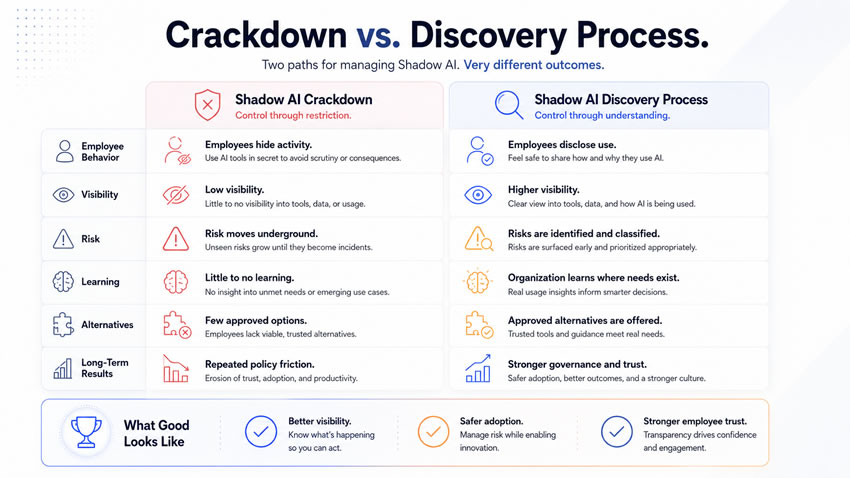
That’s the real choice in front of leadership. A crackdown enforces a boundary. A discovery process asks what the boundary is missing. Both can end in the same restriction. The two approaches carry different assumptions about the behavior underneath the tool, and they produce completely different employees on the other side of it.
The signal is already sitting in the data. Roughly three in four workplace AI users bring their own tools to work. More than half stay quiet about it, worried that admitting how much they lean on AI will make them look replaceable. That’s not a compliance gap. It’s a trust gap, and it existed before anyone opened an investigation. A response that adds fear on top of it doesn’t close that gap. It teaches people to hide better. Psychological safety research is consistent on this point: when people expect blame, they stop disclosing the very things leadership most needs to see. The goal was never just to stop the unapproved apps. It’s to understand why employees went looking for them in the first place.
The two approaches start with different questions
A crackdown usually starts after someone already got caught. The questions that follow look backward: who did this, which rule did they break, what access should come away from them. Those questions have their place. Intentional misconduct and serious data exposure deserve exactly that kind of scrutiny. As a starting posture for the whole shadow AI problem, though, they’re too narrow. They find offenders rather than patterns.
Discovery starts from a different place entirely, with operating questions instead of accusations. Which tools have found their way into daily work? Which data moves through them, and which capability is missing from what’s approved? That’s a forward-looking question, and it produces a forward-looking answer, approving, replacing, redesigning, or shutting down the workflow underneath it. The difference isn’t just methodology. It’s what employees believe will happen the moment they raise their hand. A crackdown teaches people that disclosure identifies a target. Discovery can teach something else, but only when leadership actually behaves that way every single time, not just in the announcement email.
Shadow AI is usually a work problem wearing a policy violation’s clothes
An employee doesn’t wake up trying to violate policy. They wake up with a deadline, a document too long to read twice, an analysis nobody ever trained them to do quickly. A public tool solves the immediate problem in front of them. They often have no idea what happens to the data they just typed in. They understand the work problem completely, because it’s the thing keeping them up at night, not the fine print in a vendor’s terms of service. Two-thirds of employees say they’re struggling with the sheer pace and volume of their work. That pressure is the real engine behind shadow AI adoption. It moves faster than governance ever will.
The gap is rarely the employee. It’s usually one of a small number of organizational failures repeating itself. No approved tool exists for the task, the approved tool performs poorly, or procurement takes longer than the business can wait. Sometimes nobody can find the list of what’s allowed. Sometimes the gap is a manager who rewards the output and never asks how it got made. Blocking a website can’t repair any of that. It removes the symptom and leaves the constraint exactly where it was, waiting for the next workaround.
The risk is real, and pretending otherwise would be its own failure
None of this argues for going easy on exposure. IBM’s 2025 breach research found that one in five organizations had already experienced a breach tied to shadow AI. The organizations with heavy shadow use paid an average of $670,000 more to clean it up. Those incidents exposed personal information and intellectual property at rates well above the norm for an ordinary breach. Cisco found that most security teams genuinely don’t know what their own employees are doing with generative AI. Most lack confidence they’d catch it even if they looked. The visibility gap isn’t theoretical. It’s already costing real money.
That’s exactly why discovery needs a fast lane, not a slow one. None of that should wait for a survey window to close. Protected personal data, trade secrets, financial account information, an unapproved connection into company systems, and repeated activity after a clear warning all deserve immediate attention. The employee’s intent can shape how the company handles the person. The exposure itself should decide how fast the company acts on the system. A discovery program that looks away from real danger to seem supportive loses its credibility in a single incident. A crackdown that treats every use as equally dangerous loses its accuracy the same way. Classification is what keeps the company honest about the difference.
Four separate questions, not one verdict
The instinct to collapse a shadow AI case into a single judgment, approved or not approved, is exactly what produces the worst decisions. Behavior, the use case, the tool, and the data are four different questions, and answering them separately is what makes the final decision defensible.
Behavior asks whether someone acted in good faith or ignored a boundary they already knew about. Someone reaching for a public summarizer because nothing approved exists is not the same person as someone uploading a customer database after a direct warning. Treating them identically teaches the honest one to stop disclosing. The use case asks what the work actually is. A legitimate task can be running inside the wrong tool. A genuinely low-risk tool can still be doing something it was never meant to do. The tool assessment asks what the vendor actually promises about the data. A personal account and that same vendor’s enterprise product can carry entirely different exposure under one brand name. The data assessment asks what’s actually flowing through the workflow. Summarizing a public report and summarizing a customer’s confidential file look identical in the prompt, and they mean nothing alike in consequence.
Separated this way, the company gets real options instead of one blunt answer. It can approve the use case through a different tool. It can approve the tool for public work while restricting sensitive data. It can also reject the task outright while everything else about the situation checks out fine.
A tier should follow consequence, not fear
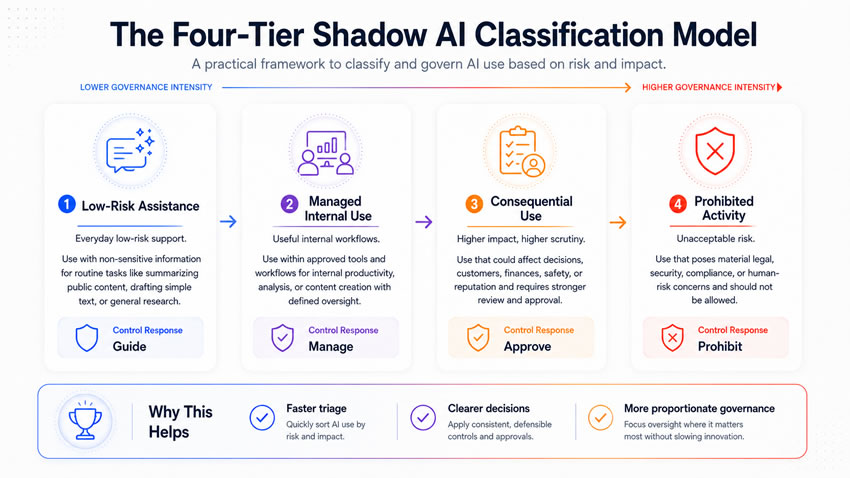
Risk classification only works when it stays proportionate. Low-risk assistance, public information, a person reviewing the result, no connection to company systems, deserves fast approval and basic training rather than a committee. Managed internal work involving business information needs a named owner and a business account behind it. Consequential work touching confidential data or real system access earns the strongest testing, logging, and human review the company has. A small category of activity simply can’t come down to acceptable risk. Unapproved employment decisions, broad-authority external agents, and sensitive data entered into a product never built to hold it all belong here. That activity should stop, and the resulting incident should get addressed directly.
Classification should determine the control response. Employee discipline should follow a completely separate review of knowledge, intent, and history. The tier decides what the workflow needs. It should never decide, on its own, what happens to the person who built it.
The invitation has to come before the investigation
Leadership should announce a defined disclosure window, typically two to four weeks, and be plain about the terms. The company wants visibility. Good-faith disclosure during the window supports classification and a real alternative. Genuinely dangerous activity still gets contained immediately, regardless of the timing. Deliberate concealment and illegal activity were never inside that protection to begin with.
The company should avoid promising blanket amnesty it can’t actually honor. A precise, honest standard earns more trust than a sweeping promise that turns out to carry hidden exceptions employees discover the hard way later.
Ask about the work before asking about the tool
A discovery survey that sounds like an interrogation will produce exactly the silence it was built to end. Employees should describe the work need before answering any technical question. Which task are they completing, and which tool do they use? Which information do they provide, who receives the output, and which approved alternative have they already tried? The governance team can chase vendor details afterward, once it knows the product and the account. The goal is an accurate inventory of work, data, and system behavior, not a confession.
Team interviews catch what surveys miss, since shadow AI often runs on informal team habits. One employee discovers a tool while several colleagues quietly use its outputs. A manager sometimes encourages a method without ever realizing the product was never approved. Walking through one recent case in real detail, the trigger, the inputs, the output’s destination, often reveals something a form can’t. A tool that looked low-risk on paper turns out to shape customer pricing. A tool that looked unnecessary is quietly removing real hours from a recurring backlog.
Technical discovery has to support disclosure, not replace it
Self-reporting alone will miss embedded features, browser extensions, and tools added through another application without anyone quite noticing. Technical monitoring can identify domains, application programming interface calls, and unusual connector activity. Cisco describes exactly this kind of discovery approach: identify shadow applications, assess usage context, and redirect users toward approved services.
Technical evidence should support classification rather than create automatic guilt. A domain visit doesn’t establish that sensitive data actually got entered, and an application programming interface call doesn’t explain the business purpose behind it. Security teams should combine technical records with employee and workflow evidence together, and the company should disclose the monitoring process itself. Employees should understand what gets observed and why. Hidden monitoring deepens exactly the culture problem the discovery process exists to repair.
Every discovery record needs a real decision path
Discovery loses credibility fast when employees report a tool and hear nothing back. Each record needs a status: newly reported, under review, approved with conditions, restricted, prohibited, or retired. Every record needs a named owner and a target decision date attached too. An approval with conditions might require a business account or documented review. A rejection should name the unacceptable risk and the available alternative. Silence teaches employees that disclosure creates work without producing any real support, and a slow decision process will drive people right back toward private methods.
Approved alternatives turn enforcement into enablement
Some shadow use reveals a genuine capability gap. Discovery should ask whether the company can meet the need through an existing tool or a different account configuration. An internal assistant built on approved sources can work too, and so can a simple process change that removes the need entirely. The alternative has to solve enough of the original problem to actually earn adoption. Employees return to private tools the moment an approved option adds several extra steps while producing weaker results. Governance teams should test the replacement directly with the employees who understand the task, then measure whether people actually use it once nobody’s checking.
Training and discipline both need to stay specific
Education should go beyond a list of prohibited data. It should cover the real decisions employees face mid-task: how to find an approved product, which information can enter it, and which outputs need verification. It should also cover how to request something new. Examples should come from real company workflows rather than generic scenarios. A salesperson needs examples involving account records, and a recruiter needs examples involving candidate information.
Discovery doesn’t remove accountability; it sharpens where accountability actually belongs. Discipline stays appropriate when an employee intentionally conceals a serious incident, repeats prohibited activity after clear instruction, or shares credentials for unauthorized access. The company should examine its own role too. Was the policy accessible? Did training exist? Did an approved alternative even exist? Did leaders apply the same rule consistently across every seniority level? Fair enforcement strengthens governance. Selective punishment just teaches employees to manage their visibility instead of managing their risk.
Managers shape behavior more than policy language does
A manager who asks for faster output without providing an approved method is setting the real operating standard, regardless of what the written policy says. A manager who praises an impressive result without ever asking how it got made is setting the same standard. Managers should ask how AI actually contributes to important work and direct employees toward approved tools. They should also report their own team’s use cases through the same process everyone else uses.
Leadership’s behavior has to match the published policy exactly, since employees notice exceptions made for executives and top performers immediately. One visible double standard can weaken the entire discovery program on its own.
Psychological safety and accountability can coexist
Governance needs employee candor, and psychological safety supports that candor when leaders respond with curiosity and consistency rather than automatic suspicion. Psychological safety doesn’t mean freedom from real consequences. It means employees can raise a concern without expecting humiliation or an automatic assumption of bad intent.
Leaders can thank employees for early reporting and separate incident containment from blame assignment. They can also openly admit when an approved system failed to meet a real need. Trust builds through consistent decisions over time, not through one encouraging announcement, and it can’t survive punitive behavior during the very first reported incident.
A shadow AI register creates a continuing operating record
Discovery should produce a structured register rather than a one-time report. Each entry should cover the tool and vendor, the business task, and the data classifications. It should also record the observed value, the risk tier, the current decision, and the review date. The register should connect directly with the approved tool register and use case inventory. A shadow record can become an approved use case after review. A rejected record still stands as evidence of demand and of the decision made about it.
Patterns emerge from the register too. Several teams reaching for the same research capability reveal a portfolio decision leadership needs to make, not an employee problem to punish. The same is true when several products enter the company because one approved platform lacks a needed feature.
Leaders have more than two options
A review can produce several outcomes beyond simple approval or prohibition. Approval with conditions, approval through a different product, a controlled pilot, and a redesigned workflow are all real options. Additional education, a narrower restriction, and genuine prohibition remain available too, when the risk can’t come down to an acceptable level. Even that last option should include containment, alternative guidance, and clear closure steps, not just a blocked door.
The response should differ across common shadow use cases
An employee using a public tool to summarize competitor websites for internal preparation may simply need a business account with source verification rules. A team uploading customer interview transcripts into a consumer tool has real value in the workflow but the wrong account behind it. The company can fix that by moving the workflow into an approved enterprise environment. A manager using an unapproved model to rank candidates needs immediate suspension, evidence preservation, and a return to an approved hiring process. Employment access is at stake regardless of intent. Each case can look similar on a security dashboard while demanding a completely different leadership decision.
Measurement should go beyond counting blocked tools
Useful measures include the number of disclosed tools and use cases, and the percentage receiving a decision within the target period. The percentage moved into approved channels and the number requiring immediate containment matter too. Employee confidence in asking for guidance and manager participation in reporting both matter too. A declining number of detected tools can mean stronger control. It can also mean weaker visibility, so the company should interpret technical detection, employee reporting, and adoption data together rather than trusting any single number. IBM found that only 34 percent of breached organizations with AI governance policies actually performed regular audits for unsanctioned use. A policy without recurring discovery provides limited real assurance.
The operating rhythm has to continue after the first audit
AI products change too quickly for an annual inventory to keep up. Weekly triage should handle new reports and urgent risk. Monthly portfolio review should examine overdue decisions and repeated demand. Quarterly audits should compare technical detection against reported activity across security, technology, and business leadership together. A serious incident, a vendor change, or an expanded permission should bypass the normal schedule entirely and trigger an immediate review. NIST’s voluntary framework connects governance, mapping, measurement, and management. It gives this continuing rhythm a structure to sit inside, rather than requiring the company to build one from scratch.
A 60-day plan can replace a crackdown with controlled discovery
Days one through 15. Leadership defines its position, approving the purpose, the good-faith disclosure standard, and the emergency conditions. It also identifies which intentional behaviors stay subject to discipline regardless of the window.
Days 16 through 30. The team builds the discovery tools: the survey, the interview guide, the shadow register, and one clear intake route for employees and managers to use.
Days 31 through 40. Leadership launches the disclosure window, explaining the process through leadership messages and manager meetings, and publishing the decision timeline so employees know what to expect.
Days 41 through 50. The team combines employee and technical evidence, prioritizing serious exposure first. It then makes and communicates decisions, approving, redirecting, or restricting each priority use case with a named owner attached.
Days 51 through 60. Leadership establishes the continuing rhythm, recurring audits, portfolio reviews, and replacement monitoring, and measures disclosure, decision speed, and approved adoption from week one onward.
The strategic implication
Shadow AI creates risk because the company lacks visibility and control. It also holds information leadership genuinely needs. Which tasks create real pressure, which approved tools are actually failing, and where can AI create value nobody has designed for yet? A crackdown can remove visible access quickly, but it can’t confirm that the underlying work need disappeared. Employees often just move the method further outside company systems instead. A discovery process gives leadership the fuller set of options. It can contain real exposure, classify ordinary use, and approve valuable methods, while still holding people accountable when they ignore clear boundaries. Employees then have an actual reason to disclose AI use before it becomes an incident. Leadership gets a far more accurate view of both the risk and the opportunity sitting in front of it.