
Summary
Most marketing teams are well past basic experimentation with artificial intelligence (AI). People already use assistants, prompts, copilots, and automation shortcuts every week. The activity is real, and almost none of it is visible at the team level.
That invisibility is the problem. Nobody fully knows which workflows depend on AI, which prompts work, what data feeds them, which outputs need review, or which use cases deserve investment.
The anchor idea is simple. The first 30 days of Marketing AI Operations should turn scattered AI activity into a visible operating map.
I have led this first month inside real organizations. The teams that build something durable spend the early weeks understanding the work, not buying tools or launching pilots they cannot support.
Marketing AI Operations is the function that turns AI use into a managed system of workflows, data inputs, review rules, reusable assets, and team enablement. It sits between marketing strategy, operations, automation, content, analytics, and governance. The first 30 days should create enough structure for the team to know what exists, what matters, what is safe, and what should move first.
What the First 30 Days Should Accomplish
The first month should not promise full transformation. It should produce clarity, a decision structure, and a small set of credible pilots.
By day 30, the function should have eight concrete outputs.
- A map of high-value marketing workflows.
- A scored backlog of AI use cases.
- A tool and data inventory.
- A simple human review policy.
- Two or three selected pilots.
- A first version of the AI capability repository.
- A measurement plan tied to business problems.
- A communication and adoption plan.
The table below shows what each core output is for and who owns it.
| 30-Day Output | Purpose | Owner |
|---|---|---|
| Workflow map | Shows where repeated work and AI usage already exist. | Marketing AI Operations lead. |
| Scored use case backlog | Prioritizes what deserves pilot attention. | Marketing AI Operations lead and workflow owners. |
| Tool and data inventory | Clarifies inputs, ownership, sensitivity, and integration options. | Marketing operations and data owners. |
| Review policy | Defines what needs human approval before use. | Marketing leadership and reviewers. |
| Pilot plan | Selects two or three credible early workflows. | Workflow owners. |
| Repository structure | Stores reusable workflows, prompts, assets, and examples. | Marketing AI Operations lead. |
Week One: Workflow Discovery
Week one is about understanding how the work actually happens. The lead should interview people across content, demand generation, campaign operations, field marketing, sales enablement, marketing operations, revenue operations, and leadership.
The goal is to find repeated friction rather than collect random AI ideas. A focused set of questions surfaces the workflows worth examining.
- Which marketing tasks repeat every week or month?
- Which tasks require too much manual synthesis?
- Which tasks depend on one strong individual?
- Which reports take too long to produce?
- Which handoffs between teams break down?
- Which workflows already use AI informally?
- Which outputs reach customers, prospects, sales, or executives?
- Which workflows create the most review burden?
- Which tasks have good source material but a poor process?
- Which processes would improve if the first draft or analysis arrived faster?
Week One: Tool Inventory
A tool inventory prevents false assumptions about what the team can already do. Most marketing teams run customer relationship management (CRM) systems, marketing automation platforms, sales engagement tools, intent data providers, analytics platforms, content systems, project management tools, AI assistants, and workflow automation tools.
The inventory should capture, for each tool, the tool name, the primary owner, and the business function it serves. It should also capture the main data it creates or stores, its current AI or automation usage, its data sensitivity, its known limitations, and any contract constraints. The inventory should also show who has access, what permissions each role has, whether data can be exported, and whether the tool supports application programming interface (API) access or workflow automation.
Week Two: Use Case Scoring
Week two turns discovery into decisions. The team scores each candidate use case with the six-category model: Business Impact, Workflow Repeatability, Data Readiness, Risk Manageability, Human Review Complexity, and Adoption Readiness.
Each category receives a score from one to five, and the totals rank the backlog. The team then assigns each use case to a decision lane of Pilot Now, Prepare First, Govern Before Building, or Do Not Automate Yet. The early pilots need enough value to matter and enough structure to review.
Week Two: Data Readiness
AI workflows are only as strong as their inputs, so data readiness gets its own assessment. A short set of questions tests whether a workflow can stand on its data.
- What data does the workflow need, and where does it live?
- Who owns that data, and how clean is it?
- How often is it updated?
- Is it approved for AI-assisted use?
- Does it include sensitive or restricted information?
- Can the output trace back to its source material?
- Does the workflow need structured fields, documents, transcripts, or exports?
- What cleanup must happen before pilot work begins?
This step deserves real attention. Gartner has predicted that organizations will abandon 60 percent of AI projects unsupported by AI-ready data through 2026.¹ Data readiness is the difference between useful AI output and confident noise.
Week Three: Human Review Rules
Clear review rules are what make AI output trustworthy. They define when a person can use AI output as a draft, when it can support internal decisions, and when it must be reviewed before any use.
The rules should cover the highest-stakes outputs explicitly.
- Customer-facing content requires review before publication.
- Executive reporting requires review for accuracy and framing.
- Sales recommendations require review before they reach a seller.
- Legal, pricing, and compliance claims require specialist review.
- Competitive analysis requires review for fairness and accuracy.
- Customer and prospect data requires handling within privacy rules.
- Automated routing or task creation requires a defined owner.
- Public publishing and sensitive internal communication require sign-off.
The goal is to define where AI may assist, where a person must approve, and where automation should not act without explicit permission. These rules help teams move faster, because they remove the ambiguity that otherwise stalls every decision.
Week Three: Pilot Selection
A strong first pilot has a recognizable profile. It solves a visible business problem, repeats often enough to matter, and uses available, approved inputs. It carries manageable risk, includes a clear reviewer, and produces an output users already need.
A good pilot also fits an existing workflow, stays measurable within 30 to 60 days, and creates reusable documentation. Useful candidates include a weekly campaign performance summary, account engagement analysis for sales follow-up, an AI-assisted content repurposing workflow, an internal campaign brief generator, and a webinar follow-up content workflow.
The discipline here is restraint. A team that launches five pilots at once usually finishes none of them well.
Week Four: Documentation
By week four, the team starts documenting the operating system in the AI capability repository. Documentation is what turns a pilot into capability that survives turnover.
Each workflow record should capture the approved use case, the workflow steps, and the prompt assets. It should also capture the required inputs, the source materials, the human review rules, example outputs, the owner, known failure points, and the review date. This can live in Notion, Confluence, Google Drive, SharePoint, or Airtable, since the structure matters more than the tool.
Week Four: Adoption Plan
A Marketing AI Operations function succeeds only when people use the workflows, which requires enablement rather than documentation alone. The adoption plan turns a finished workflow into a used one.
A complete plan includes a short explanation of why the workflow exists and a clear before-and-after example. It also includes a quick-start guide, a brief workflow demo, named support contacts, review expectations, and a feedback method. It then specifies training for the first user group, a decision on who may modify the workflow, and a schedule for follow-up.
Measurement Before Launch
Measurement should start before a pilot launches, so success is defined rather than claimed afterward. Every pilot needs a few practical measures tied to its original business problem.
Useful measures include time saved, cycle time reduction, and review quality. They also include the error or revision rate, sales acceptance, content reuse, user adoption, workflow completion rate, decision speed, and stakeholder satisfaction. A measure that does not connect to the problem the pilot was meant to solve is not worth tracking.
The Framework: The 30-Day Marketing AI Operations Roadmap
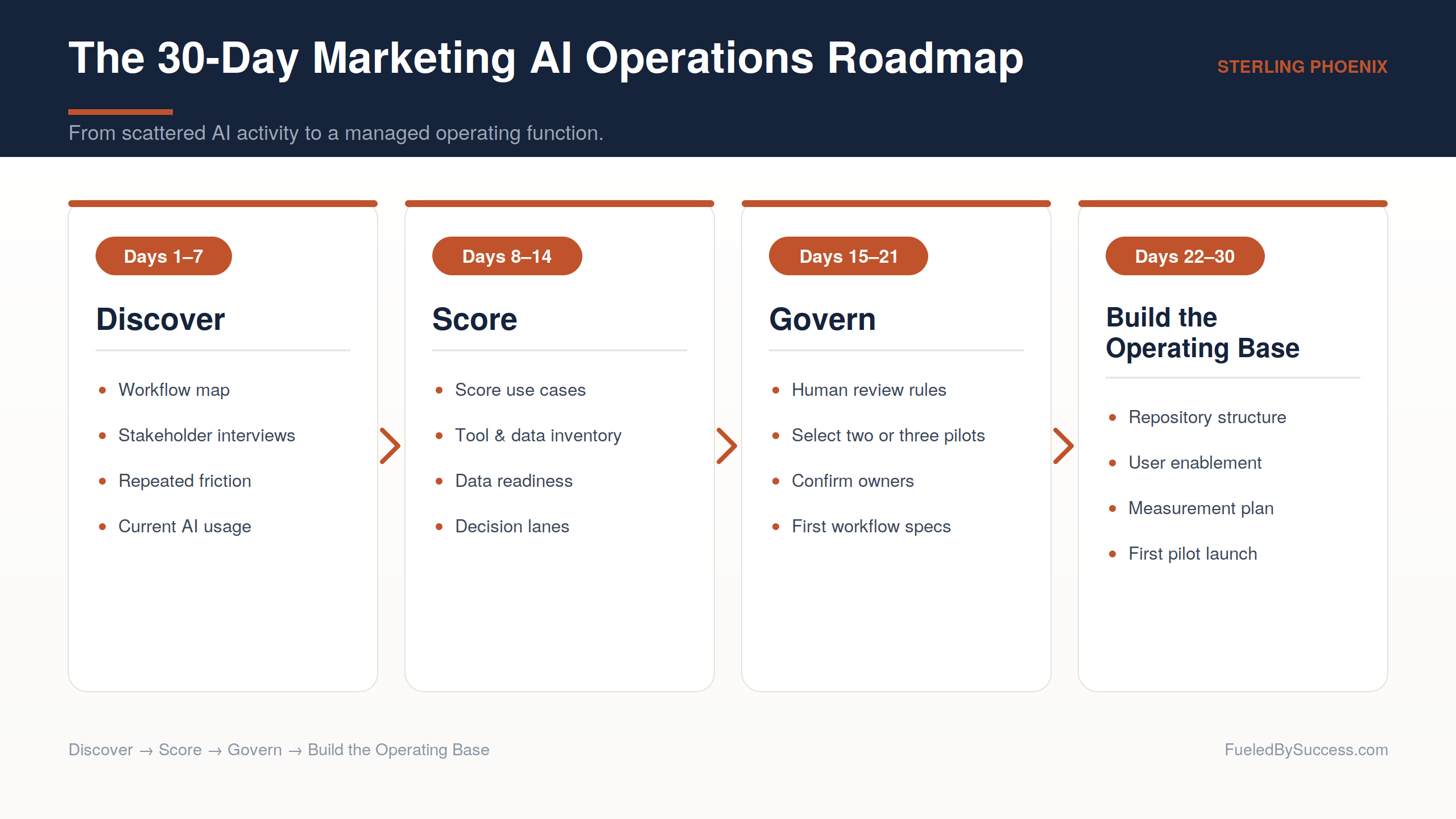
The full month moves through four phases. Each phase produces the inputs the next phase depends on.
Days One to Seven: Discover
The team maps workflows, interviews stakeholders, identifies repeated friction, and documents current AI usage.
Days Eight to Fourteen: Score
The team scores use cases, inventories tools, assesses data readiness, and assigns decision lanes.
Days Fifteen to Twenty-One: Govern
The team defines review rules, chooses pilot candidates, confirms owners, and writes the first workflow specifications.
Days Twenty-Two to Thirty: Build the Operating Base
The team creates the first repository structure, documents the pilot workflows, trains early users, defines measurements, and prepares the first pilot launch.
What Not to Do in the First 30 Days
A few early mistakes can undermine the whole function. Naming them in advance is the cheapest protection.
- Avoid buying another tool before mapping current workflows.
- Avoid launching five or more pilots at once.
- Avoid automating workflows that nobody has documented.
- Avoid using sensitive data without clear rules.
- Avoid letting every team create separate prompt systems.
- Avoid skipping human review standards.
- Avoid measuring output volume alone.
- Avoid treating early enthusiasm as adoption.
- Avoid building a repository that nobody can use.
- Avoid confusing a demo with an operating function.
What Success Looks Like After 30 Days
Success after one month is a working operating base, not a finished transformation. The signs are concrete and visible to leadership.
Leaders can see which AI opportunities matter most, and teams understand which workflows are being piloted. Data owners know what inputs are required, and reviewers know what they must approve. The first repository structure exists, the team has selected a small set of pilots, and measurement is defined before launch. Teams also have a clear path for submitting new AI workflow ideas without creating side systems. Most important, the organization now has a repeatable process for intake and prioritization.
This pattern reflects where the wider market sits. McKinsey’s 2025 State of AI report found that nearly nine in 10 respondents report regular AI use, while most organizations have not embedded AI deeply enough into workflows and processes to realize enterprise-level benefits.² A disciplined first month is built to close exactly that gap.
The Strategic Implication
The first month sets the operating pattern for everything that follows. A team that spends it on discovery, scoring, governance, and documentation builds a function that compounds.
The first 30 days should prove that AI can become a managed operating function, rather than another layer of scattered activity. That proof is what earns the mandate to scale.
Key Takeaways
- The first 30 days should turn scattered AI activity into a visible operating map.
- Workflow discovery should happen before tool selection or automation.
- Use case scoring helps teams choose pilots based on value, readiness, risk, and adoption.
- Human review rules protect quality and make AI workflows easier to trust.
- A repository, adoption plan, and measurement model turn early pilots into repeatable capability.
Frequently Asked Questions
What is Marketing AI Operations? Marketing AI Operations is the function that manages how marketing teams use AI, data, automation, workflows, governance, and enablement.
What should happen in the first 30 days of Marketing AI Operations? The first 30 days should focus on workflow discovery, use case scoring, tool inventory, data readiness, review rules, pilot selection, documentation, adoption, and measurement.
How many AI pilots should a marketing team start with? Most teams should start with two or three focused pilots, so they can learn, measure, and improve without overwhelming users.
Why is data readiness important for Marketing AI Operations? Data readiness determines whether an AI workflow has reliable, approved, and usable inputs, which is what separates useful output from confident noise.
Who should own Marketing AI Operations? A Marketing AI Operations lead, a marketing operations leader, or an AI enablement owner should own the function, with support from content, demand generation, revenue operations, sales, and leadership.
Framework Reference: The 30-Day Marketing AI Operations Roadmap
Definition. The 30-Day Marketing AI Operations Roadmap helps teams move from scattered AI usage to a structured operating function.
Phases. Discover, Score, Govern, and Build the Operating Base.
Application. Teams apply the roadmap by mapping workflows, scoring use cases, assessing tools and data, defining review rules, selecting pilots, documenting workflows, enabling users, and measuring early outcomes.
References
- Gartner. Lack of AI-Ready Data Puts AI Projects at Risk (February 2025). https://www.gartner.com/en/newsroom/press-releases/2025-02-26-lack-of-ai-ready-data-puts-ai-projects-at-risk
- McKinsey & Company. The State of AI in 2025: Agents, Innovation, and Transformation (November 2025). https://www.mckinsey.com/capabilities/quantumblack/our-insights/the-state-of-ai