
Summary
Most growing businesses eventually find the same hidden constraint.
The work appears to be spread across a team, a process, or a system. A closer look shows something different. One person is still holding the final judgment, the next move, or the quality standard in their head.
Every email waits for them. Every approval waits for them. Every follow-up waits for their memory. Every decision waits for the one person who knows what good looks like.
Many leaders call this being hands-on. Many founders call this protecting quality. Many managers call this staying close to the work.
In practice, it often becomes a one-person bottleneck.
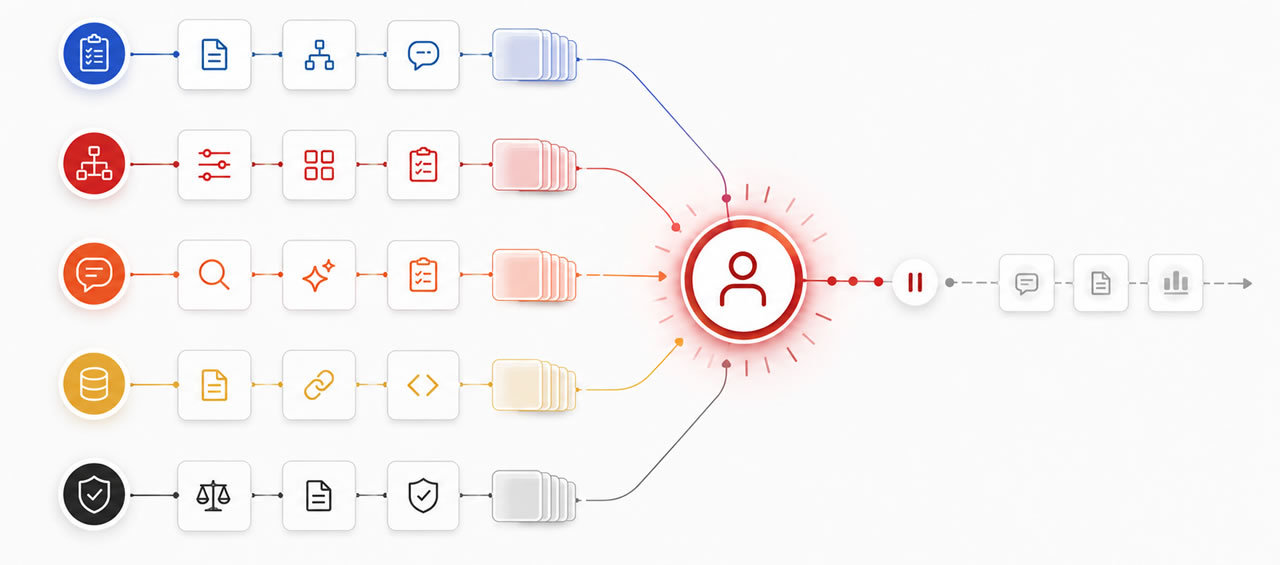
Artificial Intelligence (AI) gives us a better way to handle this problem. The goal is not to remove the person with judgment. The goal is to stop trapping that judgment inside one person’s calendar, inbox, and energy level.
That shift takes more thought than most AI conversations suggest.
A leader cannot hand AI a messy workflow and expect a reliable system. A team cannot automate approvals when nobody has defined what approval actually means. A company cannot scale judgment when judgment only exists as instinct.
The real opportunity is not just automation. The real opportunity is turning personal expertise into shared operating logic.
The Bottleneck Is Often the Mental Checklist
Artificial Intelligence (AI) does not struggle because people are involved. It struggles when people cannot explain how they make decisions.
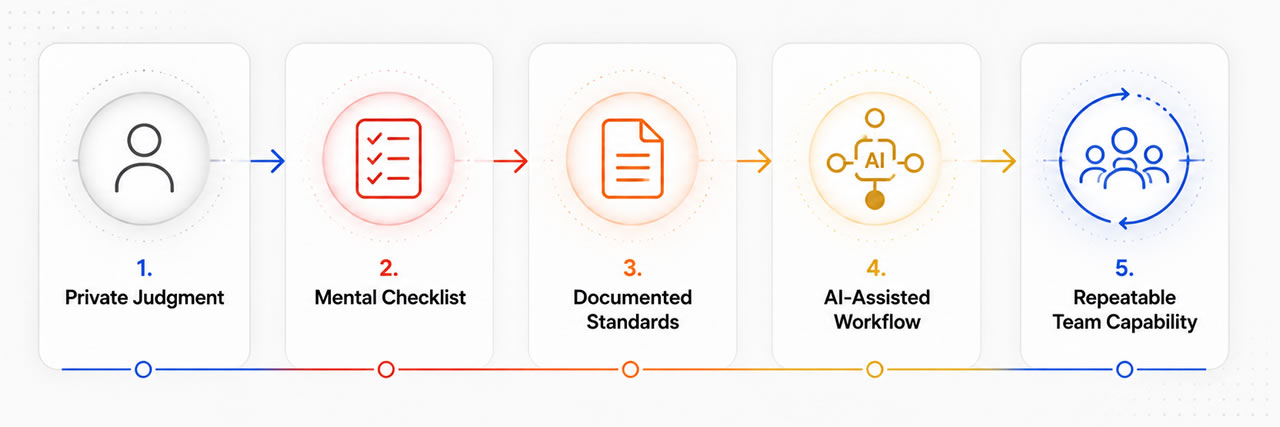
Every experienced operator has a mental checklist. They may not call it that, and they may not have written it down. They still use it every day.
They know which words sound wrong in a customer email. They know when a lead feels promising, weak, or premature. They know when a proposal needs more proof. They know when a message feels too casual, too stiff, too risky, or too vague.
That knowledge usually lives in memory. It shows up as a fast reaction during review.
The problem starts when every workflow depends on that reaction.
A salesperson drafts an email and waits for review. A marketing manager writes a campaign brief and waits for direction. A coordinator builds a report and waits for someone to interpret it. An assistant prepares follow-up notes and waits for approval.
The work is not blocked because the team lacks effort. The work is blocked because the decision criteria are undocumented.
AI can help, but only when we slow down first.
AI Works Better When Judgment Becomes Visible
Artificial Intelligence (AI) performs better when it receives clear standards, examples, boundaries, and escalation rules. That sounds simple, yet most teams skip this step.
They ask AI to write, analyze, prioritize, or respond. They rarely teach AI how the organization decides whether the output is good enough.
This is where leaders need to pause.
Before you automate the next step, watch yourself perform the step. Pay attention to what you notice. Pay attention to what you reject. Pay attention to the small changes you make without thinking.
A Practical Example From Communication Review
A leader reviewing outbound emails may notice several patterns.
- They may remove inflated claims.
- They may shorten the opening sentence.
- They may change the call to action.
- They may soften language that feels too aggressive.
- They may add proof when the message feels unsupported.
Those choices are not random. They are operating standards.
Once those standards are visible, AI can support the work more intelligently. It can draft against the checklist. It can flag weak points before human review. It can route only uncertain cases to the leader. It can learn from edits over time.
The leader still owns judgment. The workflow no longer depends on the leader touching every single item.
The Goal Is Not Full Automation
Artificial Intelligence (AI) creates risk when teams treat every delay as waste. Some friction protects quality, trust, and accountability.
A sales email that commits pricing needs review. A customer response involving a service failure needs review. A legal, financial, or sensitive communication needs review. A routine follow-up after a discovery call may not need the same level of review.
The practical question is not whether AI should handle the work. The better question is which parts of the work require human judgment.
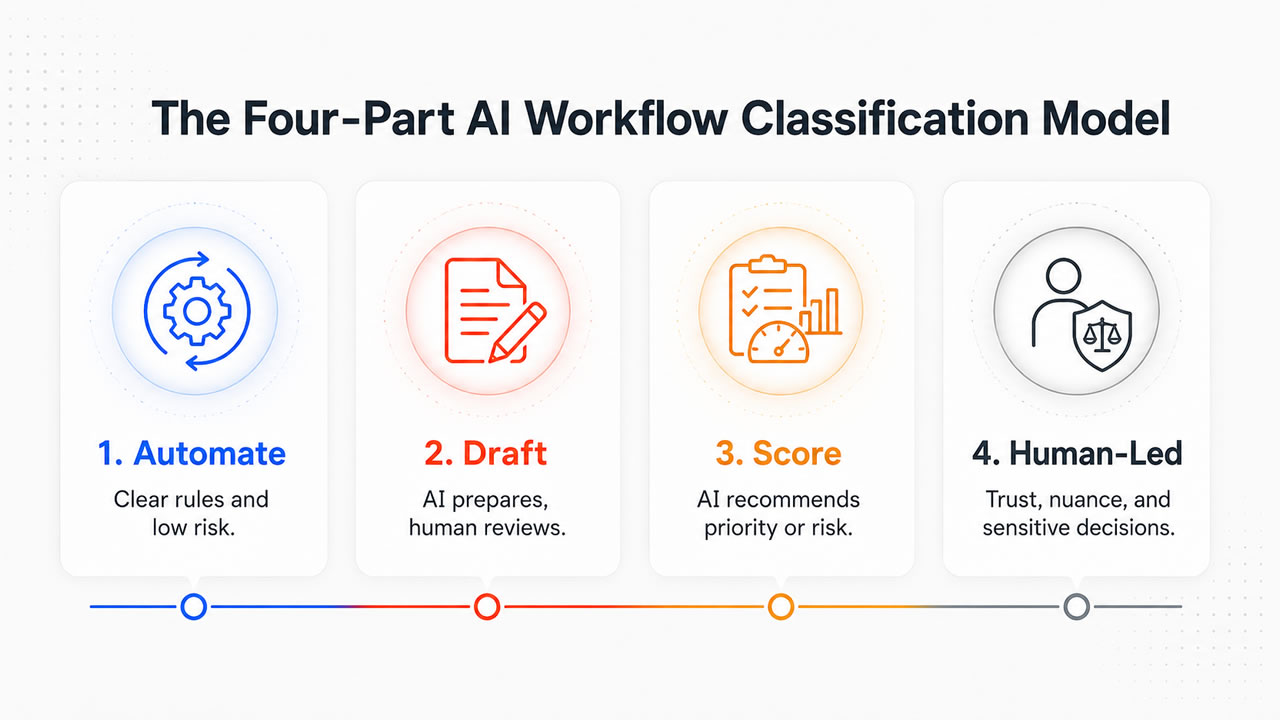
The Four-Part AI Workflow Classification Model
1. Tasks That Are Safe to Automate
These tasks follow clear rules and carry low risk.
2. Tasks That Are Safe to Draft With AI
These tasks can begin with AI, but a human still reviews the output before it leaves.
3. Tasks That Are Safe to Score With AI
These tasks allow AI to recommend priority, risk, or next steps.
4. Tasks That Should Stay Human-Led
These tasks involve trust, nuance, negotiation, sensitive context, or irreversible decisions.
This classification prevents two common failures. It stops leaders from over-automating risky work. It also stops leaders from personally reviewing low-risk work forever.
The Best AI Systems Start With a Bottleneck Audit
Artificial Intelligence (AI) should begin with a practical bottleneck audit. The audit does not need to be complicated. It needs to be honest.
Start with one workflow where work regularly stalls. Sales outreach, proposal review, content approval, customer follow-up, recruiting, and reporting often reveal the problem quickly.
Five Questions That Reveal the Real Constraint
- Which step waits on one specific person most often?
- What does that person decide during the delay?
- What information do they use to make the decision?
- What standards do they apply during review?
- Which cases truly require their approval?
The answers usually reveal hidden operating logic.
A leader may discover they are reviewing everything because the team lacks examples. A manager may discover they are approving everything because risk levels are unclear. A founder may discover they are editing every message because the brand voice exists only in their head.
That discovery can feel uncomfortable. It is also useful.
The bottleneck is not proof that the person is failing. It is proof that the system has not captured their expertise yet.
The Mental Checklist Needs to Become a Working Asset
Artificial Intelligence (AI) systems improve when teams convert judgment into reusable assets.
A working asset can be a checklist, rubric, prompt, decision tree, playbook, or review model. The format matters less than the clarity.
For a Communication Workflow
The asset should include specific standards.
- It should define the audience, the purpose, and the expected outcome.
- It should list approved language patterns and banned phrases.
- It should show strong examples and weak examples.
- It should explain when the AI should escalate instead of guessing.
For a Lead Qualification Workflow
The asset should define buying signals.
- It should explain which signals carry weight.
- It should separate curiosity from intent.
- It should identify disqualifying factors.
- It should tell the system when a human should review the account.
For a Content Workflow
The asset should define quality.
- It should include voice rules, structure rules, proof requirements, citation standards, and review criteria.
- It should explain what the content should never sound like.
- It should show examples of approved content and rejected content.
- It should clarify when a reviewer must make the final decision.
This work feels slower at first. It becomes faster later because the system stops depending on repeated explanation.
AI Should Reduce Review Load, Not Accountability
Artificial Intelligence (AI) changes where human review belongs. It should not erase accountability.
A thoughtful AI workflow gives people better leverage. It does not leave people guessing what happened.
Every AI-supported workflow needs clear ownership. Someone owns the standard. Someone owns the review process. Someone owns final approval for higher-risk actions. Someone owns performance monitoring.
This ownership should be explicit before the workflow scales.
The Visibility Layer Every AI Workflow Needs
Teams also need logs. They need to know what AI drafted, scored, changed, routed, or escalated. They need to track where humans approved, rejected, or corrected the output.
Without that visibility, AI becomes another invisible process. Invisible processes create distrust, especially when mistakes happen.
A strong AI system should make the work easier to inspect. It should show why something moved forward and why something stopped.
The System Should Learn From Human Edits
Artificial Intelligence (AI) becomes more useful when feedback becomes part of the workflow.
Most teams waste their review effort. A leader edits the same issues repeatedly, yet the system never captures the pattern. The next draft comes back with the same problems.
That is not an AI failure alone. It is a feedback design failure.
The Correction Loop
Every AI-assisted workflow should include a simple correction loop.
- The AI creates, scores, summarizes, or routes the work.
- The human reviews the output and makes corrections.
- The system captures the reason for each meaningful correction.
- The checklist, prompt, rubric, or examples get updated.
- The next cycle uses the improved standard.
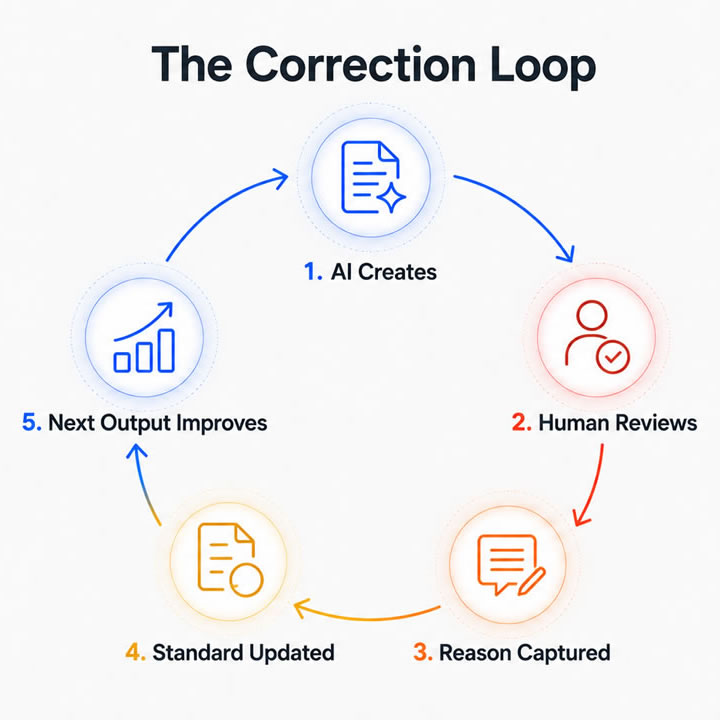
When a human edits an output, the system should capture the reason. The reason may involve tone, accuracy, missing context, weak proof, poor structure, or risk.
This turns review into training.
The leader still improves the immediate work. The system also gets better for the next cycle. Over time, the leader should review fewer routine issues and more meaningful exceptions.
That is where capacity starts to change.
The Practical Implementation Model Is Simple
Artificial Intelligence (AI) implementation does not need to begin with a large transformation program. It can start with one bottleneck and one measurable workflow.
Step 1: Choose One Workflow Where Work Regularly Stalls
Choose a workflow where one person slows the process. Common examples include sales outreach, proposal review, content approval, customer follow-up, recruiting, and reporting.
Step 2: Measure the Current Process
Define the current cycle time, volume, error rate, and approval pattern. This gives the team a baseline before AI changes the workflow.
Step 3: Document the Decision Criteria
Document the decision criteria used by the bottleneck person. Capture what they approve, reject, rewrite, escalate, and question.
Step 4: Build the First Checklist
Build a first version of the checklist. Use real examples from past work. Include examples that passed review and examples that failed review.
Step 5: Define the AI Role
The AI may research, draft, score, summarize, compare, route, or prepare. The AI should not receive broader authority than the process can safely support.
Step 6: Define the Human Role
The human may approve, reject, revise, resolve exceptions, update standards, and review performance. The human should not remain the default checkpoint for every routine step.
Step 7: Measure the Workflow Again
Track cycle time, review volume, rework, quality issues, escalation rate, and business outcome. A useful AI system should improve throughput without lowering trust.
The Leader Has to Change Too
Artificial Intelligence (AI) will not fix a leader who refuses to release control.
Some leaders stay stuck because being needed feels productive. Some founders stay stuck because every decision still feels personal. Some managers stay stuck because they have never taught the team how to think through the work.
AI forces a deeper leadership question.
Can you explain your judgment well enough for someone else to apply it?
That someone else may be a person. It may be an AI agent. It may be a workflow that blends both.
The answer determines how scalable the system can become.
A leader who cannot explain their standards will keep becoming the checkpoint. A leader who documents their standards can turn personal judgment into team capability.
That does not make the leader less important. It makes the leader more useful.
Their role shifts from constant reviewer to system designer. They spend less time catching routine issues. They spend more time improving the logic that helps the whole team operate better.
The Real Opportunity Is Operational Clarity
Artificial Intelligence (AI) reveals what was already true inside the business.
If the workflow is unclear, AI exposes the confusion. If decision rights are vague, AI exposes the ambiguity. If one person holds the standard, AI exposes the dependency.
That exposure can frustrate leaders. It can also help them build better systems.
The one-person bottleneck is not solved by telling AI to take over. It is solved by making expert judgment visible, teachable, and repeatable.
That requires thoughtful intent. It requires leaders to slow down and study their own methods. It requires teams to define where AI should act, where humans should review, and where accountability lives.
This is the work that separates AI experimentation from AI operations.
The business does not become stronger because one person works faster. The business becomes stronger when the system no longer stops at one person.
That is the real promise of AI in workflow design.
It helps us stop relying on heroic individual effort. It helps us build operating systems that carry the best of human judgment forward.