
Summary
How to Choose the Right First AI Use Case for a Business Team
A scoring framework for picking a first project that earns trust instead of attention.
Picture two ideas sitting on the table for your first AI project. One is an autonomous agent that adjusts customer prices without approval. It has executive attention, real revenue upside, and months of governance and access questions standing between you and a single live case. The other is a marketing team repurposing approved long-form content into channel drafts, with a person reviewing every external version. It sounds smaller. It could launch this quarter.
The right first artificial intelligence (AI) use case combines meaningful business value with enough operating readiness to produce dependable evidence. A high-value idea can still be the wrong place to begin. Weak data, an unstable process, low error tolerance, or unclear ownership can turn an attractive concept into a long pilot with little credibility behind it.
Stanford’s 2026 Enterprise AI Playbook examined 51 enterprise deployments. Organizational readiness, not the technology itself, separated the ones that worked from the ones that stalled. McKinsey’s research reaches a compatible conclusion from a different angle. Workflow redesign carries the strongest relationship with reported earnings impact of any practice it has tested. Only 21 percent of organizations using generative AI had redesigned even one workflow. Neither finding blames the model. Both point at the same operating gap: companies pick use cases for their promise and skip the readiness work that would make the promise real.
Your first use case should prove more than technical possibility. It should show your team can select work carefully, design a usable workflow, manage risk, support employees, and measure what happened.
Know that your first use case teaches the company how to run every use case after it
Your first use case sets expectations across the business before anyone reads a business case out loud. Employees watch how leadership selects the work and responds when the system makes mistakes. Technology teams learn whether business owners will provide data, expertise, and decision authority when asked. Executives see whether the program produces evidence or only demonstrations.
A strong first use case teaches the organization how to map a workflow, define inputs, test outputs, and route exceptions. That method pays off again on the second and third project. A weak one teaches the opposite lesson: that artificial intelligence creates more review work than it removes, or that the technology lacks value. Often the actual problem was choosing the wrong place to start.
Use the Value-Readiness Score as your core thesis
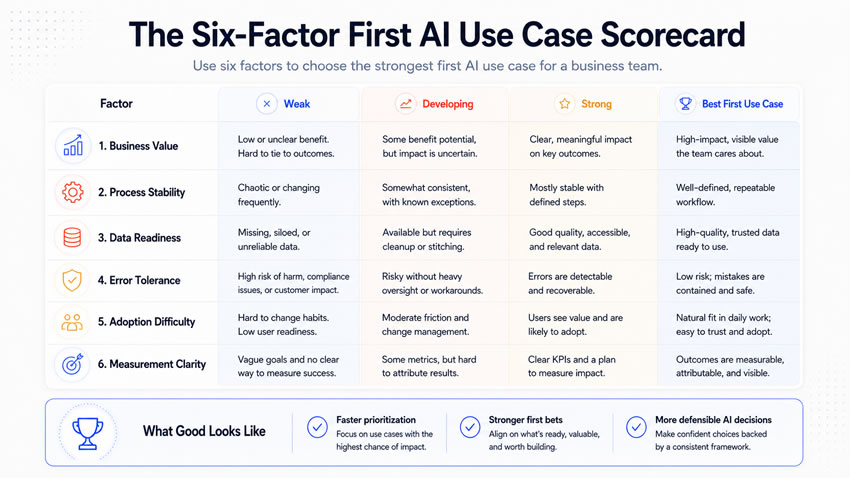
A defensible first use case needs enough business value to earn attention and enough readiness across five separate dimensions to produce a credible result. Score each of six criteria from one to five, then weight and total them out of 100 points.
Layer one: Let business value earn the attention
Business value, worth 25 of the 100 points, asks whether success would improve a result someone owns. “Reduce account research time while improving timely follow-up on qualified accounts” is a value hypothesis. “Use AI for sales research” is not. A score of one describes a vague, local benefit with no owned measure behind it. A score of five describes a priority with measurable financial, customer, quality, risk, or capacity implications, and a named owner accountable for it. A high business value score earns attention. It does not grant permission to skip the readiness questions that follow.
Layer two: Use five readiness criteria to determine whether the idea can move now
Process stability, worth 20 points, asks whether your team can describe the trigger, inputs, decisions, exceptions, and completion condition consistently. Unstable processes often produce attractive AI ideas, since employees hope the technology will resolve inconsistent practices the organization never fixed. AI can expose that inconsistency. It cannot decide which operating method your company intended. A score of one here should stop the pilot until you redesign the process.
Data readiness, worth 15 points, asks whether the required information is available, current, authoritative, and permitted for this use. A pilot can look successful when a project team hand-selects clean records. Normal operations will still bring missing fields and conflicting sources the pilot never saw. Manual cleanup before every run belongs in this score. A workflow needing 20 minutes of preparation each time has not removed that work.
Error tolerance, worth 15 points, asks what happens after the system produces a mistake. Can you detect it, contain it, and reverse it before real harm occurs? A brainstorming assistant tolerates weak suggestions because a person reviews every response. An agent sending customer commitments tolerates almost nothing, because the action itself creates the consequence. A score of one here blocks advancement regardless of the total score. You can often redesign the use case around preparation and recommendations while keeping a person on the consequential action.
Adoption difficulty, worth 10 points, asks whether employees can use the new method without excessive disruption to their role or workload. A higher score means lower difficulty on this criterion. A senior employee who reads the new workflow as a demotion of their expertise will resist it regardless of how well it performs technically. That resistance is a legitimate signal, not an obstacle to route around.
Measurement clarity, worth 15 points, asks whether your team knows the baseline and the intended result. Name the evidence source and the review date before the pilot even launches. McKinsey’s 2026 measurement framework makes the same point structurally. It connects technical performance, adoption, operational indicators, and financial impact into one line of evidence rather than five separate reports nobody reconciles. A score of one here means success depends on opinion or generated output with no credible baseline behind it at all.
Layer three: Let the readiness rule keep value from overruling reality
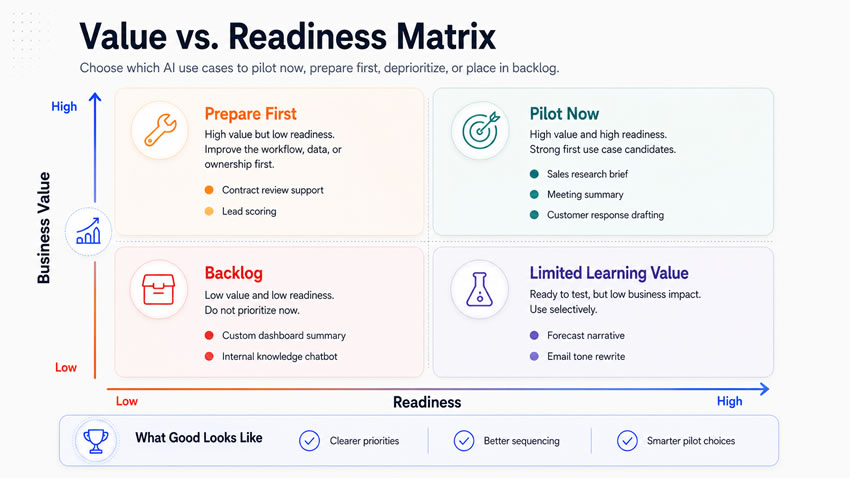
Three conditions apply after you calculate the weighted score. First, the total score must reach 70 points before a pilot deserves consideration, though the threshold does not replace risk, legal, or security review. Second, the readiness subtotal, the five criteria other than business value, must reach 50 of its 75 possible points. A candidate can score high on value and still fail this gate. It should move to a preparation backlog with named improvement actions rather than into a pilot. Third, no single criterion among process stability, data readiness, or error tolerance can score a one, regardless of the total. A score of one in any of those three means the use case needs redesign or repair before anything else happens.
Let the final score sort into four decisions. A total of 80 to 100 points is pilot-ready: define boundaries, owners, measures, and a decision date. A total of 70 to 79 is ready with conditions: name the specific gaps and close them before launch. A total of 50 to 69 needs preparation or redesign rather than a forced pilot. A total below 50 belongs in the backlog until the underlying conditions change enough to revisit it.
Watch how the score plays out against real candidates
A marketing team repurposing approved long-form content into channel drafts, with a person reviewing every external version, scores 83. That combination of strong value and strong readiness has no critical gate failures. That candidate is genuinely pilot-ready.
A commercial team proposing an autonomous agent that adjusts customer prices without approval scores 55. That total comes from a business value rating of five and an error tolerance rating of one. The readiness subtotal lands at 30 of 75, well under the gate. The idea should wait. A narrower version, an agent that prepares pricing recommendations for human approval, could score far higher using the exact same underlying capability.
An operations team automating internal meeting summaries scores 67: strong readiness, weak business value. It may support learning or convenience. It should not become the signature first use case unless you connect it to something larger, like reducing missed commitments in implementation meetings.
Avoid two extremes with your first use case
One extreme is the highly visible project with broad scope, sensitive data, and full autonomy. It attracts executive interest, then spends months resolving access and governance questions before a single employee sees any value. The other extreme is the low-risk convenience tool that launches fast and proves nothing about real operating value. The strongest first use case sits between them: meaningful recurring work, kept inside a narrow, bounded first version. Keep human approval wherever the final action carries real consequence.
Bring frontline employees and honest dissent into the scoring session
Use case selection often happens among executives, technology teams, and outside advisers, none of whom perform the work being scored. Frontline employees know which inputs arrive late, which rules vary by person, and which exceptions quietly consume a specialist’s whole afternoon. Give every rating a written reason beside it, not only a number, since disagreement between raters is useful evidence rather than noise to average away. A sales leader rating process stability a four while sales operations sees inconsistent qualification and missing records shows exactly why this matters. That gap is what the scoring session exists to surface before the pilot does.
The highest score should not win automatically, either. A second-place candidate that reuses an existing approved platform and produces evidence within 60 days can beat a higher-scoring idea. The higher score often depends on a new vendor contract and three fresh integrations. Sequence matters too. An earlier use case can build the data connections, training, and governance patterns a later one will need. That is a return the score does not capture directly.
Run this 30-day selection process to produce a defensible choice
Week one. Collect candidate problems from employees and managers, requiring every idea to name its business problem and affected result before anyone discusses a tool.
Week two. Map five to 10 candidates at a practical level, score each across the six criteria with evidence beside every rating, and apply the readiness gates.
Week three. Validate the leading candidates directly: observe representative work, interview the people who would run it, and test whether you can measure the baseline.
Week four. Choose one primary candidate and one backup, then define the pilot’s scope, owners, measures, and decision date. Record which conditions have to remain true for the pilot to continue.
What you tell them at the end
A delayed high-value idea has not failed. The scorecard has identified the work required to make it viable, which is a different outcome than quietly shipping a pilot nobody trusts. Your first use case should teach the organization how to redesign work, assign ownership, manage risk, and measure value honestly. That learning is itself part of the return, because it gives you a disciplined way to choose your second use case, and your tenth.