
Summary
Marketing teams now use artificial intelligence (AI) to draft faster, summarize faster, and repurpose faster. That speed helps, although it cannot solve the deeper content problem by itself. The volume often rises faster than the team’s ability to protect clarity, accuracy, and differentiation.
The anchor idea is simple. Artificial intelligence can accelerate content production, and content operations determines whether that speed becomes leverage or noise.
The shift toward AI-generated content is already large. Gartner predicted that by 2025, 30 percent of outbound marketing messages from large organizations would be synthetically generated, up from less than two percent in 2022. Gartner
That growth sits on top of broad adoption. McKinsey’s 2025 State of AI report found that AI use is now widespread, while scaling it across the enterprise remains uneven. McKinsey & Company
I have run content teams through this shift. The teams that gain real ground treat AI as one stage inside a system, not as a faster way to fill a blank page.
What AI Content Operations Means
AI content operations is the structured system that governs how a team uses AI to plan, create, review, repurpose, store, and improve content. It is operational work, not only creative work.
A strong system connects the pieces that usually live apart. It links campaign goals, audience and offer context, approved source material, and brand and messaging rules. It then links the AI prompts, the human review steps, the publishing requirements, the performance feedback, and the reusable workflow documentation.
When those pieces connect, content stops depending on whoever happened to write the best prompt that week. The system carries the quality, and people carry the judgment.
Why Random AI Content Use Breaks Down
Most teams begin with individual users trying their own prompts. Some outputs are useful, and some are generic. Nobody knows which inputs worked, which source materials were used, or which review standards applied.
The common breakdowns repeat across teams.
- The prompt has no connection to campaign strategy.
- The tool draws on weak or outdated context.
- The output sounds polished while saying nothing distinct.
- The review burden quietly shifts onto senior people.
- The content drifts away from the brand voice.
- The same asset gets recreated instead of reused.
- Nobody stores the workflow that actually worked.
- Performance feedback never improves the next version.
These failures trace back to the same root cause as scattered AI use everywhere. The capability lives in private chats rather than in a shared system, which is the exact gap a content operating model closes.
The Framework: The AI Content Operations Workflow
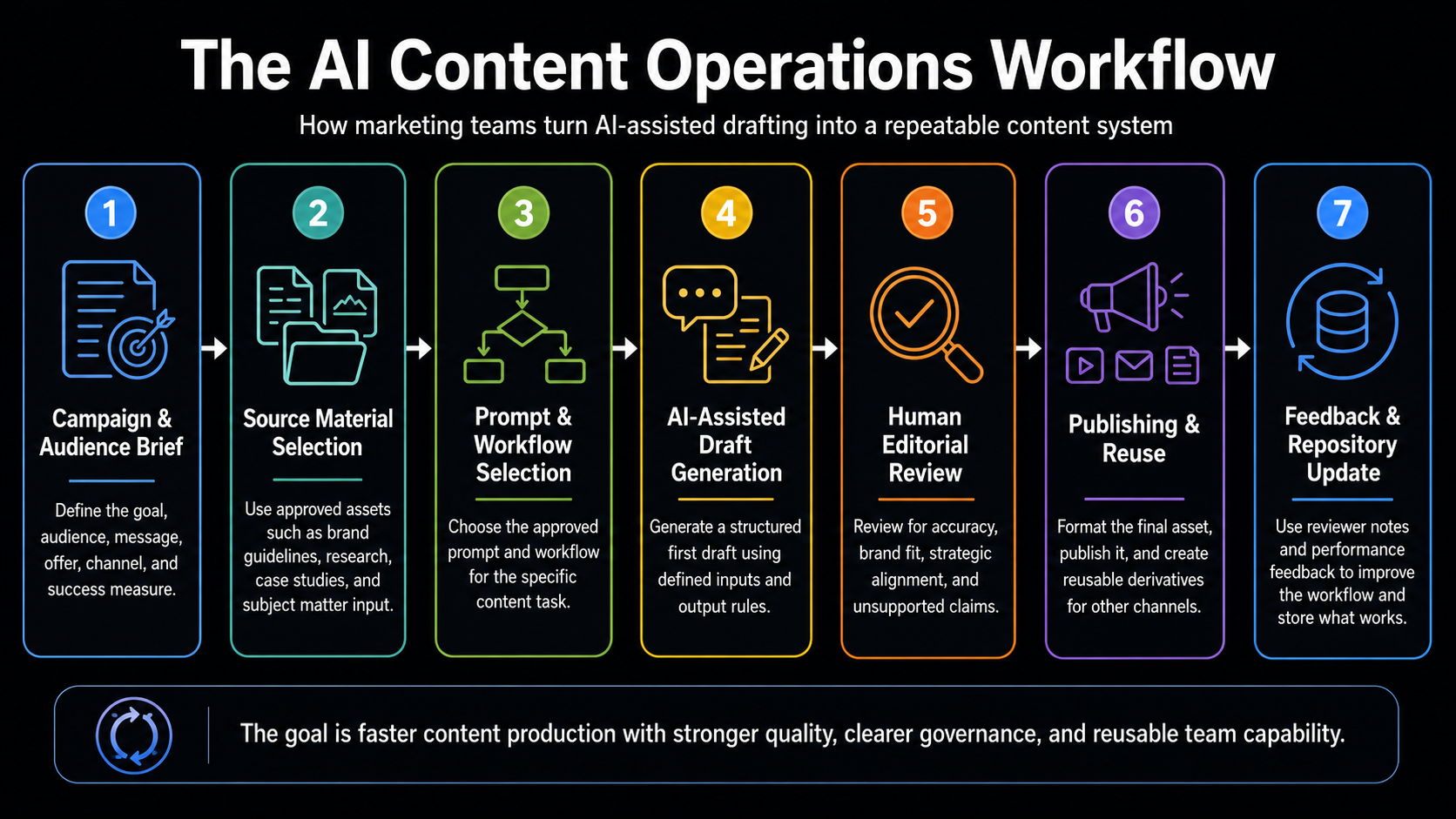
The AI Content Operations Workflow turns AI from a drafting tool into a repeatable process. It runs in seven stages, and each stage adds the structure that the previous one assumed.
Stage One: Campaign and Audience Brief
The workflow starts with a structured brief rather than a blank prompt. The brief sets the campaign goal, the target audience, the offer, the funnel stage, and the key message. It also records the likely objections, the proof points, the channel, the format, the deadline, and the success measure.
Stage Two: Source Material Selection
The workflow then defines which materials AI may use. Approved materials can include product pages, sales notes, customer research, subject matter expert input, case studies, webinar transcripts, brand guidelines, and prior high-performing content.
Stage Three: Prompt and Workflow Selection
The team then selects the approved prompt or workflow that fits the task. Common tasks include article drafting, social repurposing, webinar promotion, email sequence development, landing page revision, and sales enablement copy.
Stage Four: AI-Assisted Draft Generation
The tool then produces a first version from the approved inputs and a defined output format. The prompt specifies the audience, the angle, the structure, the source material, the claims limitations, the tone, the required sections, and the review criteria.
Stage Five: Human Editorial Review
A person then reviews the draft for accuracy, relevance, specificity, brand fit, strategic alignment, and unsupported claims. This review is required before any content reaches a customer, a prospect, an executive, or a public channel.
Stage Six: Publishing and Reuse
The approved version then gets formatted for its channel and stored for reuse. The workflow also captures derivative assets, such as social posts, email snippets, sales talking points, and short-form summaries.
Stage Seven: Feedback and Repository Update
The team then uses performance results and reviewer notes to improve the workflow. The successful prompts, examples, source assets, and review lessons go back into the AI capability repository for the next cycle.
A short example makes the stages concrete. A webinar campaign could start with a campaign brief, speaker notes, registration goals, audience pain points, and approved messaging. The workflow could generate email drafts, social posts, landing page copy, and sales follow-up snippets from the same source material. A reviewer would check claims, tone, and offer alignment before publishing. The strong outputs would then return to the repository as reusable examples for the next webinar.
What Belongs in the Content Brief
The brief is where most content quality is won or lost. A weak brief produces a weak draft no matter how good the tool is.
A useful AI content brief states the business objective, the target reader, and the funnel stage. It also states the primary message, the supporting proof, and the approved source materials. It then specifies the required claims and the claims to avoid, the brand voice requirements, the format and channel, the call to action, the review owner, and the success measure.
The Quality Control Checklist
A shared checklist keeps review consistent across people and campaigns. A reviewer should be able to apply it in a few minutes.
- Does the content solve the correct business problem?
- Does it speak to a specific reader rather than everyone?
- Does it use accurate source material?
- Does it avoid unsupported claims?
- Does it include the right level of evidence for the claim being made?
- Does it sound like the brand?
- Does it include enough practical substance?
- Does it avoid generic AI phrasing?
- Does it support the campaign goal and use the correct call to action?
- Does it create a useful next step for the reader?
- Does it need legal, product, or executive review?
Where Artificial Intelligence Helps Most
Artificial intelligence is strongest on structured, repeatable content work. It turns campaign briefs into first drafts, repurposes long-form content into channel-specific assets, and summarizes subject matter expert input. It also generates outline options, drafts email variations and social captions, builds sales enablement summaries, and compares drafts against brand rules to flag missing proof or weak sections.
The pattern is consistent across these uses. Artificial intelligence accelerates the mechanical parts of content, and it leaves the creative and strategic judgment to people.
Where Human Judgment Must Stay Visible
Human judgment should stay visible wherever meaning, trust, or risk is involved. That includes positioning choices, claims and evidence, audience nuance, brand voice, and customer sensitivity. It also includes competitive framing, executive communication, regulated content, final publication decisions, and the interpretation of performance.
Research supports the need for oversight. Gartner’s generative AI guidance for marketing positions the technology as an enablement tool for content work that is regulated by human oversight, not a replacement for judgment. McKinsey’s 2025 State of AI research also emphasizes that higher-performing organizations protect against more risks and build more deliberate oversight into their AI use. GartnerMcKinsey & Company
The Operating Model Behind AI Content Operations
A workflow needs an operating model, or it depends on memory and goodwill. The model assigns the responsibilities that keep the system running.
The operating model names who owns the workflow, who owns the source material, and who approves prompts. It also names who reviews drafts, who publishes final assets, who updates the repository, and who reviews performance. It then sets how often the workflow gets improved.
The AI Content Repository Layer
Every reusable content workflow should have a record in the AI capability repository. That record is what makes the workflow survive beyond the person who built it.
Each record captures the workflow name, the content type, the intended user, and the required inputs. It also captures the approved prompt, the source asset links, the brand rules, the review checklist, an example output, known failure points, an owner, and the date it was last tested.
What Leaders Should Measure
Measurement should track usefulness rather than volume. Treat the following as operating measures rather than guaranteed outcomes.
- Time saved in first-draft creation shows operational efficiency.
- The number of reusable workflows created shows shared capability.
- The share of content tied to approved briefs shows discipline.
- The number of assets repurposed from flagship content shows reuse.
- The review rejection rate and unsupported claims caught show quality control.
- Brand consistency ratings from reviewers show voice integrity.
- Content production cycle time shows speed with structure.
- Sales usage of enablement content shows downstream value.
Common Mistakes
Most content failures are predictable, and naming them prevents them.
- Teams start with prompts before campaign strategy.
- Teams use AI without approved source material.
- Teams publish drafts without enough human review.
- Teams measure volume instead of usefulness.
- Teams ignore brand voice until the final edit.
- Teams ask AI to invent proof that does not exist.
- Teams let every person build separate, undocumented workflows.
- Teams treat repurposing as copying instead of adapting.
- Teams skip the performance feedback that improves the next version.
A 30-Day Implementation Roadmap
A first working version is realistic within 30 days when scope stays narrow. The goal in month one is a usable system, not a complete one.
- In week one, the team audits current AI content use, identifies repeated tasks, and gathers existing prompts, briefs, and brand rules.
- In week two, the team creates one standard AI content brief and one quality control checklist.
- In week three, the team builds three approved workflows for high-volume tasks, such as article drafting, social repurposing, and email support.
- In week four, the team tests the workflows, trains the first users, stores the assets in the repository, and schedules the first review cycle.
The next cycle should focus on improving the highest-used workflow before expanding the system.
The Strategic Implication
Artificial intelligence can help a marketing team move faster, and the team still needs strategy, source control, brand judgment, and review discipline. The tool supplies speed, and the system supplies quality.
The teams that win with AI content will be the ones that turn fast drafting into repeatable content operations. That is how speed becomes leverage instead of noise.
Key Takeaways
- AI content operations turns individual drafting shortcuts into repeatable team workflows.
- Strong workflows begin with campaign briefs, source material, and review standards.
- Artificial intelligence helps most with repeatable drafting, summarization, repurposing, and comparison tasks.
- Human review remains essential for claims, strategy, brand voice, and final publication decisions.
- The best content workflows feed successful prompts, examples, and lessons back into the repository.
Frequently Asked Questions
What is AI content operations? AI content operations is the structured system a marketing team uses to plan, create, review, repurpose, store, and improve AI-assisted content.
How is AI content operations different from AI content creation? AI content creation focuses on producing an output. AI content operations defines the workflow, source material, review process, governance, and reuse system around that output.
What should an AI content brief include? An AI content brief should include the audience, campaign goal, message, source material, format, channel, review owner, call to action, and success measure.
Can AI replace content strategists or editors? Artificial intelligence can support repeatable content tasks, and human judgment remains essential for strategy, claims, brand voice, and final approval.
How should teams measure AI content operations? Teams should measure cycle time, reuse, review quality, rejected outputs, sales usage, content usefulness, and performance by channel.
Framework Reference: The AI Content Operations Workflow
Definition. The AI Content Operations Workflow is a seven-stage system for turning artificial intelligence from a drafting tool into a repeatable content operating process.
Stages. Campaign and Audience Brief, Source Material Selection, Prompt and Workflow Selection, AI-Assisted Draft Generation, Human Editorial Review, Publishing and Reuse, and Feedback and Repository Update.
Application. Teams apply the workflow by grounding every AI-assisted content task in a clear brief, approved inputs, review standards, repository records, and performance feedback.
Sources
- Gartner. (2023). How Tech Marketing Teams Are Capitalizing on Generative AI to Improve Content Marketing. https://www.gartner.com/en/doc/785385-how-tech-marketing-teams-are-capitalizing-on-generative-ai-to-improve-content-marketing
- McKinsey & Company. (November 2025). The State of AI in 2025: Agents, innovation, and transformation. https://www.mckinsey.com/capabilities/quantumblack/our-insights/the-state-of-ai