
Summary
When an artificial intelligence (AI) deployment underperforms, the immediate response is almost always to scrutinize the tool. Leaders question the vendor selection, revisit the platform decision, and evaluate the technology choice. Four years of diagnosing AI deployments inside real organizations taught me that this is the wrong place to look.
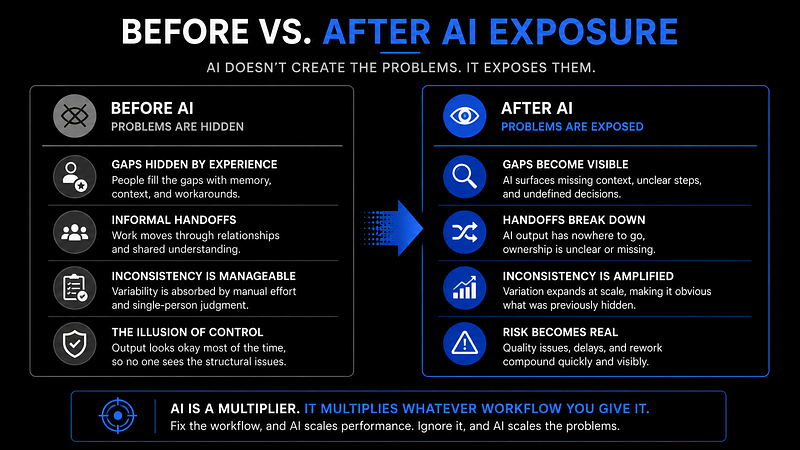
The workflow that received the AI tool is where the problem almost always lives. That workflow had structural gaps before the deployment began. AI made the work faster, and it made those gaps impossible to continue papering over quietly.
AI Makes Hidden Problems Visible
When a workflow has ambiguous steps, AI output will be ambiguous. When a workflow has no written standard for what good output looks like, AI will produce inconsistent results. No one will be able to explain why some output works and some does not. When a workflow depends on one person’s undocumented judgment, AI will expose that dependency the moment it attempts to replicate that judgment at scale.
These are not failures of the technology. They are the workflow’s existing structural problems, surfaced at volume. The problems existed before AI arrived. AI simply removed the individual effort that used to conceal them.
There is a more useful way to read this. A broken workflow surfaced by AI deployment is diagnostic information. It tells you exactly where the work system needs redesign before the program scales. McKinsey & Company’s research on AI and business transformation shows a consistent pattern. Organizations that redesign their processes before deploying AI significantly outperform those that layer AI onto existing ones.

Four Signs Your Workflow Will Resist AI
Not every workflow is ready to receive AI output. Four characteristics mark the ones that will resist it.
The steps are implicit. The people doing the work know what comes next because they have done it before. The sequence has never been written down. New team members figure it out over time through observation and accumulated context. AI cannot learn through observation or accumulated context. It needs the sequence explicit and present before it can work with it.
The quality standard lives in someone’s judgment. Someone on the team knows what good output looks like. Others defer to that person when something feels off. When AI produces output at volume, it overwhelms the single point of quality judgment. The workflow has no system for absorbing that volume because it was never designed to need one.
The handoffs are informal. Work moves between people or functions through relationships and shared context, not through defined triggers or documented ownership transfers. Those informal handoffs function because people have relationship history. AI output does not have relationship history. It produces and stops, leaving the workflow to determine who owns the result and what happens next.
The documentation has not kept up with the actual process. Every workflow evolves. Most documentation does not. The written version and the real version have diverged. Deploying AI into a documented process that no one actually follows produces output for a workflow that no longer exists.
Three Questions to Run Before the Next Deployment
Three questions form the core of a workflow audit. They can be run in a single working session with the team responsible for the workflow. The gaps they reveal are exactly the gaps that AI will expose at scale, on a timeline the organization did not choose.
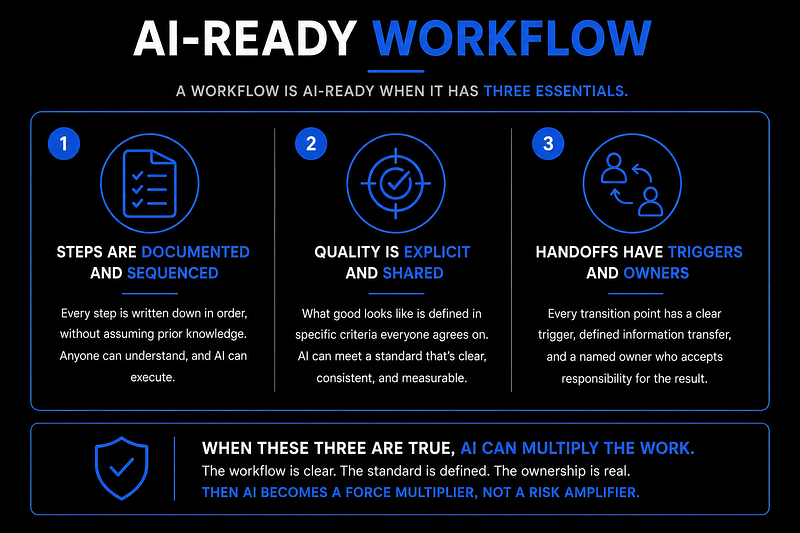
Question One: Can every step in this workflow be described in writing, in sequence, without assuming prior knowledge? Ask the person who does the work to write out every step. Then ask someone unfamiliar with that workflow to attempt it using only the written documentation. Where they get stuck is where the workflow has implicit steps that AI will not be able to navigate either.
Question Two: Who determines whether the output is good, and what specific criteria do they apply? If that person cannot write down the criteria, the quality standard does not yet exist in a usable form. AI cannot consistently meet a standard that has not been made explicit. The standard must be documented before AI can be built around it.
Question Three: What happens at each handoff in this workflow, and who accepts ownership of the result? Map every transition point. Identify the trigger that initiates the handoff, what information transfers with it, and who becomes responsible for the output. Informal handoffs that work in low-volume manual workflows break down quickly when AI removes the bottleneck upstream.
What Workflow Redesign Actually Produces
I built a 10-tool AI suite. Each tool was purpose-built for a specific, redesigned workflow. AI was layered on top of the redesigned process, not on top of the original one.
The redesign work was unglamorous. Every step was documented in sequence. Quality criteria were written out explicitly and agreed to by the teams using the tools. Handoffs were formalized with defined triggers and named ownership. That work happened before the AI tool was built, not after.
The outcomes are documented. Manual production time dropped 40%. Content output per team member tripled. Campaign cycle times reduced 20–30%. Those results came from the workflow design, not from the tool selection. The same tools deployed into the original undocumented workflows would have produced the same ambiguous output that every underperforming deployment produces. The story those deployments tell is always the same.
The Workflow That Can Actually Use AI
A workflow ready to receive AI output has three characteristics. Every step is documented and sequenced. The quality standard is explicit and shared. Handoffs have defined triggers and named owners. When AI produces output at volume, the workflow knows what to do with it. Accountability is already assigned before the output arrives.
The comparison that matters is not between teams that chose different AI tools. It is between teams that redesigned their workflows before deploying AI and teams that did not. The teams that did can absorb what AI produces. The teams that did not spend their energy managing output that their workflow has no system for handling.
Redesigning the workflow before deployment is what determines whether the deployment will work at all.
The Diagnostic That Comes Before Everything Else
The most valuable function of an underperforming AI deployment is not the output it produced. It is the structural problems it surfaced in the workflow that received it. Those problems existed before the tool arrived. Organizations that treat that information as a diagnostic and redesign the workflow accordingly are the ones that report results worth sharing. The ones that switch tools carry the same structural gaps into the next deployment.
Run the three questions on every workflow before AI touches it. Redesign what the audit reveals. Deploy into a work system that is ready for what AI produces. The AI Workflow Audit Assistant in the ChatGPT store guides teams through a more comprehensive version of this diagnostic if your team needs additional structure.