
Summary
Most organizations that report artificial intelligence (AI) disappointment chose the right tool for the job. The technology performed exactly as the vendor described. The team had access to it. Results were marginal at best.
That pattern repeats across industries, company sizes, and entire functions. The technology is rarely the source of failure.
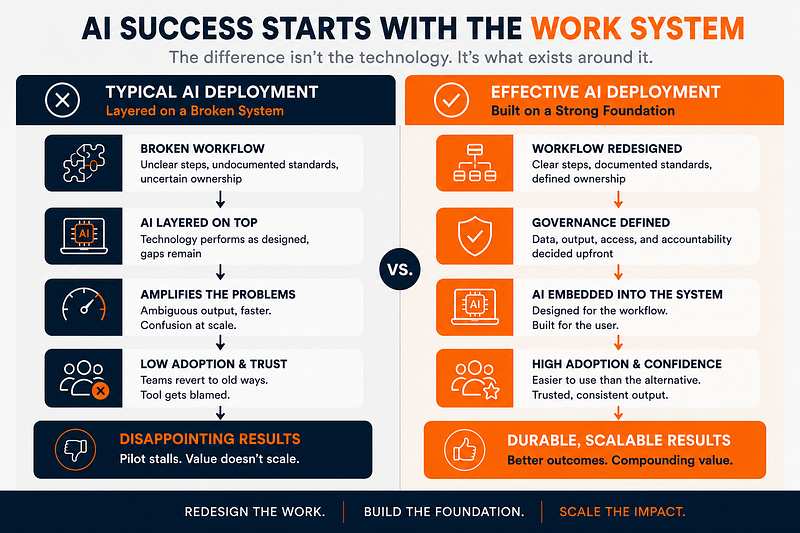
Four years of building AI systems inside a real enterprise taught me something clear. The work system underneath the technology is almost always where the failure lives. Organizations deploy AI into workflows that were unclear before AI arrived. They deploy it into processes that nobody has documented in years. The technology produces output, but no one agrees whether the output is any good. The rollout stalls, the tool gets blamed, and the organization tries a different tool next quarter.
McKinsey & Company’s research on AI adoption has consistently found one persistent pattern. Organizations struggle far more with scaling AI than with selecting it. The organizations that achieve durable results have one thing in common: they redesigned their work systems before deploying the technology. The ones that struggle layered AI on top of unchanged processes and expected different results.
The Workflow Was Already Broken
AI does not fix a broken workflow. It accelerates one and makes the breakage visible at scale. When a process has ambiguous steps, undocumented standards, and unclear ownership, AI produces ambiguous output faster. No one is certain who should review it or what standard to review it against.
This shows up in marketing teams, sales operations, and recruiting workflows. In every case, the team reports that AI is not working. In every case, the real problem is that the workflow had gaps that manual effort used to paper over quietly. AI removed that quiet cover and made the gaps obvious.
Before any AI deployment, ask one foundational question. If you were designing this workflow from scratch today, what would it look like? The answer to that question is what AI should be built into. The current version of the workflow, with its inefficiencies and undocumented judgment calls, is not a foundation worth building on.
Governance Built After the Incident
Most organizations treat AI governance as something to address after adoption is underway. This sequence produces the same result almost every time. An incident forces the conversation, and the governance that gets built is damage control rather than infrastructure.
Brand voice can collapse when AI gains access to client-facing channels without documented tone standards. Data privacy errors emerge when no one has explicitly decided what information is appropriate to include in a prompt. Teams abandon AI tools entirely when one visible failure destroys confidence in the program.
None of those outcomes required the technology to malfunction. The technology performed exactly as designed. The governance infrastructure was simply not present to shape what the technology produced.
Governance built before deployment is infrastructure, not bureaucracy. It makes speed possible by removing the need to relitigate every decision at the moment of use. Organizations that build governance early move faster. Every team member works from the same explicit decisions rather than inventing their own.
Adoption Fails When Design Fails
When AI adoption rates are low, the instinct is to add more training. That instinct is usually wrong. The actual problem is almost always a design problem. The tool was not built for the specific workflow or the specific user.
People adopt what is demonstrably easier than the alternative. When AI is harder to use than the existing method, people return to the existing method. Solving that problem requires redesigning the tool for the specific workflow and the specific user, not scheduling another training session.
Research on enterprise technology adoption consistently shows that tools designed around specific workflows achieve higher adoption than generic interfaces deployed broadly. The design question comes before the training question, not after it.
Three Questions to Ask Before the Next Deployment
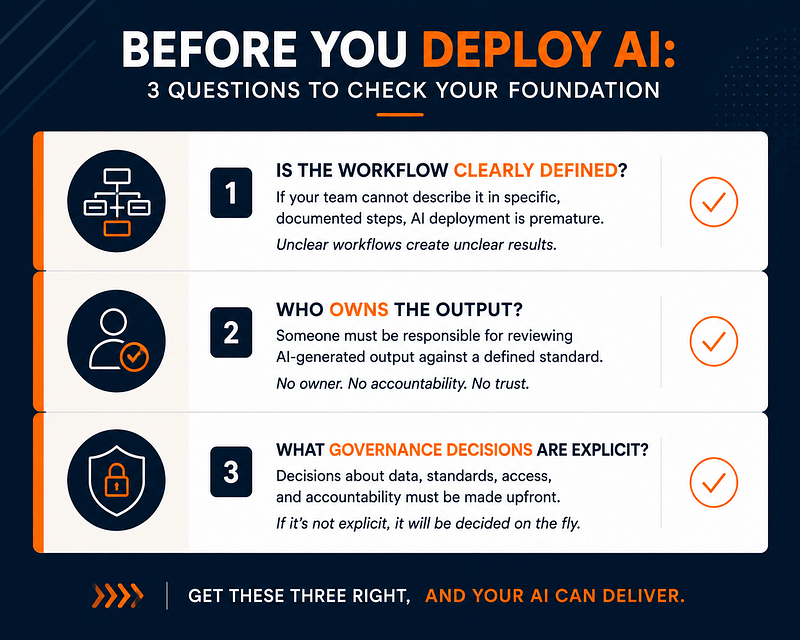
Before any AI deployment, three questions reveal whether the foundation is ready.
First: what does this workflow look like before AI? If your team cannot describe it in specific, documented steps, AI deployment is premature. You are building on an unclear foundation, and AI will make that lack of clarity impossible to ignore.
Second: who owns the output? Someone must be responsible for reviewing AI-generated output against a defined standard. If that person and that standard are not identified before deployment, they will be missing when you need them most.
Third: what governance decisions have been made explicitly? Governance is not a policy document sitting in a shared drive. It is a set of explicit decisions about data handling, output standards, access controls, and accountability. When no one makes those decisions explicitly, the tool’s users make them on the fly.
The Work That Happens Before the Work
The organizations achieving durable results from AI are not the ones with the most sophisticated technology stack. They are the ones that did the less visible work first. They redesigned their workflows, built governance before deployment, and designed tools for specific users rather than deploying generic interfaces.
That work is not glamorous. It does not generate press releases or conference keynotes. It is, however, the difference between a pilot that impresses a conference room and a program that improves results at scale.
The technology is ready. The question worth asking is whether your work system is ready for what the technology will produce.