
Summary
Every organization that has invested in artificial intelligence (AI) has at least one person who uses it effectively. That person knows which prompts produce reliable output for specific workflows. They know what data handling constraints apply in which contexts. They know why certain quality problems recur and how to correct them. They know the governance decisions that were made, whether those decisions were ever documented or not.
When that person takes a call from a recruiter, the organization has a problem.
How Capability Concentrates
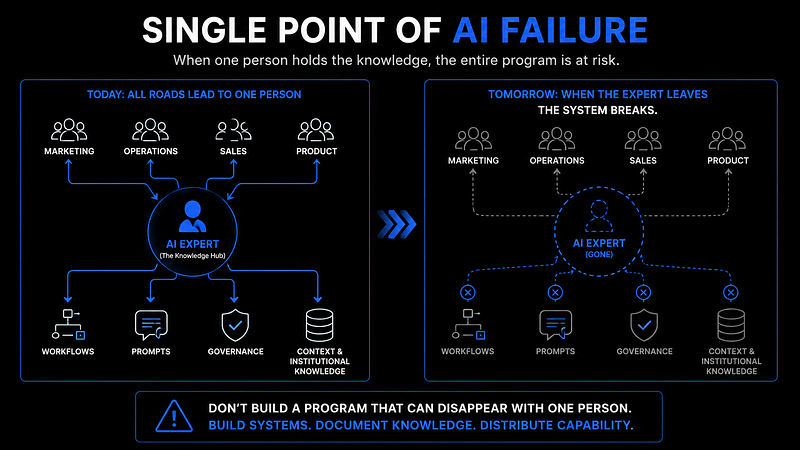
AI capability concentration is the natural outcome of how most organizations adopt AI. A tool arrives. One person develops genuine proficiency. Others use the tool peripherally or not at all. The proficient person becomes the internal resource for AI questions, AI troubleshooting, and AI-assisted work that requires consistent quality. Their expertise becomes load-bearing for the organization’s AI program, whether anyone recognizes it or not.
This pattern is visible in every industry and at every organizational size. Gartner’s research on AI adoption consistently surfaces key-person dependencies as one of the primary risks in enterprise AI programs. The expertise concentrates not because anyone planned it that way. In technology adoption, the path of least resistance always runs through the people who engage most deeply.
Most organizations do not have an AI strategy. They have an AI power user. The distinction matters enormously when that person leaves.
Why This Is a Systems Risk, Not a Personnel Risk
Organizations that frame this problem as a retention challenge apply the wrong solution. Retention bonuses, equity grants, and flexible arrangements delay the problem rather than solving it. The real risk is that the organization’s AI capability is not transferable in its current form. Whether or when the expert leaves is secondary to that underlying fragility.
When the expert leaves without capability transfer having happened, the damage compounds quickly. If the workflows they ran are undocumented, no one inherits them. If the prompts they used are stored in personal accounts, no one can access them. If the governance decisions they held are implicit rather than explicit, no one can apply them consistently.
The organization loses far more than a person. It loses the entire operational infrastructure of the AI program, which was never converted into something the organization actually owns. Solving that requires an organizational systems response, not a retention strategy.
What Leaves When the Expert Leaves
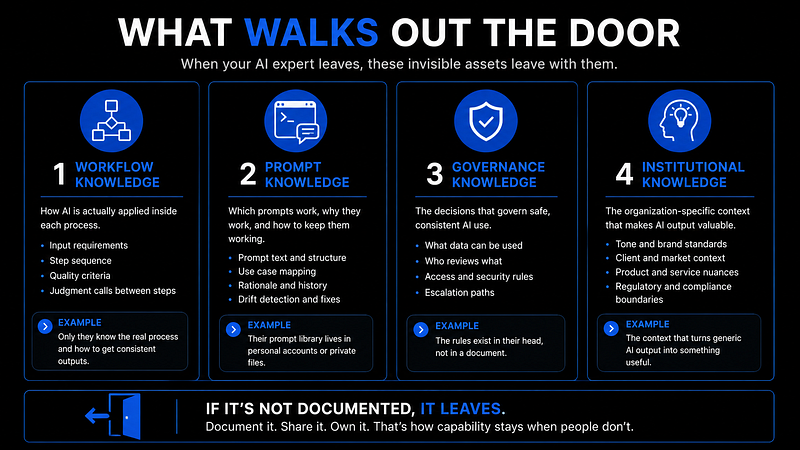
Four categories of knowledge walk out with the expert if they have not been converted into organizational assets before the departure.
Workflow knowledge. The expert knows how AI is actually applied inside each specific process. That includes the input requirements, the step sequence, the output quality criteria, and the judgment calls that exist between documented steps. This knowledge lives in the expert’s practice. In most organizations, it exists nowhere else.
Prompt knowledge. The expert knows which prompts produce reliable, consistent output for which specific use cases. That includes not just the prompt text itself, but why it was written that way, what it replaced, and how to diagnose output when model updates cause drift. Prompt libraries held in personal accounts are organizational assets in personal custody.
Governance knowledge. The expert holds the decisions that shape AI use across the organization: what information enters the tools, who reviews output against what standard, what access controls exist, and what the escalation path looks like. Governance knowledge held by one person is governance that cannot be audited and cannot be enforced after that person is gone.
Institutional knowledge. The expert carries the organization-specific context that makes AI output useful: tone standards, brand guidelines, client sensitivities, product constraints, and regulatory boundaries. Generic AI output is not useful to a specific organization. The expert’s institutional knowledge is what bridges that gap. When this knowledge leaves with the person, every successor starts without it.
The Four Things That Make AI Capability Distributable
Converting individual AI expertise into organizational AI capability requires four investments. None of them are technically complex. All of them require operational discipline.
Document workflows in specific, executable steps. A workflow document that says “use AI to help with content” is not a workflow document. A real workflow document specifies the prompt structure, required inputs, quality criteria, approval checkpoint, and revision process. The test is whether a new team member can execute the workflow to the same quality standard using only the documentation. If they cannot, the workflow is not yet documented.
Maintain a prompt library as an organizational asset. Prompts are operational infrastructure. They belong in shared systems with version control, documented rationale, and clear ownership. Each prompt entry should document what the prompt does, which workflows use it, and what output standard it should meet. It should also note when the prompt was last reviewed against current model performance. Prompt maintenance is an ongoing operational responsibility, not a one-time configuration task. Teams that treat it otherwise discover model drift after the damage is done.
Document governance decisions explicitly and formally. Every governance decision the expert holds should exist as a written record. That record should cover what was decided, who decided it, when the decision was made, and what it covers. The governance document is what makes the program auditable by someone who was not present when the decisions were made. Without this documentation, a new AI lead starts from scratch rather than from a foundation.
Build a structured capability transfer program. Moving AI capability from an individual to a team requires intentional design. Exposure and encouragement do not accomplish it. A structured program pairs the expert with team members on specific workflows. Team members progress through increasingly independent execution, with proficiency documented against explicit standards. The goal is to make the expert’s departure something the organization can absorb without losing the program they built.
Three Questions Leadership Should Answer Now
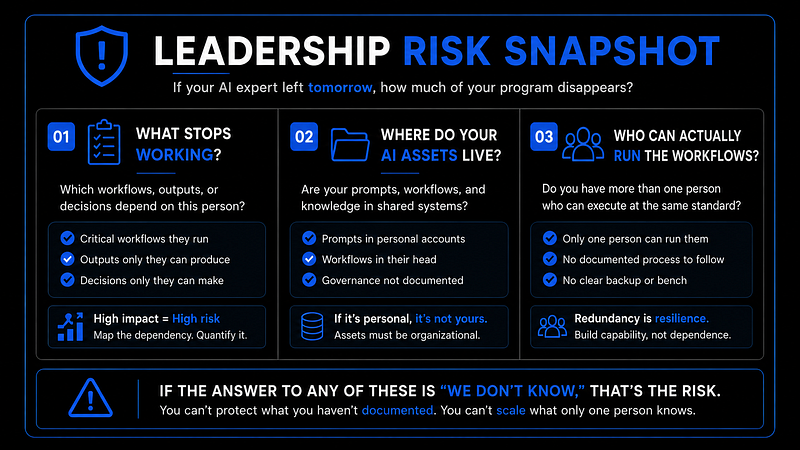
Leaders accountable for AI investment need to answer three questions honestly before the next departure forces the conversation.
First: if the person who holds the organization’s AI expertise left tomorrow, what would stop working? That answer is the concentration risk inventory. Every item on that list is an undocumented workflow, prompt, or governance decision. Each one needs to become an organizational asset before the next departure.
Second: where do the organization’s AI assets currently live? Do they live in shared systems that survive a departure? Or do they live in individual accounts, personal files, and institutional memory that leave with the person? The location of AI assets determines whether they are assets at all.
Third: what is the capability transfer plan? A training schedule is not a capability transfer plan. A real plan is staged, specific, and moves AI proficiency from wherever it currently concentrates to a distributed organizational capability. If no plan exists, concentration will continue to accumulate until an event forces the question under the worst possible conditions.
The Investment That Creates Durability
Organizations that invest in AI but not in distributing AI capability are building programs that depend on specific people remaining in place. That is organizational fragility dressed up as adoption. The individuals who hold that capability will be recruited, promoted, reassigned, or will simply leave. When they do, the organization will discover whether its AI program was built into its systems. Most organizations discover the answer at the worst possible moment.
Building AI capability into the organization’s systems requires documentation discipline, intentional capability transfer, and treating AI knowledge as infrastructure rather than individual expertise. That investment converts an AI program from fragile to durable. Every organization can make it, provided they do the work before the departure and not after it.