
Summary
A five-layer diagnostic framework for identifying why AI initiatives stall and what leaders must redesign to move forward.
Most AI strategies do not fail because of the technology, but because the organization cannot absorb what the technology produces.
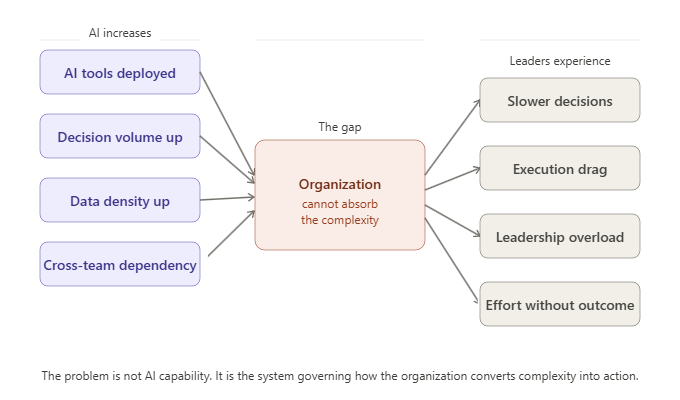
Leaders invest in tools, models, and platforms expecting acceleration. Instead, they experience slower decisions, heavier coordination, and a widening gap between effort and outcome. The technology performs. The organization does not.
The problem is not AI capability. It is the system governing how the organization converts complexity into action. As AI increases decision volume, data density, and cross-functional dependency, organizations without modern coordination systems experience amplified failure, not acceleration.
This is the pattern the Organizational Throughput Diagnostic is designed to identify.
Why the Standard Diagnosis Fails
Organizations have a predictable diagnostic reflex when performance stalls. They examine what people are doing. They analyze behavior, attitude, capability, and commitment. When they find gaps, they respond with training, coaching, restructuring, or cultural initiatives designed to change what individuals do.
These interventions are not wrong. They are incomplete.
They assume the organizational system itself is functioning, and that the gap between strategy and performance lives in the human layer. In many cases, that assumption is incorrect. The gap lives in the architecture: the design of the systems governing how information flows, how decisions get made, how cross-functional work moves, how resources are allocated, and how cognitive load is distributed across the leadership layer.
McKinsey’s 2025 State of Organizations research found that only 31 percent of executives describe their organizations as effective at converting strategy into execution. The research identifies system design, not talent, as the primary differentiator between organizations that execute effectively and those that do not. The organizations that execute well have, whether deliberately or incrementally, built internal systems that process complexity without fragmenting it.
The organizations that struggle have not.
The Organizational Throughput Diagnostic gives leaders a structured method to identify which system is failing inside their specific organization before investing further in interventions that cannot reach the actual constraint.
The Core Concept: Organizational Throughput
Organizational throughput is the capacity of an organization to convert external and internal complexity into coordinated action at the speed its environment requires.
When throughput is high, information becomes insight. Insight becomes decision. Decision becomes coordinated execution. The system moves with coherence.
When throughput is constrained, complexity accumulates inside the system faster than the system can process it. Information generates confusion rather than clarity. Decisions slow or fragment. Execution stalls at coordination boundaries. The organization remains capable but unable to fully translate that capability into performance.
The AI era has made throughput the central leadership challenge of the decade. AI tools have accelerated the rate at which organizations generate data, surface decisions, and coordinate work. The inputs into organizational systems have multiplied. The internal architecture governing those inputs has not kept pace in most organizations.
Gartner’s research on AI adoption and organizational performance consistently identifies what it calls the “complexity absorption gap”: the growing distance between the rate at which AI-enabled environments generate complexity and the rate at which organizational systems are designed to process it. Organizations sitting in this gap experience the same visible symptoms: slower decisions, execution drag, leadership overload, and a persistent sense that effort is not translating into progress. This is why AI initiatives stall even in organizations with strong strategy, funding, and talent.
Closing that gap requires leaders to examine and redesign the five systems that govern organizational throughput.
The Five System Layers
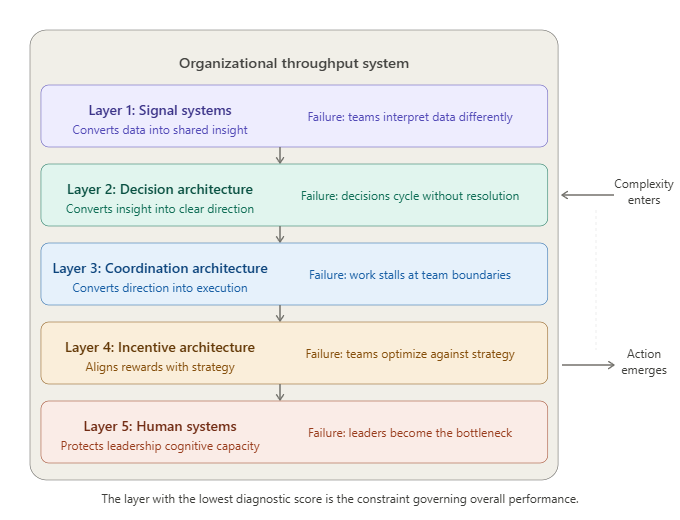
The Organizational Throughput Diagnostic evaluates five interconnected systems. Each system governs a specific stage in the conversion of complexity into action. When any one of them fails, it becomes the constraint governing overall organizational performance.
Layer 1: Signal Systems
Signal systems govern whether the organization reliably understands what is happening. This is not a data availability problem. Most organizations have more data than they can process. The failure is interpretation: the organization cannot extract reliable, shared insight from the information it already holds.
When signal systems fail, different teams interpret identical data differently and reach incompatible conclusions. Leadership is routinely surprised by developments that the data, read correctly, should have anticipated. Significant leadership time is consumed debating facts rather than making decisions.
The constraint at this layer is not information. It is the absence of a system that converts information into shared organizational understanding.
Layer 2: Decision Architecture
Decision architecture governs whether the organization can convert insight into clear direction quickly enough to matter. In the AI era, this layer has become one of the most common points of failure. AI tools have dramatically increased decision volume and velocity without corresponding upgrades to the systems designed to make decisions.
When decision architecture fails, decisions require extended meeting cycles. Issues escalate repeatedly without resolution because decision authority is undefined. Strategic agenda time is consumed by operational problem-solving. The organization understands what is happening but cannot agree on what to do about it.
The constraint at this layer is not analytical capability. It is the design of decision systems and time-horizon governance.
Layer 3: Coordination Architecture
Coordination architecture governs whether the organization can execute once direction is established. Strategy aligned at the executive level routinely fails at the boundary between teams. Resources are committed on paper but not in practice. Ownership at functional handoffs is improvised rather than designed. Cross-functional dependencies accumulate unmanaged until they become blockers.
When coordination architecture fails, strategic initiatives stall not because teams lack capability but because the system governing shared work does not make coordination structurally easy. Leadership becomes the informal coordination mechanism, absorbing cognitive load that the architecture should distribute.
The constraint at this layer is not collaboration willingness. It is coordination system design.
Layer 4: Incentive Architecture
Incentive architecture governs whether the behaviors the organization actually rewards align with the strategic direction it claims to pursue. This is the most frequently underestimated system in the framework. Organizations invest heavily in strategy, communication, and alignment without examining whether their performance management systems reinforce or contradict what they are asking people to do.
When incentive architecture fails, teams optimize locally because that is what the system rewards. Cross-functional work is treated as discretionary because it does not appear in individual performance metrics. Leaders privately acknowledge that the incentive system punishes the behaviors the strategy requires.
The constraint at this layer is not misaligned values. It is misaligned system design.
Layer 5: Human Systems (Leadership Cognitive Throughput)
Human systems govern whether the leadership layer has the protected cognitive capacity to process the complexity the organization generates and provide the strategic direction it requires. As AI accelerates decision volume and organizational complexity deepens, this layer has become a primary point of failure in organizations that have not deliberately redesigned their leadership operating rhythm.
When human systems fail, decision volume exceeds the capacity of the leadership layer to process it thoughtfully. Teams become dependent on leadership intervention to move work forward. Strategic thinking is crowded out by operational demands. Leadership exhaustion becomes persistent rather than episodic.
The constraint at this layer is not leadership capability. It is the absence of governance architecture designed to protect it.
The Relationship Between Layers
The five systems are interdependent. A failure in any one layer eventually creates pressure on the others.
Signal system failure creates decision overload, because leaders spend time resolving disagreements about what is happening rather than deciding what to do about it. Decision architecture failure creates coordination pressure, because unclear direction generates improvised execution. Coordination failure increases leadership cognitive load, because leaders absorb the coordination friction the architecture should manage. Incentive misalignment undermines all other repairs, because teams will ultimately optimize for what the system rewards regardless of what strategy documents say.
This interdependence is why surface-level interventions so rarely produce lasting results. Fixing coordination without addressing incentives produces coordination improvements that erode as teams return to optimizing their individual scorecards. Redesigning decision architecture without addressing signal systems produces faster decisions made from inconsistent information.
The assessment identifies the primary constraint. Sustained throughput improvement requires leaders to eventually examine and align all five layers.
The Strategic Implication for Leaders
The organizations that will perform through the complexity of the AI era are the ones with the most coherent internal architecture for processing complexity into action.
That architecture is designed. It must be deliberately maintained as the organization grows and the environment changes.
Most leaders understand intuitively that something structural is limiting their organization’s performance. The friction is real. The drag is measurable. The gap between effort and outcome is visible. What most organizations lack is a precise diagnostic that tells them which system is generating the constraint.
That precision matters because the repair must match the failure. Investing in leadership development when the constraint is incentive misalignment produces capable leaders who cannot execute against a system that rewards something different than what the strategy requires. Investing in communication and alignment when the constraint is coordination architecture produces organizations that understand the strategy clearly and still cannot move it forward consistently.
Complexity is not the threat. The absence of a system designed to process it is.