
Summary
Most marketing teams can now point to someone using artificial intelligence (AI). Someone drafts faster, summarizes meetings, builds reports, or writes prompts that save real time. That activity matters, although it does not prove the organization has built anything that lasts. The gains are real, and they usually stay trapped inside the people who produced them.
The difference between using AI and operationalizing AI is the difference between individual speed and organizational capability.
That gap shows up in the research, not only in the anecdotes. McKinsey’s 2025 State of AI report found that AI use is now widespread, while many organizations still struggle to embed it deeply into workflows and processes.¹ The subject of this essay sits in that space, between adoption at the tool level and capability at the operating level.
I have watched both versions inside real teams. Usage is where the journey starts, and operationalization is where the advantage actually lives.
Usage Creates Speed That Does Not Travel
Using AI means an individual points a tool at a task. People draft copy, summarize documents, analyze spreadsheets, research accounts, and automate small steps. The work often creates genuine value, and that value tends to stay local to the person who created it.
The pattern is easy to recognize once you look for it. The strongest prompts live in private chats and in one person’s memory. Output quality swings with individual skill, source material changes without a note, and review depends on whichever manager happens to be closest. When that person leaves, the capability leaves with them, and the team starts over.
What Operationalizing Actually Means
Operationalizing AI means turning AI-supported work into managed, repeatable, governed, and measurable capability. It builds the operating layer that lets a team reuse, trust, improve, and govern the work rather than rediscover it each week.
That layer ties together what usage leaves scattered. It connects workflow discovery, use-case scoring, a tool inventory, and a data-readiness check. It then adds documented prompts, controlled source assets, review rules, training, a shared repository, and a measurement loop that feeds improvement.
Consider a marketer who uses a tool to summarize account engagement data each week. That habit creates personal speed and nothing more. A team operationalizes the same work by defining what makes it repeatable. That means the approved data exports, the comparison logic, and the prompt. It also means the review step, the storage location, and the feedback loop that improves the next run.
Seven Shifts From Usage to Capability
The move from usage to capability is visible in seven places. Each one separates a clever tool habit from a durable operating system, and a team rarely matures in one without the others.
Ownership Moves From the Moment to the System
Usage keeps ownership vague. The person at the keyboard owns the moment, and the system itself has no owner at all.
Operationalized AI makes ownership explicit at every layer. One person maintains the workflow, another keeps the prompt current, and others hold the data, the review, the training, and the measurement. Capability cannot scale while every asset is technically nobody’s job.
The Unit of Work Becomes the Workflow
Usage starts with a prompt, which answers a single task and then disappears. Operationalized work starts with a workflow, which defines the trigger, the inputs, the AI step, the review point, the output, the storage location, the owner, and the improvement loop.
Picture a marketer who asks a tool to summarize campaign performance. The result is fast, and it stops there. A team turns the same task into a weekly campaign summary workflow. The workflow names the data sources, the prompt, the review checklist, and the reporting format, so anyone can run it well.
Data Becomes a Shared, Governed Asset
Usage tolerates messy inputs because one person supplies the missing context from memory. Operationalized AI cannot lean on context that lives in someone’s head.
The team can name which data is approved, where the source of truth lives, and who owns it. The same clarity covers how often the data changes, how sensitive it is, and which tools may use it, so an output can trace back to its source. This is a scaling issue rather than a technical footnote, and the cost of ignoring it is documented: Gartner has predicted that organizations will abandon 60 percent of AI projects unsupported by AI-ready data through 2026.²
Review Scales to Risk
Usage leaves review to personal judgment, which works until the stakes rise. Operationalized AI sets the level of review against the risk of the output.
A quick user check suits low-risk internal drafting. Owner review and source verification suit business-influencing internal work. Formal approval belongs to anything customer-facing or high-stakes. A brainstorm should never carry the same scrutiny as a pricing claim, an executive report, or a sales recommendation.
Knowledge Leaves the Private Chat
Usage scatters knowledge across private chats, screenshots, documents, and memory. Operationalized work stores that knowledge where the team can find and reuse it.
A complete record holds the approved use case, the workflow steps, the prompt, and the inputs it requires. It also holds the source assets, the review rules, an example output, an owner, and a review date. For the tactical build, see the companion guide, How to Build a Marketing AI Capability Repository.
Adoption Turns Into Deliberate Work
Usage can stay private indefinitely. Operationalized AI changes how people work, and that change takes deliberate enablement rather than an announcement.
People adopt a workflow when training fits their role and a quick-start guide lowers the cost of the first attempt. They keep using it when managers set clear expectations, when the safeguards are visible, and when support arrives after the first real run.
Measurement Moves From Activity to Usefulness
Usage gets measured by activity, such as how many people logged in or how many drafts appeared. Operationalized AI measures whether the work was useful to the business.
The honest measures track time saved on repeatable work, the quality of reviewed output, and how often sales accept an AI-supported brief. They also track reused assets, user and manager confidence, and whether workflows get reviewed on schedule. Volume alone tells a leader almost nothing.
The Framework: The AI Operationalization Ladder
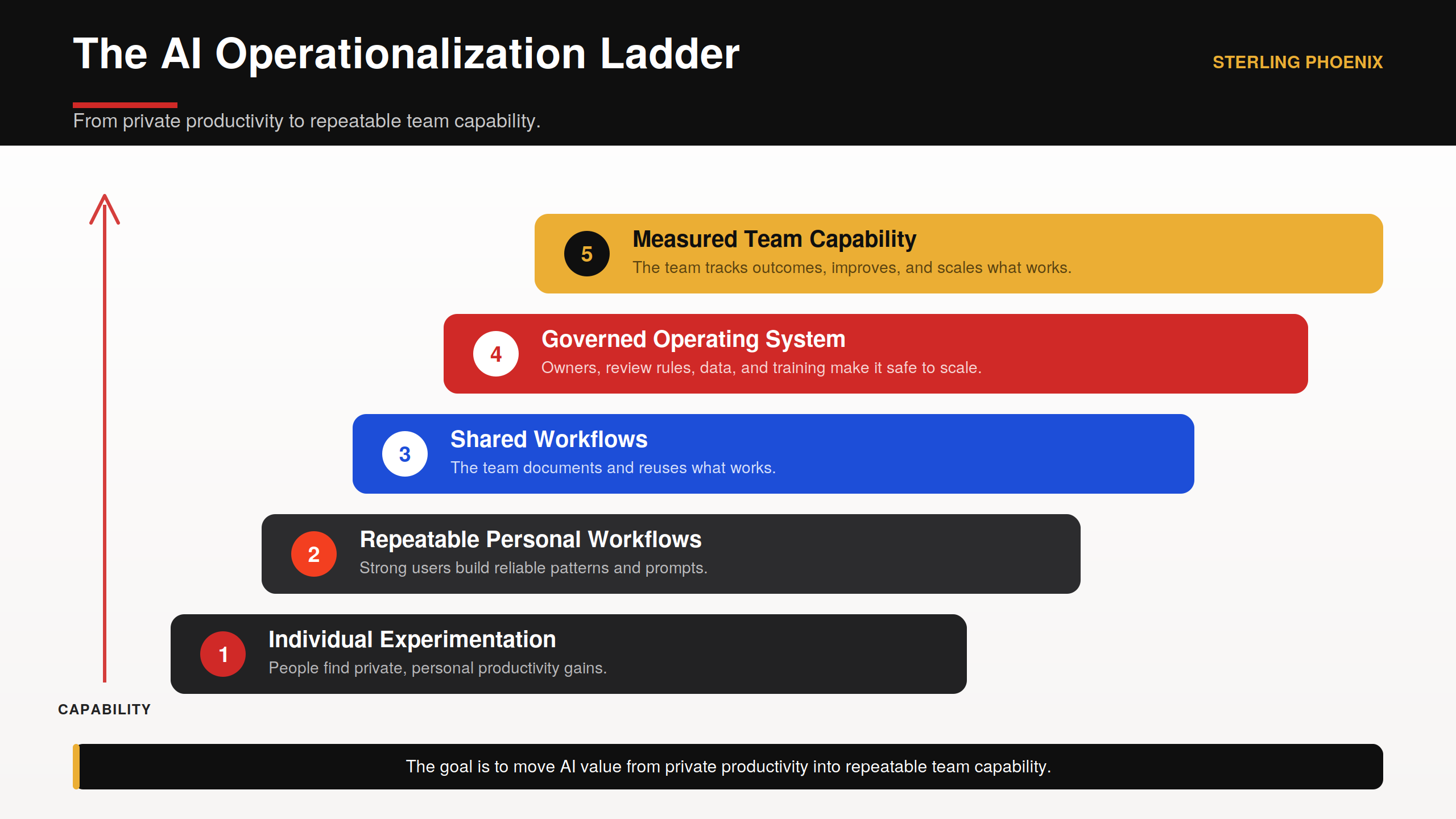
The shift is not a switch a team flips once. It is a climb, and the AI Operationalization Ladder names the five rungs.
Level One: Individual Experimentation
People test tools privately and discover real personal gains. The value is genuine, and it belongs to the individual.
Level Two: Repeatable Personal Workflows
A few strong users settle into reliable patterns, prompts, and shortcuts. The capability is consistent, and it stays personal.
Level Three: Shared Workflows
The team documents the best workflows and begins to reuse them. The knowledge starts to leave private chats.
Level Four: Governed Operating System
Owners, review rules, approved data, and training make the system safe to scale. The team can now trust the work it did not personally produce.
Level Five: Measured Team Capability
The team tracks outcomes, improves what works, and retires what does not. Most teams sit between levels two and three, and the climb to level five is where the advantage compounds.
Moving From Usage to Operationalization in 30 Days
A team can start the climb in a month, and the goal is a working foundation rather than a finished system.
- In week one, the team interviews people, reviews tools, collects prompts, and maps where AI already supports the work.
- In week two, the team scores use cases by impact, repeatability, data readiness, risk manageability, review complexity, and adoption readiness.
- In week three, the team assigns owners, defines source assets and prompts, sets review rules, and writes the first training notes.
- In week four, the team pilots one or two workflows, reviews the output, gathers feedback, and updates the repository.
What Leaders Reward, and What They Should Build
Leaders reward AI theater without meaning to. A polished tool demo earns applause while no one owns the workflow behind it. A growing prompt library signals momentum until someone notices it carries no review standard. Output counts look like value while saying nothing about whether the work was useful. Automation impresses a room even when the underlying data was never ready for it. Each of these wins is visible, and none of them survives the person who created it.
The work worth rewarding is harder to photograph. It begins with a use-case intake process and a scoring model. It continues through tool inventory, data readiness, review standards, a shared repository, role-specific training, and honest measurement. This work compounds because it turns individual gains into a system the team can reuse.
Common Mistakes
A few confusions keep teams stuck at usage, and each one mistakes a part for the whole.
- Teams treat access as adoption.
- Teams treat prompts as workflows.
- Teams treat automation as strategy.
- Teams treat output volume as value.
- Teams treat data readiness as a technical detail.
- Teams treat private expertise as team capability.
Where to Go Deeper
This article sets the frame, and the companion guides handle the tactical build. Each one goes deep on a single layer of the operating system.
- To prioritize the right use cases, read the AI use case scoring guide.
- To document reusable workflows, read the Notion AI capability repository guide.
- To improve adoption, read the article on the hidden work of AI adoption in marketing teams.
- To control governance risk, read the article on AI tool sprawl.
The Strategic Implication
The future advantage will not come from whether a team has people using AI, because many teams already do. It will come from whether the organization can turn that usage into capability that survives turnover, improves over time, and stands up to real business work.
Using AI helps people move faster. Operationalizing AI helps the organization get better.
Key Takeaways
- Using AI creates individual productivity gains, while operationalizing AI creates repeatable team capability.
- The shift becomes visible across ownership, workflow design, data, review, documentation, adoption, and measurement.
- A prompt earns its value once it attaches to a workflow, an owner, approved inputs, and a review standard.
- The AI Operationalization Ladder maps the climb from individual experimentation to measured team capability.
- The work worth rewarding is the quiet operating system, not the visible tool demo.
Frequently Asked Questions
What is the difference between using AI and operationalizing AI? Using AI means individuals apply tools to tasks. Operationalizing AI means the team turns that work into managed, repeatable, governed, and measurable capability.
Why is operationalizing AI important for marketing teams? Marketing teams need it because their work touches campaigns, customer data, brand voice, sales enablement, reporting, and public communication.
What does operationalized AI require? It requires workflow ownership, approved inputs, documented prompts, review standards, training, governance, a shared repository, and measurement.
How can a team start operationalizing AI? A team can map current AI use, score use cases, document one high-value workflow, define review rules, and store the workflow in a shared repository.
What should leaders measure when operationalizing AI? Leaders should measure repeat workflow use, time saved, output quality, user confidence, review burden, reusable assets, and business usefulness.
Framework Reference: The AI Operationalization Ladder
Definition. The AI Operationalization Ladder shows how teams move from isolated AI usage to repeatable, governed, and measurable capability.
Levels. Individual Experimentation, Repeatable Personal Workflows, Shared Workflows, Governed Operating System, and Measured Team Capability.
Application. Teams apply the ladder by identifying current AI use, systemizing high-value workflows, assigning owners, defining review rules, documenting assets, training users, and measuring business outcomes.
References
- McKinsey & Company. The State of AI in 2025: Agents, Innovation, and Transformation (November 2025). https://www.mckinsey.com/capabilities/quantumblack/our-insights/the-state-of-ai
- Gartner. Lack of AI-Ready Data Puts AI Projects at Risk (February 2025). https://www.gartner.com/en/newsroom/press-releases/2025-02-26-lack-of-ai-ready-data-puts-ai-projects-at-risk