Summary
Picture two companies reporting their AI programs to the board this quarter. One holds 500 active licenses and runs zero production workflows. The other runs 50 licenses supporting several dependable processes, and creates more real organizational value doing it. Only one of those slides is describing capability. The other is describing a purchase.
Tool adoption tells you whether employees received access to artificial intelligence (AI). Capability building tells you whether your organization can produce better business results through AI-supported work. You can purchase licenses, run training, and report strong attendance. Employees may still use AI inconsistently and keep their best methods locked inside personal accounts. Managers see more generated content without seeing faster workflows, stronger decisions, or lower risk.
Deloitte found that sanctioned workforce access to AI grew 50 percent during 2025, reaching roughly 60 percent of workers by early 2026. Access grew far faster than deeper business change. Some 37 percent of surveyed companies were still using AI at a surface level. Another 30 percent were redesigning key processes, and only 34 percent reported deep transformation. McKinsey found a similar gap, with nearly 90 percent of companies having invested in AI while fewer than 40 percent reported measurable gains. None of this reflects employee resistance. It reflects unfinished work: process redesign, shared standards, clear ownership, governed data, and measurement that most companies have not completed yet.
Know that access and capability answer two different questions
Tool adoption answers whether employees received approved access, activated their accounts, and began using available features. That is a useful question, and it is also an incomplete one. An employee can become an active user while producing little business value. A department can generate thousands of outputs while creating more review and correction work than it removes. Adoption measures describe participation. They say nothing about whether that participation became dependable performance.
A license and operating capacity are genuinely different assets. A license gives one person permission to use a product. Capacity gives a team a dependable way to complete more valuable work, and the relationship between the two is indirect at best. Capability lives in the workflow surrounding the tool, not in the seat count.
Use the Capability Ladder as your core thesis
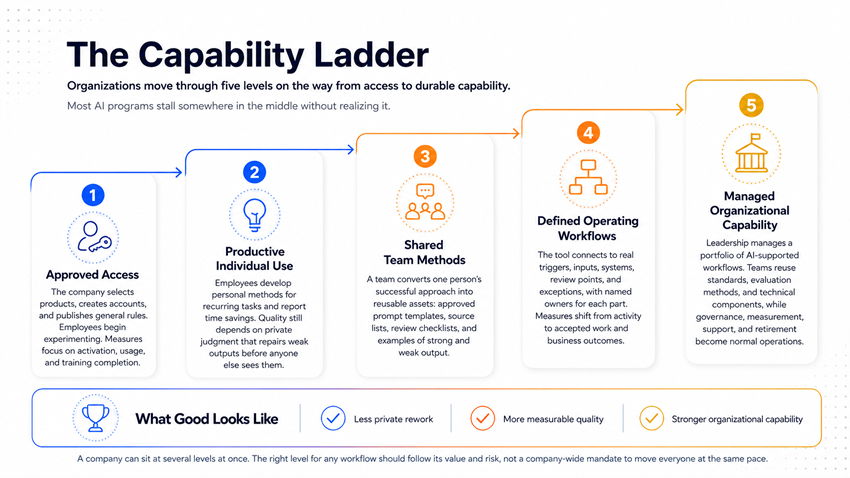
Your organization moves through five levels on the way from access to durable capability. Most AI programs stall somewhere in the middle without realizing it.
Level one, approved access, is where you select products, create accounts, and publish general rules. Employees begin experimenting. Measures focus on activation, usage, and training completion, and you mainly learn where demand exists.
Level two, productive individual use, is where capable employees develop working methods for recurring tasks and report real time savings. This is also where the gap starts to hide. An employee’s judgment repairs every weak output before anyone else sees it. The finished work looks dependable while the method behind it stays invisible and entirely personal. Product training, which teaches interface navigation and prompt construction, gets employees this far. It does not teach them which customer information may enter the tool, or which source wins when two documents disagree. It also does not teach which claims need legal review before anyone sends them.
Level three, shared team methods, is where a team converts one person’s successful approach into a reusable asset. That asset can include approved prompt templates, source lists, review checklists, and documented examples of strong and weak output. Without this step, several people solve the same problem independently, testing different sources and formats, while managers repeat the same corrections across every version. Shared standards let a team start from a tested method and improve it through documented feedback rather than private workarounds. They also make quality measurable for the first time. “Good output” cannot support a real review process, but a defined standard identifying required facts, structure, and evidence can.
Level four, defined operating workflows, connects the tool to real triggers, inputs, systems, review points, and exceptions, with named owners accepting responsibility for each part. The team tests the workflow against normal conditions, launches inside clear boundaries, and starts measuring accepted work and business outcomes rather than activity. This is also where governance has to reach the workflow level rather than stopping at the product. Approving a tool answers one question: does the company permit this product under stated conditions. It says nothing about whether a specific use, on confidential customer data, on an employee decision, deserves the same treatment as public research.
Level five, managed organizational capability, is where leadership manages a full portfolio of AI-supported workflows. Teams reuse standards, evaluation methods, and technical components across the business. Governance, measurement, support, and retirement all become part of normal operations. Knowledge keeps moving across employees and departments even as people leave and technology changes underneath them. Your company can sit at several levels simultaneously. One workflow can reach level five while another remains an early experiment. Let the right level for any given workflow follow its value and risk, not a company-wide mandate to move everyone at the same pace.
Watch for the signs a program is stuck below level four
A handful of patterns reliably signal that a program is still an adoption story rather than a capability story. Success reports lean entirely on licenses and training attendance. Different departments run several products for the identical task. Strong prompts sit inside personal accounts instead of a shared repository. Employees quietly repeat the old process after using the new tool because trust never got built. Managers cannot say where the released time went. Tool renewals get approved without a shred of outcome evidence attached. None of this is a reason to blame employees. Employees cannot follow standards, workflows, or measures the company never built in the first place.
Give an enablement function the job of moving workflows up the ladder
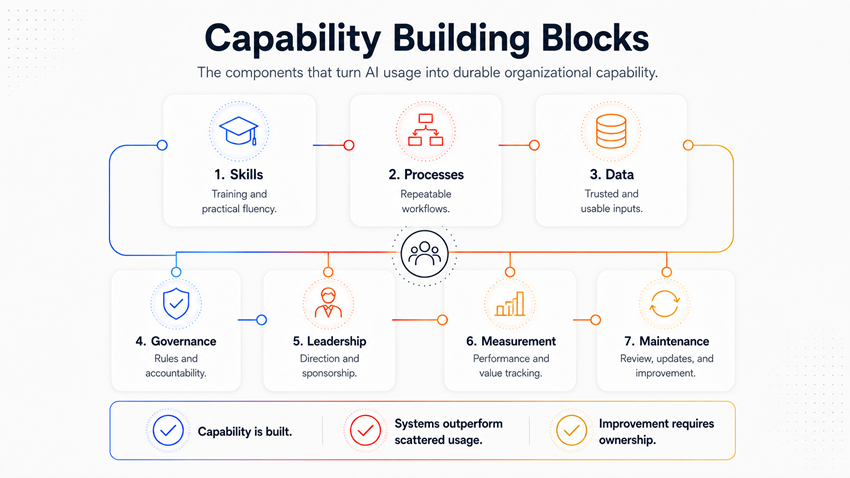
The work of climbing the ladder needs an actual owner, not a hope that adoption compounds on its own. An enablement function should discover valuable use cases, assess workflow readiness, and build shared standards. It should also coordinate data access, define human review, measure business impact, and retire workflows that stop earning their keep. It does not need to own every AI decision. Business leaders stay accountable for results, technology teams maintain the systems, and risk teams keep their existing authority. Enablement’s job is connecting those responsibilities around real work instead of leaving each one to operate in isolation.
Build your training in layers to build capability rather than only awareness. Foundational education covers shared concepts and data rules. Role-based training connects AI to the specific responsibilities of marketing, sales, finance, or operations. Workflow training has people practice the exact inputs, exceptions, and review steps inside a real production process, not a polished demo. Manager training teaches leaders to interpret performance and manage the workload shifts AI creates. Owner training prepares the people who maintain the workflow after launch. One training event cannot do all five jobs, which is exactly why one training event so rarely produces lasting competence.
Run this 90-day plan to move one workflow up the ladder
Days one through 30. Build visibility. Review current access, usage, and existing employee experiments, then pick one recurring workflow with real value and an engaged business owner. Map its current process from request through completion and establish a baseline before changing anything.
Days 31 through 60. Design the capability. Define the future workflow’s trigger, inputs, human decisions, and exceptions, then assign business, technical, data, review, and measurement responsibility. Build the shared instructions, evaluation cases, and training guide, and test the design against strong, typical, and weak inputs.
Days 61 through 90. Launch and manage. Start inside controlled boundaries, limiting the first user group and volume by risk. Hold weekly reviews during the first month and compare results against the baseline. Decide whether to expand, revise, restrict, or retire the workflow, documenting the reusable assets for the next one.
What you tell them at the end
Tool adoption remains genuinely necessary. Employees need access before they can build real understanding, and personal experimentation is where most useful methods get discovered in the first place. The mistake is reporting that early signal as if it were the finished transformation.
Access creates the opportunity. Capability is the work of converting that opportunity into a business result your company can produce again, on purpose. That holds true even after the person who discovered it has moved to another role. The organizations pulling ahead in 2026 are the ones treating the ladder as the actual project, not the licensing rollout as the finish line.