
Summary
The most common framing of artificial intelligence (AI) governance is that it slows organizations down. The assumption is that careful, deliberate setup trades speed for caution. Four years of building and governing AI systems inside a real enterprise taught me that assumption gets it exactly backwards.
Organizations that build governance before deployment move faster. They move faster because every team member works from the same explicit decisions rather than inventing their own interpretation at the moment of use. The slowdown happens later, after the incident, when the organization has to rebuild trust, redesign processes, and document decisions it should have made weeks earlier.
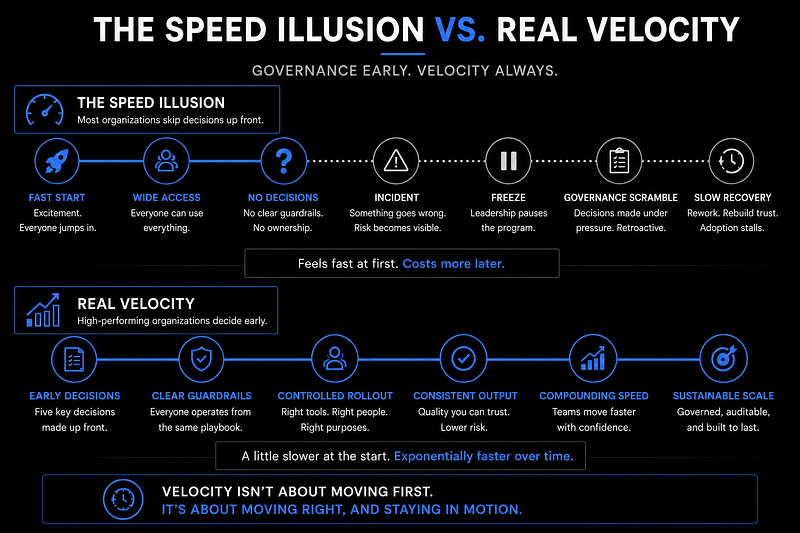
Gartner has consistently identified AI governance as one of the top priorities for technology and operations leaders. The research reflects a consistent pattern in practice. Organizations that scale AI successfully made their governance decisions early and explicitly. The ones that struggle are still making them after the fact.
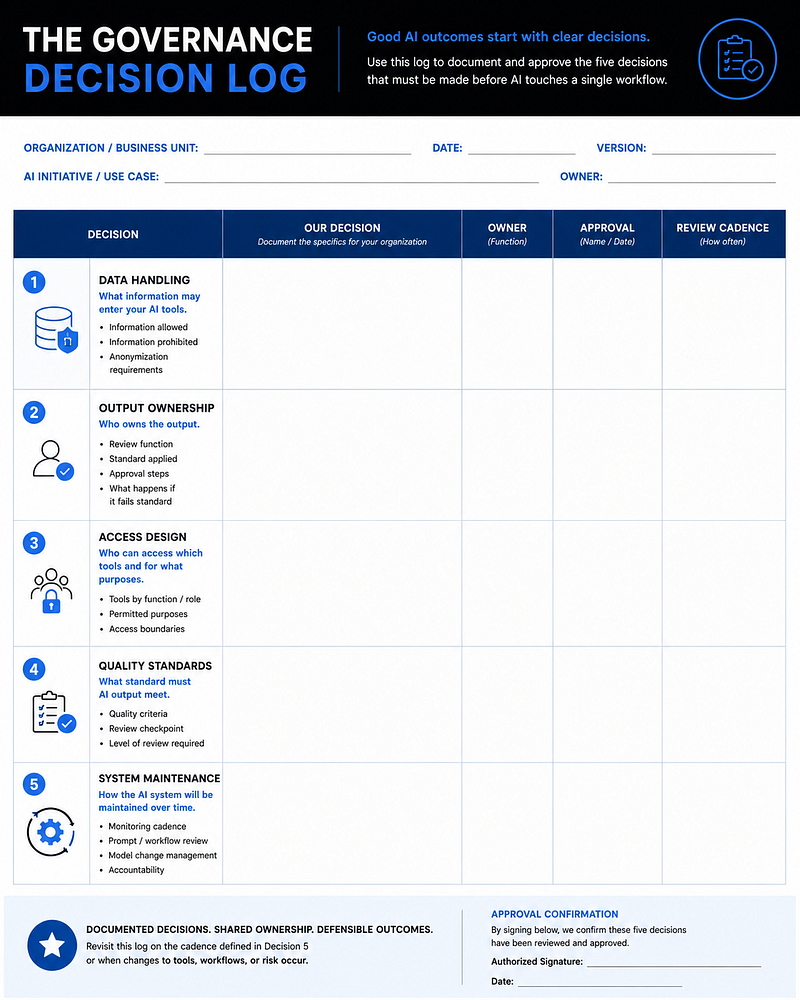
Five decisions determine whether an AI deployment is defensible before it scales. Most organizations skip all five and wonder why adoption stalls, quality degrades, or a compliance concern forces them to pause the program they spent months building.
Decision One: What Information May Enter Your AI Tools
Every AI tool your team uses accepts inputs. Those inputs shape its outputs. When no organizational decision governs what enters the tool, each person makes a personal judgment about what is safe to share. Those judgments vary widely across a distributed team, and the exposure compounds with every user and every session.
This decision must address three things. First, which categories of information are appropriate inputs. Second, which categories are prohibited. Third, what anonymization steps are required when sensitive information is relevant to the task. That specification does not need to be long. It needs to be clear, accessible, and present at the moment of use. A policy document that no one reads is not a governance decision.
In the AI tool suite I built for a $40M enterprise operating across three countries, data handling guidance appeared inside each tool itself, at the exact moment a user was preparing to enter information. When guidance is embedded at the point of temptation rather than posted in a handbook, people actually see it.
Decision Two: Who Owns the Output
AI-generated output is not self-certifying. Someone must review it before it represents your organization. When that ownership is unassigned, review becomes optional. Errors, misrepresentations, and off-brand content pass through because no one has been told that stopping them is their responsibility.
This decision identifies a named function (not a named individual, who may leave) as the owner of AI output review for each deployment. It specifies the standard that reviewer applies and the approval step required before output reaches its destination. It establishes what happens when output fails the standard and what the revision process looks like.
Ownership and standard must be documented together. A reviewer without a standard is simply exercising personal judgment under the label of quality control. That arrangement fails the moment the reviewer changes.
Decision Three: Who Can Access Which Tools and for What Purposes
Generic AI access, where every tool is available to every user for any purpose, creates several problems simultaneously. It mixes outputs from different risk levels into the same operational stream. It provides no way to trace which team or role produced a given output when questions arise. It makes role-appropriate guidance impossible to deliver at the point of use.
Access design separates tools by function and by the risk profile of the work each function performs. In the AI suite I built, sales tools were separated from recruiting tools, which were separated from client-facing content tools. The separation was structural, not procedural. It was built into the system architecture so that appropriate access was automatic rather than manually enforced and manually forgotten.
Role-based access builds auditability into the system from the start. That auditability protects the organization when a decision about any specific output ever needs to be traced.
Decision Four: What Standard Must AI Output Meet Before It Leaves Your Organization
Every organization has standards for what it publishes, proposes, and presents. Those standards exist in legal review, brand guidelines, technical accuracy requirements, and professional norms. When AI enters production workflows without those standards documented and applied to its outputs, the standards do not disappear. They simply stop being enforced.
This decision documents the specific quality criteria that AI output must meet for each workflow where AI is deployed. It identifies who applies those criteria and what the review checkpoint looks like in practice. It determines the level of review required before AI output represents the organization externally.
An explicit, shared standard applied consistently matters more than a perfect standard applied by one person. One person’s judgment is not transferable. An explicit shared standard is.
Decision Five: How the AI System Will Be Maintained Over Time
AI models update on schedules your organization does not control. Outputs that performed consistently six months ago may drift as the underlying model changes. Prompts that were carefully calibrated to produce reliable results require periodic testing and revision. Organizations that treat AI deployment as a one-time event discover this when outputs degrade unexpectedly and they cannot identify why.
This decision establishes prompt maintenance as an ongoing operational responsibility. It assigns ownership of that responsibility, sets a review cadence, and documents what a prompt review process looks like in practice. It also determines how the organization tracks AI system performance over time, so drift is visible before it becomes a problem.
I maintained prompt libraries across four years of quarterly model updates at that same enterprise. Treating AI systems as living infrastructure, requiring regular upkeep rather than one-time configuration, is what kept results consistent as the technology underneath them changed.

The Governance Decision Log
Before deploying any AI tool, complete this log as a leadership team. Each entry represents one of the five decisions. Each decision requires a named owner and an explicit resolution. Unresolved entries are deployment risks, not items to revisit later.
Decision One — Data Handling: What information may enter this tool? What is prohibited? What anonymization steps are required? Owner: [name or function]. Approved by: [name or function].
Decision Two — Output Ownership: Who reviews AI output before it reaches its destination? What standard does that reviewer apply? What is the revision process when output fails the standard? Owner: [name or function]. Approved by: [name or function].
Decision Three — Access Design: Which roles may use this tool? For what specific purposes? What structural controls enforce those boundaries? Owner: [name or function]. Approved by: [name or function].
Decision Four — Quality Standards: What criteria must this tool’s output meet? Who applies those criteria? What is the approval checkpoint before output leaves the organization? Owner: [name or function]. Approved by: [name or function].
Decision Five — System Maintenance: Who owns ongoing prompt review and calibration? At what cadence? How will output quality be tracked over time? Owner: [name or function]. Approved by: [name or function].
A completed log takes one focused meeting. An undocumented deployment takes months to correct after the incident, and that correction never happens under ideal conditions.
What Governance Actually Buys
Organizations that complete these five decisions before deployment gain something more practical than compliance. They gain the ability to move without stopping to relitigate every situation as it arises. When a team member encounters an edge case, the governing decisions are already made. When a new tool is added to the suite, the framework already exists to evaluate and govern it. When leadership asks how the organization is managing AI risk, the answer is documented and defensible.
The organizations that treat governance as a prerequisite rather than an afterthought do not move more cautiously with AI. They move more confidently. Every decision made once, at the right moment, is a decision that never has to be remade under pressure.