
Summary
Most marketing teams already use artificial intelligence (AI) every day. Many of those same teams cannot say where their best prompts live. They also cannot name which workflows are approved or which outputs require human review.
The activity is real. The capability is fragile. AI fluency lives inside individual people, their private chats, and their personal habits. It has not moved into the team’s system of work.
I have seen this pattern inside real marketing work. The first gains usually come from a few strong users who know how to brief the tool, judge the output, and connect it to business context. The problem begins when a team mistakes that individual fluency for organizational capability.
That gap matters because individual skill does not compound across a team. When a strong user leaves, the capability leaves with them. The team starts over from scratch.
The Structural Reality Behind Stalled AI Adoption
The numbers describe a maturing market rather than a tooling shortage. McKinsey’s 2025 State of AI report found that 88 percent of organizations now report regular AI use in at least one business function, up from 78 percent a year earlier. More than 70 percent regularly use generative AI, and marketing and sales rank among the most common functions for it.
Adoption is no longer the interesting question. Scaling is. McKinsey reports that only about one-third of organizations have begun scaling AI across the enterprise, while two-thirds remain in testing or proof-of-concept stages. Most deployments stay isolated inside teams, tools, and one-off use cases.
Many marketing leaders misread this pattern as a tooling gap. They license another platform and expect output to rise. The constraint sits in a different place entirely.
The real constraint is structural. AI capability is trapped at the individual level, and no single owner is responsible for moving it into the shared operating system. The work of conversion has no home.
The Role That Owns the Operating Layer
A Marketing AI Operations Manager exists to do that conversion work. The role turns individual AI experimentation into repeatable team capability.
The position sits between marketing strategy, operations, data, automation, enablement, and governance. It belongs fully to none of them and touches all of them. That overlap is the point, because the value lives in the connections between those functions.
The cleanest definition is this. A Marketing AI Operations Manager builds and owns the operating layer that sits between AI tools and marketing outcomes. Strategy decides what the team should achieve, and this role decides how AI reliably helps the team achieve it.
The Framework: The Capability Operating Layer
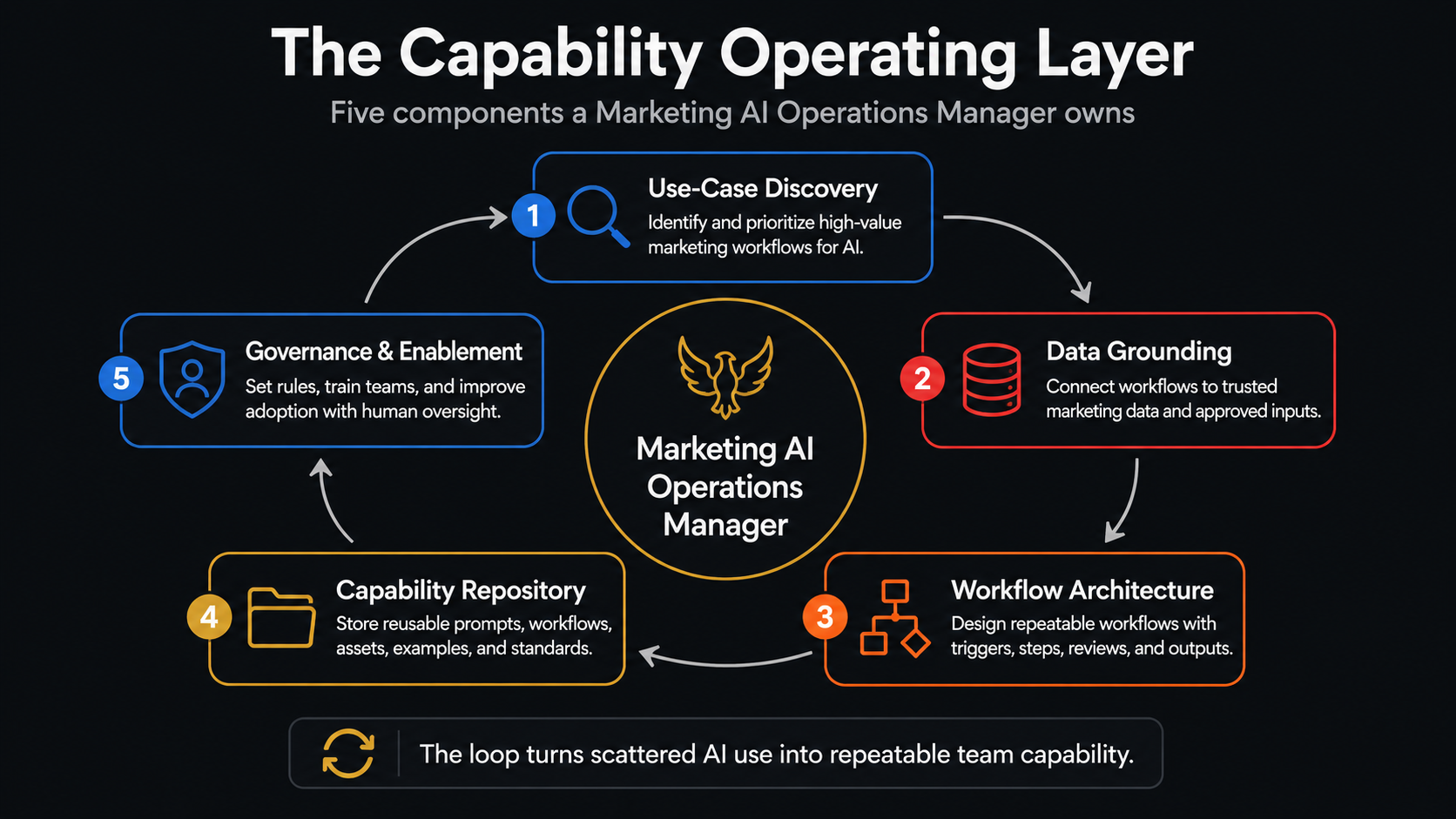
The Capability Operating Layer is the shared system that turns individual AI use into reusable workflows, governed inputs, documented prompts, review standards, and measurable team capability. It has five working components, and they run as a loop rather than a checklist.
Component One: Use-Case Discovery
The role decides which workflows justify AI before any tool enters the conversation. A strong operator does not begin with the question of which platform to buy. They begin by asking which workflows create enough repeated pain or business value to deserve the investment.
Strong candidate workflows tend to share a profile. They include weekly campaign performance synthesis, account engagement analysis, sales follow-up briefings, content repurposing, competitive research summaries, and reporting narratives. Each one repeats often and carries real cost when done poorly.
Component Two: Data Grounding
The role connects AI to real, trustworthy marketing inputs. AI workflows gain most of their value when they draw on actual business signals rather than generic knowledge.
Useful inputs include customer relationship management (CRM) records, email engagement, website activity, paid media performance, intent data, and webinar attendance. The risk is straightforward. Messy, incomplete, or mislabeled data produces confident summaries built on weak foundations. This role therefore requires data judgment alongside tool fluency.
Component Three: Workflow Architecture
The role builds complete workflows rather than isolated prompts. A prompt answers a single task in the moment. A workflow defines the trigger, inputs, decision rules, AI step, human review point, output, storage location, owner, and improvement loop.
The difference shows up in how a use case is specified. A weak instruction reads, “Use AI to summarize campaign data.” A strong workflow reads like an operating procedure that a teammate could run without supervision.
The Weekly Account Intelligence Workflow (a real example)
- Every Wednesday, the workflow pulls engagement data from approved systems.
- It consolidates account-level signals into a single view.
- It compares the current week against prior activity.
- It classifies companies by intent level.
- It drafts a summary report for the team.
- It creates sales-ready briefs for newly active accounts.
- It routes every output for human review.
- It stores the approved files in the correct location.
That level of specification is what separates a productivity trick from an operating asset.
Component Four: The Capability Repository
The role stores what works so the team can reuse it deliberately. Teams lose enormous value when prompts, examples, and workflows live in scattered documents and private chats.
A useful repository contains approved use cases, reusable workflows, prompt assets, source materials, governance rules, quality checklists, named owners, and review dates. It also records strong example outputs and known failure points. This repository is the compounding layer that lets a team build on yesterday rather than repeat it.
Component Five: Governance and Enablement
The role protects quality and helps people actually adopt the work. Governance answers clear questions about which tools are approved, which data may be used, which outputs require review, and who owns final approval.
Good governance helps teams move faster because the rules are known in advance. Enablement then closes the loop. The role writes short internal guides, runs workflow demos, shows before-and-after examples, and teaches people where human judgment still belongs. What governance and enablement learn feeds directly back into use-case discovery, which is why the layer operates as a loop.
What This Changes Inside the Organization
Leaders feel this role most in four places. Leadership behavior shifts from celebrating individual AI wins toward funding shared systems that survive turnover.
Workflow design changes from improvisation to documented sequences with owners and review points. Decision systems gain consistency because the team works from approved inputs rather than whatever data sits closest to hand. Organizational structure clarifies, because one accountable owner now connects marketing, data, automation, and governance.
This shift also manages a real risk. McKinsey’s 2025 survey identifies inaccuracy as one of the risks that organizations most actively work to mitigate. A defined review layer is how a marketing team keeps speed without sacrificing trust, because it makes clear which outputs require human validation before they reach a customer or an executive.
Execution Guidance for Leaders, Hiring Managers, and Recruiters
Score Use Cases Before You Build Them
A simple scoring model keeps the backlog honest. Rate each candidate workflow across six criteria, then build the highest-scoring few first.
- Business impact measures how much revenue, pipeline, or saved time the workflow affects.
- Workflow repeatability measures how often the team performs the task.
- Data availability measures whether trustworthy inputs already exist.
- Risk exposure measures the cost of an error reaching a customer or executive.
- Human review complexity measures how hard the output is to verify.
- Adoption readiness measures whether the team will actually use the result.
Score each criterion on a scale of one to five, then total the results. Prioritize workflows that combine high business impact, high repeatability, available data, manageable risk, clear review paths, and strong adoption readiness. The strongest first project is usually an ordinary, high-frequency task that wastes time today and has enough structure to improve safely.
Evaluate the Role Across Five Skill Areas
Hiring managers and recruiters can assess candidates against five categories rather than a tool checklist.
- Marketing systems judgment covers demand generation, content, campaigns, sales enablement, and reporting.
- AI tool fluency covers comfort with assistants such as Claude and ChatGPT, plus automation platforms.
- Workflow architecture covers triggers, inputs, branching logic, review points, and error handling.
- Data judgment covers where marketing data comes from, how it gets distorted, and what makes it usable.
- Enablement and governance covers documentation, training, standards, and the prevention of duplicated work.
Expect Results on a 90-Day Curve
A capable hire produces a visible arc in the first 90 days. The early weeks focus on diagnosis, and the later weeks focus on compounding.
- In the first 30 days, the manager audits current AI usage, interviews stakeholders, maps workflows, reviews data sources, and builds a scored use-case backlog.
- From day 31 to day 60, the manager selects two or three high-value pilots, defines success measures, builds the first workflows, and establishes review rules.
- From day 61 to day 90, the manager refines those workflows, trains the team, creates the capability repository, measures impact, and prepares the next roadmap.
Ask Three Diagnostic Questions
Leaders can test their own exposure quickly. The answers usually reveal how much capability is trapped inside individuals.
- If your strongest AI user left next month, how much of their working knowledge would remain inside the team?
- How many of your AI outputs reach a customer or executive without a defined review step?
- Where do your most-repeated marketing workflows store the prompts, inputs, and examples that produce good results?
The Strategic Implication
Marketing leaders have spent three years proving that AI works in their teams. The next advantage comes from a different question, which is whether AI works as a system rather than as a collection of talented individuals.
A Marketing AI Operations Manager is the function that answers that question. The role turns scattered productivity into durable capability, and durable capability is what compounds while competitors keep starting over.
Key Takeaways
- A Marketing AI Operations Manager converts individual AI experimentation into repeatable team capability.
- The role builds the operating layer between AI tools and marketing outcomes.
- The Capability Operating Layer has five components that run as a loop.
- The work begins with use-case discovery and data grounding, not tool selection.
- A capable hire shows a clear 90-day arc from diagnosis to compounding systems.
Frequently Asked Questions
What does a Marketing AI Operations Manager do? A Marketing AI Operations Manager designs, documents, and governs the AI workflows a marketing team relies on, so capability lives in the system rather than inside individual habits.
How is the role different from marketing operations? Traditional marketing operations manages campaigns, systems, and performance processes. Marketing AI Operations connects AI, data, automation, governance, and enablement into reusable workflows.
Why are companies hiring for this role now? AI adoption is widespread, but scaling remains limited. Companies need someone to convert scattered AI activity into repeatable team capability.
Framework Reference: The Capability Operating Layer
Definition. The Capability Operating Layer is the shared system that turns individual AI use into reusable workflows, governed inputs, documented prompts, review standards, and measurable team capability.
Components. Use-Case Discovery, Data Grounding, Workflow Architecture, the Capability Repository, and Governance and Enablement.
Application. Leaders apply it by scoring use cases before building, grounding workflows in approved data, documenting complete workflows, storing reusable assets centrally, and closing the loop with governance and training.
Source: McKinsey & Company. (November 2025). The State of AI in 2025: Agents, innovation, and transformation. https://www.mckinsey.com/capabilities/quantumblack/our-insights/the-state-of-ai