
Summary
Picture two workflows running side by side in your company right now. One routes every output through a manager, and the queue keeps growing faster than anyone can clear it. The other lets everything through untouched, and nobody notices the error until a customer does. Both workflows have the same underlying problem: nobody decided where review earns its cost.
Human review belongs wherever an artificial intelligence (AI) error could create a serious commitment, consequence, or loss of trust. Let review protect a defined decision, never stand in as a vague instruction to check every output. That distinction affects your risk and your productivity together. Reviewing everything can create a queue that quietly erodes the capacity gain the workflow was supposed to deliver. Reviewing too little lets preventable errors reach customers and business systems before anyone catches them.
The National Institute of Standards and Technology (NIST) recommends defining human roles, oversight, appeal, override, and system limits. Match each one to the system’s actual context and risk. McKinsey found that higher-performing AI users were more likely to define exactly when outputs required human validation. They were also more likely to have redesigned complete workflows around that decision. The need for review changes as a workflow proves itself. Let the decision follow real operating evidence, not optimism or fear.
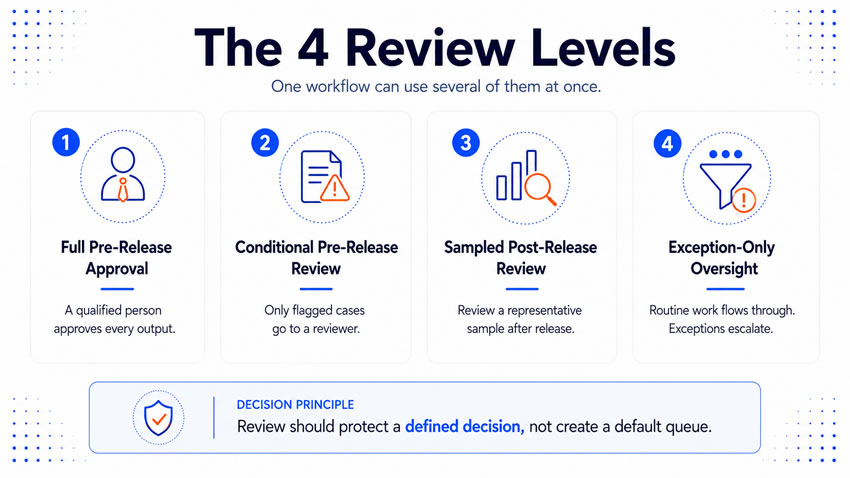
Cover most workflows with four review levels
Full pre-release approval puts a qualified person in front of every output, fitting work with serious consequences or difficult reversibility. Conditional pre-release review sends only defined cases for approval, low confidence, unusual value, sensitive data, while routine cases proceed under approved limits. Sampled post-release review examines a representative portion of completed work once individual errors stay limited and reversible. Exception-only oversight lets routine cases proceed automatically while failures and unusual conditions route to a person. One workflow can reasonably use several of these levels at once. You do not have to choose between approving everything and abandoning oversight entirely.
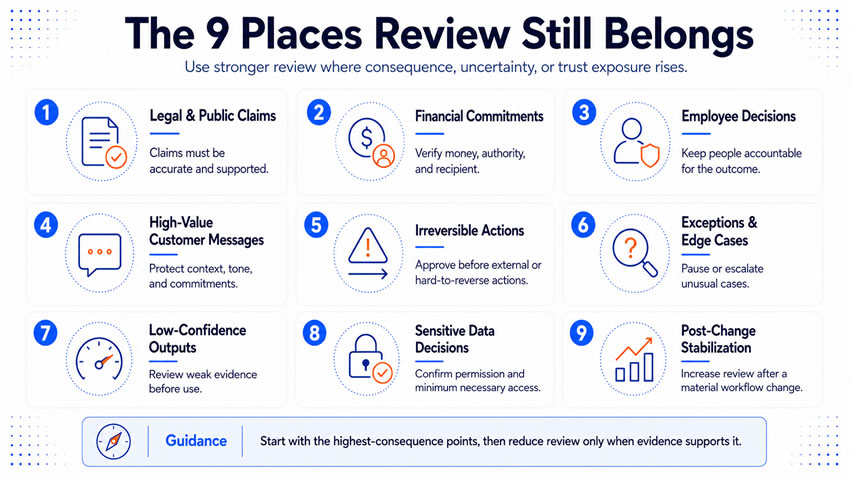
These four levels are the dial. They tell you how much scrutiny a given output gets, from full approval down to exception-only. The nine places below are the map. They tell you where in your business you need to decide what that dial should be set to. Every place gets one of these four levels assigned to it, sometimes more than one, depending on the specific case in front of you.
Place one: watch legal, regulatory, and public claims
AI can draft a claim faster than anyone can research and validate it. The resulting language can overstate evidence or quietly shift legal meaning through one changed phrase. The Federal Trade Commission (FTC) requires businesses to support advertising claims with real evidence, and it has already acted on unsupported AI product claims specifically. A reviewer needs to examine research quality, required disclosures, and the exact promise the wording creates. Marketing employees may catch a brand concern while missing a contractual or regulatory one entirely.
Give regulated claims, contractual language, and financial statements full approval. Lower-risk public content can move to conditional review once specific topics trigger specialist attention. Routine content can earn sampled review only after you have an approved claim library with current evidence and named owners behind it. Keep giving new claims the strongest attention regardless of how mature the rest of the program gets.
Place two: watch financial commitments and material transactions
AI can prepare prices, refunds, and payment instructions, and some systems can initiate transactions directly. These actions create immediate obligations. A model can calculate a reasonable-looking answer without understanding who is authorized to approve it, or while working from incomplete account information. Focus financial review on the commitment created, not on how sophisticated the underlying technology happens to be.
Give large payments, unusual refunds, and anything outside standard policy full approval. Amounts crossing a defined threshold, changed payment destinations, and conflicting supporting information should all trigger conditional review before release. The reviewer needs to verify the amount, the recipient, and the authority behind the action. Your record should show exactly who approved it and what evidence supported that call.
Place three: watch sensitive employee and candidate decisions
AI can organize applications and summarize performance data, but employment decisions affect pay, promotion, discipline, and continued work. The Equal Employment Opportunity Commission (EEOC) has been explicit that AI used in employment decisions stays fully subject to federal anti-discrimination law. Performance data can quietly reflect unequal assignments or inconsistent management. A system may lean on a proxy variable that looks neutral while producing uneven effects across groups.
Give hiring, termination, promotion, compensation, and discipline full human review. Keep AI limited to organizing evidence and flagging missing information, not holding any real authority over the outcome. A qualified person stays accountable for the decision itself. Your employees and candidates need a real path to correct wrong information or appeal a result they believe is unfair.
Place four: watch high-value customer communications
AI can prepare proposals, renewal responses, and service remedies. A message can be factually accurate while still damaging a relationship through poor timing or tone. Strategic accounts often carry context no system holds: an open negotiation, a prior service failure, an executive relationship. An ordinary request can matter more than it looks like it should.
Give major proposals, contract discussions, and executive communications full review. Messages touching an unresolved complaint, an unusual concession, or a pricing exception deserve conditional review. Use signals like account strategy status or an active renewal to flag what counts as high-value, not revenue size alone. The reviewer should confirm the facts, the intended commitment, and whether the message even belongs in this channel. Some situations genuinely need a phone call rather than an email.
Place five: watch irreversible or difficult-to-reverse actions
AI workflows can delete records, change permissions, publish content, and update business systems. Agentic systems can chain several of these together with limited human intervention in between. MIT Sloan notes that agentic AI reintroduces familiar challenges around data quality, governance, and trust. Greater autonomy increases the effect of any single error. A deleted record might have a backup. A customer who already received the incorrect message still received it.
Give genuinely irreversible actions and anything with serious external consequences full review before execution. Actions crossing a defined threshold or touching sensitive systems need conditional review. Human approval alone cannot compensate for unrestricted system access. Run this review alongside real technical controls: approval limits, staging environments, and delayed execution. A tested recovery process needs an actual shutdown method behind it too.
Place six: watch unusual exceptions and edge cases
AI performs best when real conditions resemble the testing environment. Normal work still constantly produces cases that do not: conflicting data, an unsupported request, a policy situation without precedent. A fluent output can hide the fact that a case sits entirely outside the workflow’s intended boundary. Employees sometimes force an exception through the standard path because no alternative exists.
Make conditional review the default response to recognized exceptions, and move to full review whenever the exception carries serious financial, legal, or customer consequences. Give unknown cases a safe default: pause or escalate, never guess. Review creates the most value here when it changes the workflow itself rather than repeatedly rescuing the same recurring problem. Frequent exceptions should become new workflow paths, not permanent manual patches.
Place seven: watch low-confidence outputs and weak evidence
AI can produce confident-sounding language from limited evidence. Your workflow needs its own real definition of confidence rather than relying on tone to signal reliability. NIST recommends defining acceptable performance limits and documenting a system’s actual knowledge boundaries directly. Weak evidence raises the odds that an output contains an unsupported conclusion the person using it will never notice unless the workflow surfaces it.
Trigger conditional review when confidence falls below an approved threshold, and move to full review the moment low confidence combines with real business impact. A single blended confidence score rarely tells the whole story. A workflow can look fine on average while one weak condition, missing information, disagreeing sources, quietly undermines the result. The reviewer needs to see the output beside its actual supporting evidence, not only a confidence label with no context behind it.
Place eight: watch sensitive data access and disclosure decisions
AI workflows can retrieve, combine, and distribute information across several systems at once, and technical access never equals business permission. A system might have the ability to retrieve an entire customer record while the task needs two fields. A generated summary can combine several harmless facts into one sensitive conclusion nobody approved. NIST advises connecting AI governance directly with your existing data controls, especially for sensitive information.
Give new sensitive data access, external disclosure, and high-impact data combinations full review. Anything expanding the normal data boundary under defined conditions needs conditional review. The minimum necessary principle is the right test here too. Let the workflow receive exactly what its approved purpose requires. The reviewer confirms permissions, retention, and that logs and notifications do not quietly expose more than intended.
Place nine: watch the first cases after a material workflow change
Increase review after any change to models, prompts, data sources, integrations, or business scope. A workflow can remain technically functional while its actual output quality shifts underneath it. NIST recommends postdeployment monitoring and change management across the AI lifecycle for exactly this reason. Previous performance evidence only applies to the tested configuration. A new model can interpret instructions differently, and a wider user group can introduce requests the original test never covered.
Give the first high-impact cases after a major change full review. Apply conditional review broadly through a defined stabilization period before returning to sampled or exception-only oversight. A calendar date alone cannot prove stability. You need enough representative cases, normal work, difficult inputs, and known exceptions, to confirm the workflow meets its approved thresholds again.
Give review real authority, real criteria, and real capacity
A review step protects nothing if the reviewer cannot act on what they find. Specify exactly what a reviewer can do: approve, correct, reject, escalate, pause the individual action, or stop the whole workflow. Protect that authority from delivery pressure before launch, not after someone gets punished for using it.
“Check the AI output” cannot produce consistent oversight. A useful instruction names what the person evaluates and what counts as acceptance. Keep it short enough for real work, since a 40-item checklist teaches people to rush through it. Put capacity in the business case from day one too. A system generating 200 daily outputs cannot depend on one manager’s spare time. Narrow the use case or improve the review model before you remove review to relieve the pressure.
Measure review quality itself: the percentage of outputs changed, the severity of what gets caught, and differences between reviewers on the same sample. How many review findings lead to a workflow change, versus getting quietly corrected and forgotten, matters as much. Your goal is improving the whole decision system, human and AI performance together, not producing a report nobody acts on.
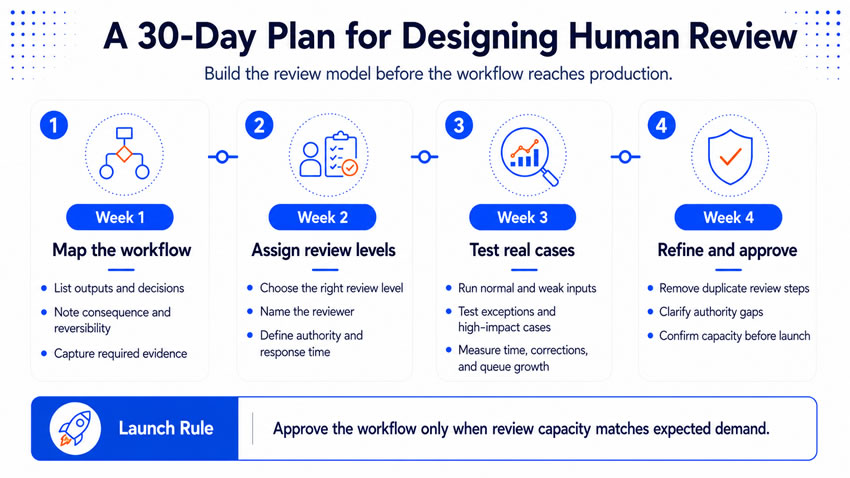
Run this 30-day plan to design human review
Week one. Map every output, decision, and action in the workflow, documenting the potential consequence, reversibility, audience, and required evidence for each one.
Week two. Assign one of the four review levels to each meaningful point, defining the trigger, the reviewer, their authority, and the expected response time.
Week three. Test the design against normal cases, weak inputs, exceptions, and high-impact cases, measuring review time, correction rates, and queue growth directly.
Week four. Remove duplicated reviews, clarify overlapping authority, and add controls wherever reviewers lack evidence or technical protection. Approve the workflow only once review capacity matches expected demand.
What you tell them at the end
AI can prepare information, draft content, and recommend actions well. Human review adds real value only where a person contributes context, accountability, or judgment the workflow genuinely cannot supply on its own. It should never become a permanent repair layer absorbing preventable failures.
Give legal claims, financial commitments, employee decisions, and irreversible actions strong approval by default. High-value communications, exceptions, low-confidence outputs, and sensitive data need review when specific conditions appear. Material changes earn a temporary increase in scrutiny until new evidence justifies stepping back down. Your organization keeps responsibility for everything AI does on its behalf. The review process is what makes that responsibility visible and workable instead of theoretical.