
Summary
Picture three requests moving through your AI system this week. One needs a person’s eyes on it before it goes anywhere. One can run inside its own boundaries as long as somebody is watching the dashboard for what falls outside them. One can complete on its own, with nobody reviewing the individual case, as long as someone still owns what happens if it breaks. Treat all three the same way, and you either drown your reviewers or leave real exposure unwatched.
Human oversight needs a defined operating model. A general instruction to keep people involved does not explain when they intervene, what they review, or which authority they retain. Some artificial intelligence (AI) workflows need a person to approve every output. Others can operate inside defined boundaries while people monitor selected cases and exceptions. A smaller group can run without case-level review at all, provided the actions stay narrow, reversible, and observable.
RAND’s research frames this as a progression, evaluating tasks across criticality, accuracy, novelty, and observability rather than treating oversight as one fixed setting. The National Institute of Standards and Technology (NIST) recommends documenting the actual degree of human oversight, along with overrides, errors, complaints, and accountability. Risk, reversibility, confidence, and business impact should decide how close a person stays to each action. A company-wide policy that applies the same rule everywhere cannot make that call.
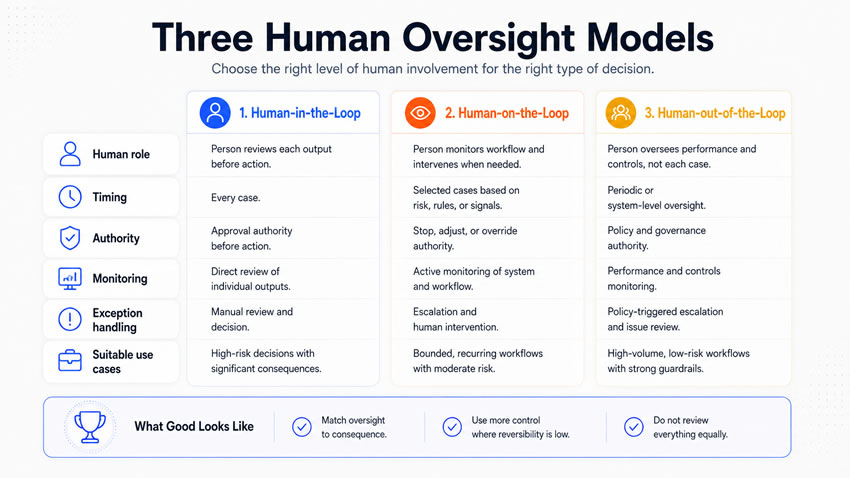
Use three levels of involvement, not one blanket policy
Human-in-the-loop means a person reviews each output, decision, or action before the workflow proceeds. Human-on-the-loop means the system operates within approved boundaries while people monitor selected cases and can intervene. Human-out-of-the-loop means the system completes individual cases without review while people govern overall performance, limits, and incidents.
No model removes accountability. Human-out-of-the-loop operation still needs named owners, monitoring, logs, audits, and the authority to stop the system immediately. The difference is where people participate in individual cases, not whether anyone remains responsible for the outcome.
Treat oversight as a design decision, not a step added at the end
Human oversight often gets attached to a workflow late, right before launch, as a review step bolted onto something already built. That approach can produce a control that sounds responsible and fails during real work. The reviewer may lack the context to catch an error. The queue may grow faster than anyone can process it. Employees may approve outputs quickly because they assume the system already did the hard analysis.
Let oversight enter the design before you select permissions or review capacity, and answer a specific set of questions first. Which outputs can affect people, money, or legal obligations? Which actions can be reversed completely? Which failures can you detect before harm occurs? Which person has the authority to intervene, and how fast do they need to respond? The answers determine whether a person belongs in, on, or outside each case-level loop, not a general commitment to “keep humans involved.”
Use the Loop Placement Model as your core thesis
Four primary factors decide the right level for a given action, and two supporting factors confirm whether that level can work in practice.
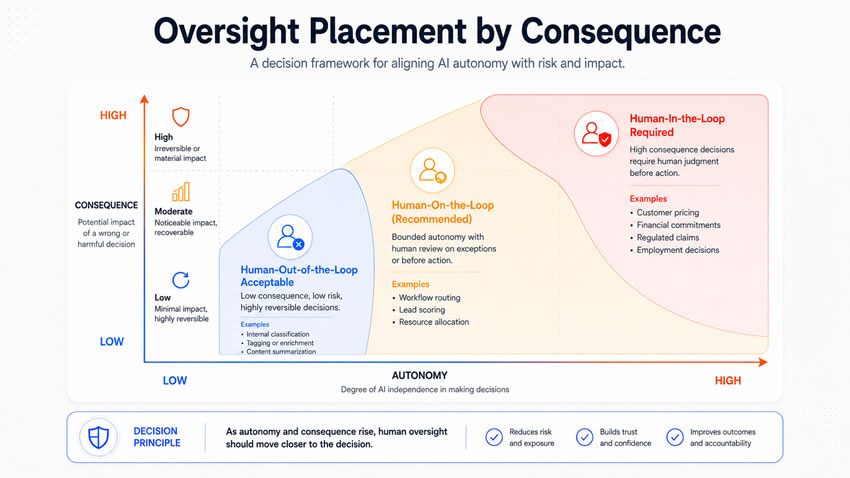
Risk combines the likelihood of failure with the seriousness of its consequence. A frequent low-impact mistake can still create large correction costs, while a rare high-impact mistake can create unacceptable exposure on its own. High risk supports human-in-the-loop review. Moderate risk can support human-on-the-loop supervision with strong boundaries. Low, well-understood risk can support human-out-of-the-loop operation once testing supports it.
Reversibility measures whether you can restore the complete situation after an error, not only the database record. A system record may be recoverable while a damaged customer relationship is not. Limited reversibility supports human-in-the-loop review. Strong reversibility for normal cases can support human-on-the-loop supervision. Easy, complete reversibility can support human-out-of-the-loop operation.
Confidence should combine data quality, test performance, and operating history, never a model’s own generated confidence score alone. Low or uncertain confidence supports human-in-the-loop review. Confidence established across normal cases can support human-on-the-loop supervision. High, stable confidence within a narrow range can support human-out-of-the-loop operation.
Business impact measures how the output affects revenue, customers, employees, rights, or reputation. A low-volume workflow can still need strong oversight when each individual decision carries major consequences. High impact supports human-in-the-loop review. Moderate impact can support human-on-the-loop supervision. Low impact can support human-out-of-the-loop operation.
Observability, the first supporting factor, asks whether you can detect failure before serious consequences occur. A system can be accurate on average while its failures stay invisible. Weak observability supports keeping people closer to the work regardless of what the other factors suggest.
Workflow maturity, the second supporting factor, reflects how much real operating evidence exists. A system can perform well during a short pilot. It can still lack the production history across normal users, volume, and system changes that a lighter oversight model requires. Start new or recently changed workflows with stronger oversight by default.
One high-consequence factor can override everything else. Never let a high-impact action move to a lighter model because the other five conditions look favorable that quarter.
Give each level its own controls, not only its own label
Human-in-the-loop review fails quietly when the reviewer lacks the right expertise, the supporting evidence, clear acceptance criteria, or real stop authority. “Review the AI output” does not create a consistent decision. The reviewer needs to see the output beside its sources and confidence indicators, not reconstruct the case across five different systems. MIT Sloan’s research found that targeted prompts and visual signals help reviewers catch omissions and inaccuracies. It explicitly warns against treating individual review as the complete solution on its own. A review step is a control, not a courtesy, and it needs the same design discipline as any other control.
Human-on-the-loop supervision fails when dashboards replace active management. A supervisor drowning in reports without clear thresholds is not supervising anything. The workflow needs explicit boundaries defining which cases proceed automatically. It also needs reliable detection of cases falling outside those boundaries, plus alerts with a named owner, severity, and required response. NIST recommends recording oversight levels, overrides, and downstream actions for exactly this reason: a supervisor without that record cannot reconstruct what the system did.
Human-out-of-the-loop operation fails when it hides ongoing maintenance behind the appearance of full autonomy. Someone still maintains the permissions, the source data, and the recovery process. That work belongs in the operating model and the business case, not in one employee’s unofficial daily routine. The system needs a narrow, well-tested purpose, minimum necessary permissions, defined operating limits, and a recovery procedure that has been tested, not only documented.
Watch one workflow use all three levels at once
A customer service process shows how the three levels combine in practice. The system can classify an incoming case and assign it to a queue without review. Incorrect routing is cheap to detect and easy to correct. It can draft responses to routine questions under supervision, with a person sampling routine outputs and reviewing every low-confidence response directly. It should require full review before a qualified employee approves a refund, a policy exception, or a sensitive communication. That decision carries real financial and relationship consequences. Assigning one oversight label to the whole product would hide three genuinely different risk profiles behind a single word.
Give moving between levels its own evidence and its own reversal
A workflow earns lighter oversight through evidence, not through time in production alone. That evidence means stable performance, low major-correction rates, dependable exception detection, and successful recovery testing. The accountable owners still need to sign off on the change. Keep the first reduction narrow, with one case group moving to a lighter model while a related group stays under closer review. Attach a stabilization period and a review date to that change.
The same evidence runs in reverse. A model change, an expanded permission set, rising complaints, or an unresolved incident should return a workflow to stronger oversight immediately. That reversal is a normal management action, not an admission that the whole project failed.
Run this 30-day plan to set the oversight model for one workflow
Week one. Map every decision and action in the workflow from trigger through completion, documenting current human involvement and any informal workarounds already in use.
Week two. Score each action against the four primary factors, then check observability and workflow maturity, flagging any action with serious legal, financial, or reputational consequences.
Week three. Assign human-in-the-loop, human-on-the-loop, or human-out-of-the-loop to each meaningful action, then define the reviewers, supervisors, permissions, alerts, and shutdown procedures each level requires.
Week four. Test the design against normal cases, weak inputs, known exceptions, and simulated failures. Approve the model only after it holds up under realistic conditions, with a reassessment date and rollback conditions attached.
What you tell them at the end
Human attention is a limited resource with a real cost. Direct review should protect the decisions where professional judgment genuinely changes the result. Supervision should focus people on the exceptions and the declining performance that deserve attention. System-level governance should manage the narrow, well-tested work where individual review would add almost nothing.
Applying the strongest level everywhere creates delay and approval fatigue. Applying the lightest level everywhere creates exposure nobody is watching for. Let the right placement follow the evidence, action by action, not a single company-wide policy applied to everything at once.