
Summary
AI is supposed to reduce cost. Most organizations discover, eventually, that it relocates cost instead, into categories their dashboards were never designed to measure.
I’ve spent four years building artificial intelligence (AI) systems inside real organizations. The work involved designing, deploying, governing, and maintaining those systems through quarterly model changes and genuine operational pressure. The expensive part is rarely the tool itself; it is what the tool exposes about the work systems built around it.
If you’re only measuring time saved, you’re not measuring the real cost of AI. You’re measuring the part that’s easy to see while the part that matters accumulates somewhere else.
What the Hidden Cost Myth Actually Is
The Hidden Cost Myth of artificial intelligence (AI) is the belief that adoption reduces organizational cost. The more accurate picture is that AI redistributes cost rather than reducing it. The categories it creates are harder to see, harder to measure, and far more expensive to recover from once they become visible.
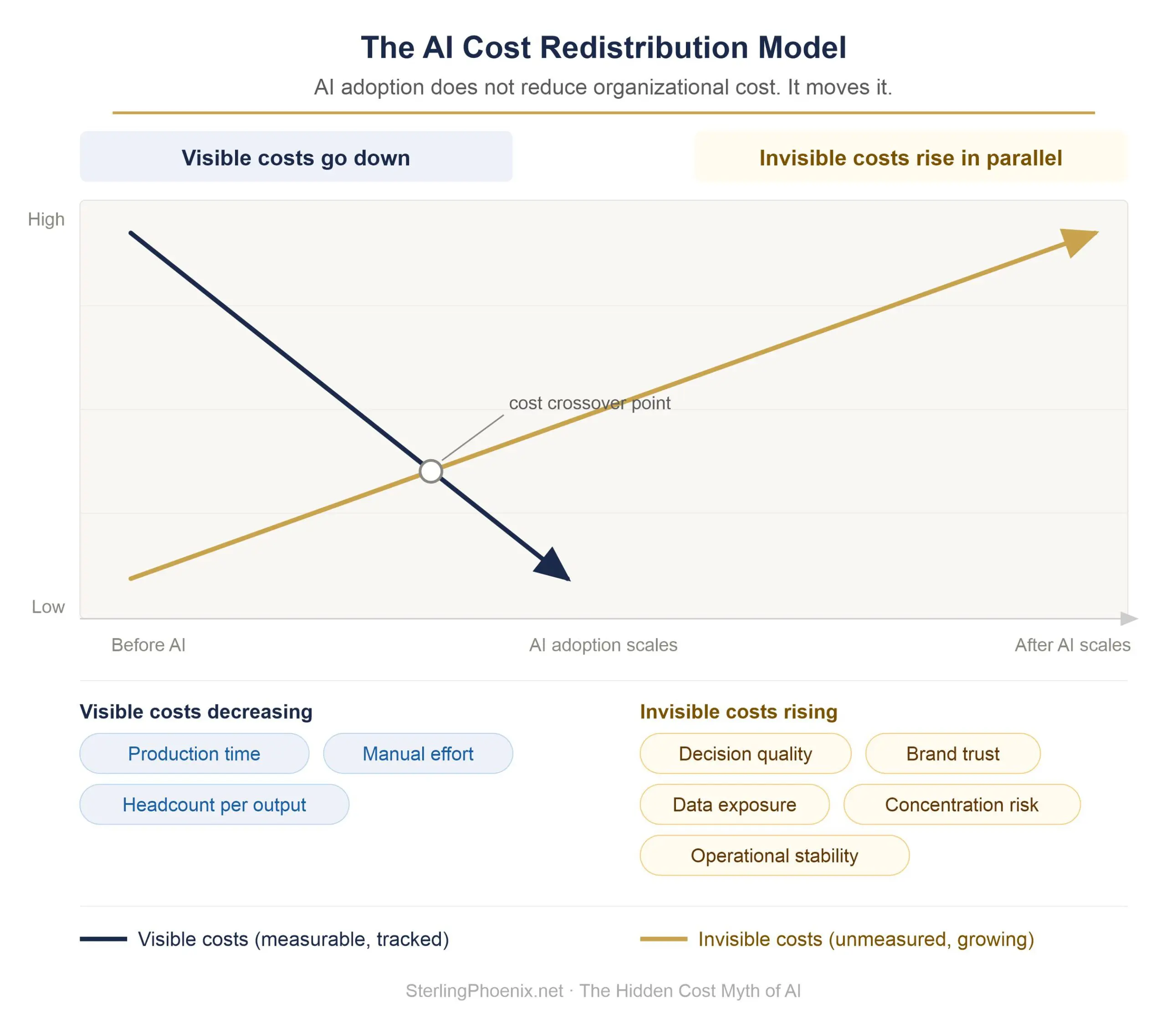
I think of this as the AI Cost Redistribution Model: visible costs go down while invisible costs rise in parallel. The visible costs, including production time, manual effort, and headcount per unit of output, decrease in ways that are easy to celebrate. The invisible costs rise in ways that are easy to miss: decision quality, brand trust, data exposure, operational stability, and capability concentration in people the organization cannot afford to lose.
The cost relocated to where your dashboards aren’t looking.
How to Know Your Costs Have Already Shifted
The shift rarely announces itself. Artificial intelligence (AI) doesn’t send a warning when your cost structure changes underneath your productivity numbers. Recognition requires looking at the right indicators.
These are the signals worth watching:
- Your AI program depends almost entirely on one person’s expertise and institutional knowledge.
- Your team produces more insights than your organization can review, decide on, and act before those insights go stale.
- Employees are using AI tools with different access levels, different standards, and no shared governance connecting them.
- Sensitive client data has probably moved through an AI tool without your explicit knowledge or authorization.
- You measure AI adoption in usage volume rather than outcome quality.
If more than two of those describe your organization, your cost structure has already shifted.
Why These Costs Don’t Show Up Immediately
Artificial intelligence (AI) creates immediate output and delayed consequences. That gap is precisely why the Hidden Cost Myth persists.
Production speed is easy to measure; decision quality reveals itself only in misaligned commitments, damaged client relationships, and revenue lost over months. Brand erosion is visible only in retrospect, often only after a competitor has taken ground. Operational fragility appears only when the one person who understood the AI system is no longer there.
What feels efficient in the moment often becomes expensive later. For a period, sometimes months, sometimes longer, everything looks like a win. The costs that will matter most are accumulating somewhere the dashboards don’t reach.
The Four Areas Where Hidden Costs Actually Live
After four years of building, governing, and diagnosing artificial intelligence (AI) programs inside real organizations, the pattern is consistent. AI costs redistribute into four areas, each with specific texture worth understanding.
Decision Cost. AI lowers the effort required to produce an answer without lowering the risk of acting on a wrong one. When outputs get accepted without validation or treated as authoritative simply because they arrived quickly, the organization starts paying in decision quality.
A sales team that uses AI to respond faster makes a predictable discovery. Speed without validation produces promises that delivery cannot support. Deals close that should never have closed. Commitments get made that the team then walks back. The cost shows up in client relationships, refund conversations, and reputation damage, none of which appear on the AI productivity dashboard.
Bad decisions are among the most expensive costs in any business. Artificial intelligence (AI), deployed without validation discipline, accelerates the pace at which bad decisions get made.
Reputation Cost. Artificial intelligence (AI) produces language that sounds professional, polished, and reasonable. It also removes the specificity, nuance, and actual business truth that make a brand distinct and defensible. The erosion is cumulative rather than dramatic, and it compounds quietly over time.
Several automotive groups discovered this the hard way. Employees were using AI to handle customer inquiries and accelerate sales conversations. New hires were being told to use AI instead of being trained on how the business actually operated. The customer experience began reflecting the model’s best guess rather than the company’s own standards, history, and values. Some of those groups banned AI use entirely, not because the technology failed, but because the cost showed up in places they hadn’t planned to manage: lost sales, brand erosion, and promises that delivery couldn’t support.
Sounding like everyone else is a competitive disadvantage, not a neutral outcome, and reversing it is expensive.
Operational Cost. This is where organizations discover that artificial intelligence (AI) output velocity and organizational absorption capacity are two very different constraints. The constraint AI introduces is organizational absorption capacity, not production capacity. AI can produce insights, analysis, content, and recommendations faster than most organizations can review, decide on, and act. The result is a backlog of unused output and a market that has already moved.
A substantial analysis gets completed and sits for months while internal review cycles run. By the time decisions get made, the conditions the analysis described have changed and a new analysis is required. The productivity gain on the front end became a waste problem on the back end.
There is also a financial dimension most organizations don’t anticipate. A flat-fee license feels unlimited; an application programming interface (API)-based deployment is billed by the token. Those token costs exceed most budgets faster than anyone anticipates. Organizations deploying artificial intelligence (AI) through APIs regularly find that what leadership approved as an annual budget is exhausted in three or four months. Token costs are rising, usage is difficult to govern without explicit system controls, and the investment that cleared one budget cycle becomes an emergency conversation in the next one.
Security and Exposure Cost. This is the cost most organizations underestimate most severely. Artificial intelligence (AI) tools are fast, convenient, and accessible, which means people use them with far less caution than the risk warrants.
Confidential client data gets pasted into public-facing tools. Sensitive financial information, protected health data, and proprietary intellectual property move through systems whose privacy settings haven’t been reviewed or adjusted for the sensitivity of what’s flowing through them. The exposure is often invisible in the moment. By the time it becomes visible, the conversation has moved from risk management to damage control.
Tool fragmentation compounds this problem. In most organizations, AI tool access varies significantly across the team. Some members work with professional-tier accounts; others have basic access or free versions governed by different data handling policies. There are no shared standards for what information may enter which tool, under what conditions, and with what protections. Leaders observe inconsistent output quality without recognizing that the team is working with fundamentally different capabilities under no shared governance.
The Hidden Cost Nobody Names: Concentration Risk
Artificial intelligence (AI) capability, left unmanaged, concentrates inside individuals rather than becoming an organizational asset. In most organizations, one person carries the entire working knowledge of how AI actually functions for the business. That person was rarely given a formal AI mandate; they simply became the de facto expert. Every undocumented workflow, every prompt library, and every governance shortcut lives inside their knowledge rather than the organization’s systems.
When that person leaves, the organization loses more than an employee; it loses the entire undocumented infrastructure of how its AI program functioned. The program stops rather than slowing down, because the institutional knowledge that made it work was never documented.
An AI program that lives inside one person’s expertise is a dependency with an unknown departure date.
How to Manage the Real Costs of AI
Managing these costs requires artificial intelligence (AI) governance built before deployment, not assembled after an incident. If governance isn’t defined before deployment, it will be defined by whatever goes wrong first. Governance built before deployment is infrastructure; governance assembled after an incident is damage control.
The organizations that move fastest with AI build clear governance early. Early decisions made once create a foundation for every deployment that follows.
Define where AI may and may not operate. Not every task should be delegated to AI, and not every team member should access every tool. Decide explicitly where AI creates genuine leverage and where human judgment must remain primary. Document those decisions and make them visible across the team.
Design validation into the workflow before the first output ships. AI output must not move forward without review, context alignment, and named decision ownership. Responsibility for the output belongs to the person who validated it against real business reality. Prompting the tool is not the same as owning the truth of what it produced.
Standardize tool access and shared data standards. Fragmented tool access produces fragmented quality and fragmented governance. The organization needs shared standards for authorized tools, data permissions, and output review. Those standards must live in the workflow at the moment of use, not in a policy document outside it.
Build AI knowledge into the organization’s documented systems, not into individuals. Document the workflows, governance decisions, prompt libraries, and institutional choices that make your AI program work. Treat AI capability as an organizational asset. The goal is a program that survives personnel change, not one that collapses when its architect leaves.
Establish baseline measurements before deployment, not after. Most organizations measure AI adoption by activity: how many people are using it and how often. Activity is not impact. Impact requires a baseline measurement taken before deployment and a comparison taken after, against the same metric. Without the before, you cannot demonstrate the after, and you cannot detect when AI is failing quietly.
The Reality Most Organizations Are Still Missing
Artificial intelligence (AI) changes where cost shows up rather than eliminating it. Most AI cost problems are visibility problems, not spending problems. The organizations that struggle are measuring time saved, output volume, and production speed. Those metrics are real and incomplete in equal measure.
The organizations that win with AI measure decision quality, risk exposure, system stability, and outcome accuracy. They built governance before they needed it. They designed validation into the workflow before the first output went live. They distributed AI capability across the organization before a key person became irreplaceable. They knew where their costs lived before those costs made themselves known the hard way.
The Question That Actually Matters
If you lead artificial intelligence (AI) adoption inside your organization, ask yourself whether you know where your AI costs actually live. Most organizations don’t have an AI cost problem yet; they have an AI cost visibility problem.
Account for the costs before they account for you.