
Summary
Picture the pilot that looked successful six months ago. Now a customer questions an output, and nobody in the room can defend where the data came from or who signed off on the logic. The team that built it covered the gap with personal knowledge and manual corrections. That team has since moved on, and the gap is showing.
Every artificial intelligence (AI) workflow needs eight forms of ownership, even when eight people are not available to hold them. A small company can assign several roles to one person. A larger company can divide one role across a department. The headcount can change. The responsibilities themselves cannot disappear. A missing one eventually returns as an operating problem: unreliable data, unclear approvals, weak outputs, or a result nobody can defend.
These problems usually surface after a pilot already looked successful, the moment the original team’s personal knowledge and manual corrections stop quietly covering the gap. McKinsey found that organizations capturing greater financial value from AI were far more likely to redesign workflows. Workflow redesign carried one of the strongest relationships with real business impact of anything the research tested. MIT Sloan identifies strategy, systems, synchronization, and stewardship as the core requirements for AI maturity. The National Institute of Standards and Technology (NIST) calls for defined responsibilities across management, design, testing, and human oversight. These eight roles turn that guidance into a structure your team can staff.
Know what an AI operating model answers
An AI operating model explains how your company selects, designs, approves, runs, measures, and improves AI-enabled work. It connects strategy to daily execution by answering questions a tool inventory or a policy document cannot. Who decides which problem deserves attention? Who understands how the current work functions? Who builds and maintains the technology? Who reviews outputs and handles exceptions? Who can change or stop the workflow? The eight roles below give you a dependable way to move an idea into controlled production.
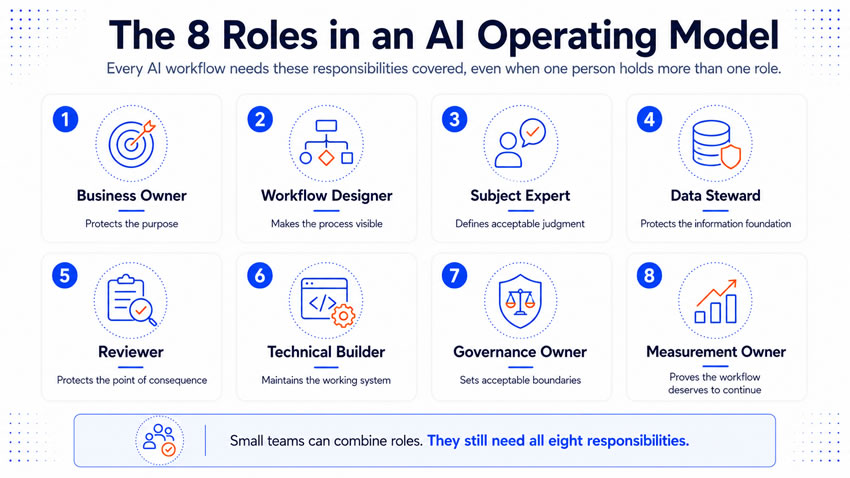
Role one: let the business owner protect the purpose
The business owner stays accountable for the outcome the workflow was built to improve, whether that is revenue, cycle time, or risk. They should understand the business problem before anyone discusses models or automation platforms. They decide whether the work deserves continued investment. This role defines the problem in business terms and approves the users and boundaries. It resolves conflicts between departments, and it holds the authority to pause or retire the workflow entirely.
A strong owner also protects the project from solution-first thinking. That is the moment an employee discovers an impressive AI capability and starts hunting for somewhere to use it. The owner should pull the conversation back to the actual business need every time that happens. Without this role, projects tend to drift into technology demonstrations. The team ends up measuring model activity because nobody defined the business outcome. Deloitte found greater reported value when senior leaders actively shaped AI governance themselves. Value dropped when that work got delegated entirely to technical teams.
Role two: let the workflow designer make the process visible
The workflow designer examines how work moves across people, decisions, and systems. This role exists specifically to stop the team from automating one visible task while ignoring everything around it. A model can summarize a document in seconds. An employee still spends an hour finding it, checking facts, and routing the result. That hour is exactly what this role is supposed to find.
The designer should observe real work directly rather than trust interviews alone. Employees describe the intended process. Observation reveals the practical one they follow under deadline pressure. Personal workarounds belong in that map too. That includes a private spreadsheet kept because the system is missing one field, or a quiet call to a subject expert before approving anything unusual. Without this role, companies typically automate the most visible task. They gain speed in one step while the complete process barely changes. MIT Sloan argues that AI creates real value through workflow redesign specifically, including the sequence and handoffs between people and machines. That is exactly what this role makes visible before you commit real investment.
Role three: let the subject expert define acceptable judgment
The subject expert understands the work well enough to recognize a correct, useful, and defensible result. They translate that professional judgment into instructions, examples, and exception rules a system can follow. “Make it better” cannot guide a builder or a reviewer. A usable standard names required evidence, appropriate tone, and a recommended next action instead.
This role should help build a real decision table. It needs the condition the workflow must recognize, the evidence required, the approved action, and who holds override authority. An account prioritization workflow illustrates this well. It needs defining how fit, buying signals, and recent engagement should weigh against each other. Without that guidance, a model will happily overvalue whatever activity is easiest to detect and ignore the commercial context that matters. Without this role, a workflow can pass every technical test while still producing weak business decisions. The tests never represented the difficult cases employees face. Expertise needs to stay active after launch too, since policies and market conditions keep changing underneath the workflow.
Role four: let the data steward protect the information foundation
The data steward makes sure the workflow receives information it can legally and practically use. This covers quality, access, source authority, and lifecycle management together. AI failures often get blamed on the model when the real problem started with incomplete or conflicting source data. This role identifies the authoritative sources, defines required fields, and monitors completeness. It also manages what happens when two records disagree.
The steward should work closely with the workflow designer. The designer names what information the process needs. The steward determines whether that information exists and can support the approved use. Testing should cover strong, typical, and weak inputs together, with a defined response for each: proceed, request more information, or refuse processing outright. It should never fill an important gap through unsupported inference. Without this role, a workflow can quietly receive broader access than its purpose requires. A source change can degrade quality without ever producing a visible technical failure anyone would catch.
Role five: let the reviewer protect the point of consequence
The reviewer examines outputs or actions before they create unacceptable exposure. They apply a defined quality standard rather than a vague instruction to “check it.” The right model depends on business impact and reversibility. Full review applies before every release. Conditional review triggers on risk. Sampled review supports ongoing quality, and exception-only review fits once normal cases have earned lighter touch. One workflow can reasonably use several of these at once, routine classifications running automatically while customer commitments still require approval.
This role needs real authority and real available time. Assigning review to an already overloaded manager creates an unmanaged queue with a person’s name attached to it. The reviewer should record the decision, the error category, and the reason for every material change. That turns human review into evidence rather than only a gate. Without this role, errors reach downstream employees or customers before anyone notices. Employees may quietly perform informal review without recording anything, so the workflow ends up looking more dependable than it is. NIST calls for exactly this kind of defined human oversight and clear human-AI configuration.
Role six: let the technical builder maintain the working system
The technical builder turns the approved workflow into a dependable technical process, configuring the complete system rather than one isolated model call. This role selects components, connects source and destination systems, and applies permissions. It also builds the logs and monitoring that make failures visible instead of silent. The builder should understand the business design before choosing the architecture. A technically elegant system can still fail the moment it ignores how employees complete the work.
Testing needs to go well past ideal examples: peak demand, expired credentials, duplicate events, and partial failures. Each needs a defined response, retry, pause, alert, or a return to manual processing. Without this role, workflows that function fine during a demonstration lack real production controls. Connections fail silently, logs quietly expose sensitive information, or the whole thing depends on one employee’s personal account that nobody documented.
Role seven: let the governance owner set acceptable boundaries
The governance owner coordinates the decisions responsible AI use requires, applying security, privacy, legal, and compliance requirements to one specific workflow. This means making sure the right specialists participate and that their decisions become real operating instructions, not holding every kind of expertise personally. Controls should scale with exposure. A low-risk internal drafting assistant needs nowhere near the process an autonomous financial decision system requires. MIT Sloan describes exactly this as minimum viable governance: oversight calibrated to risk and embedded inside the workflow rather than bolted on top of it.
A practical risk assessment weighs data sensitivity, decision impact, system autonomy, audience, and reversibility together. Greater exposure should produce stronger approval and monitoring requirements. Without this role, governance decisions arrive late, after your team has already built the workflow. Several departments may review the same issue without anyone consolidating the decision. Deloitte’s research connects active governance leadership with meaningfully greater business value than leaving it to technical teams alone.
Role eight: let the measurement owner prove the workflow deserves to continue
The measurement owner defines how your company will judge performance, value, quality, and risk. This role exists specifically to stop the project from relying on generated volume or estimated hours saved as if that were evidence. It needs to participate before launch, since a meaningful baseline requires real data from the previous process, not a reconstruction after the fact.
The scorecard should separate business outcomes from operating measures. A sales workflow might use qualified pipeline as its primary outcome, supported by cycle time, correction rates, and adoption underneath it. A practical scorecard covers five areas: the business result that justified the investment, workflow performance, quality, and risk. Financial performance measured against the complete operating cost rounds it out. Without this role, teams measure whatever the platform makes easy to report, generated words or active users. Leadership can end up funding a popular workflow for years without ever understanding what it contributes.
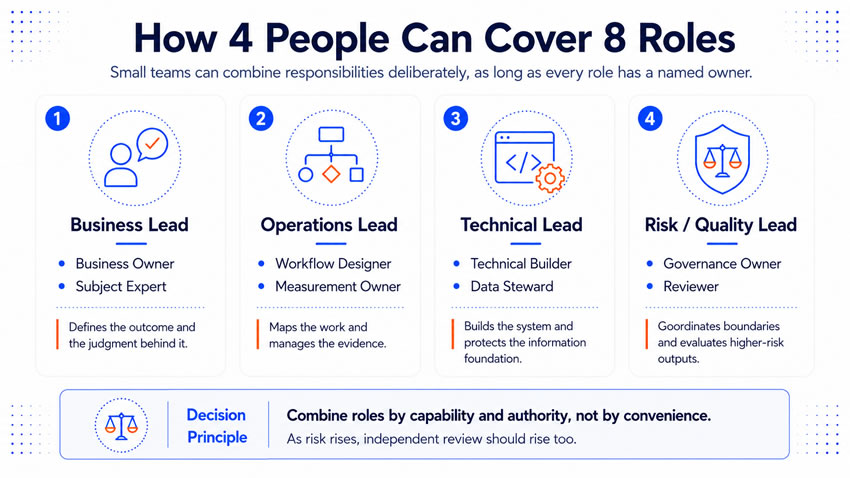
Cover eight roles with four people
A small team does not need eight full-time specialists. It needs a deliberate assignment for every responsibility, based on capability and authority rather than convenience. A practical structure splits the work across four people. A business lead can serve as business owner and subject expert, defining the result and providing operating knowledge. An operations lead can serve as workflow designer and measurement owner, mapping the process and managing the evidence. A technical lead can serve as technical builder and support the data steward, building and maintaining the system itself. A risk or quality lead can serve as governance owner and reviewer, coordinating approvals and evaluating higher-risk outputs.
This arrangement works when each person has enough knowledge and capacity for their combined roles. It becomes dangerous the moment one person controls every decision without any independent check. The technical builder should not approve their own security decisions on a higher-risk workflow. The business owner should not get to declare value without evidence reviewed by someone who understands the measures. Let independent review grow as risk grows, not stay fixed regardless of it.
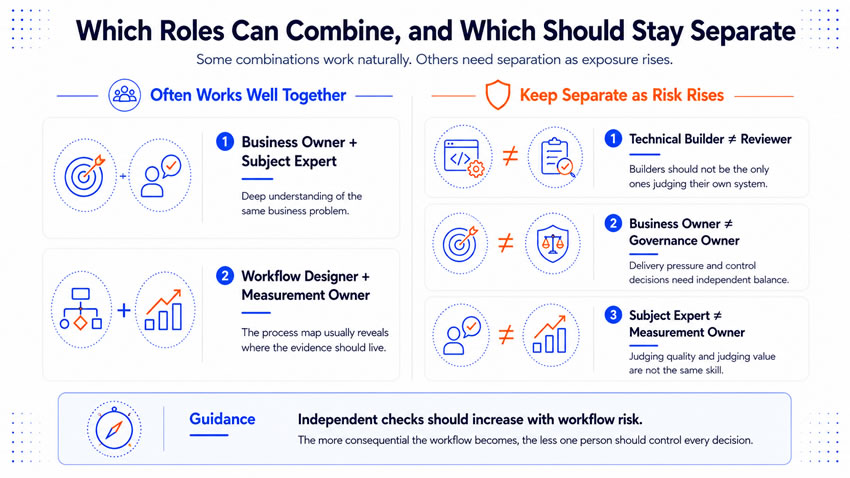
Know which roles should stay separate
Some combinations genuinely work well. The business owner and subject expert often pair naturally, since both need deep understanding of the same problem. The workflow designer and measurement owner combine well too, since the same person who understands the process usually knows where the evidence should live.
Other combinations create real conflicts as exposure rises. The builder should not become the only reviewer, since the person who built the system has the hardest time noticing its own unexpected failures. The business owner should not control every governance decision alone, since delivery pressure and compliance requirements can genuinely pull in opposite directions. The governance owner needs independent authority to pause an unsafe launch regardless of the business owner’s preference. The subject expert should not define value alone either, since judging quality and judging financial return are different skills entirely. The measurement owner should not depend only on vendor reports. A vendor’s own activity numbers were never designed to answer your company’s real business question.
Keep ownership visible with a responsibility matrix
Give every workflow record one person for each of the eight roles and the deliverable that role owns. That means the business owner’s business case, the workflow designer’s process maps, and the subject expert’s decision rules. It also means the data steward’s access rules and the reviewer’s correction records. The technical builder’s working configuration, the governance owner’s risk classification, and the measurement owner’s scorecard round out the set. The same name can appear more than once across the matrix. Every row still needs a name attached to it, plus a backup for anything that genuinely cannot wait for someone to get back from vacation.
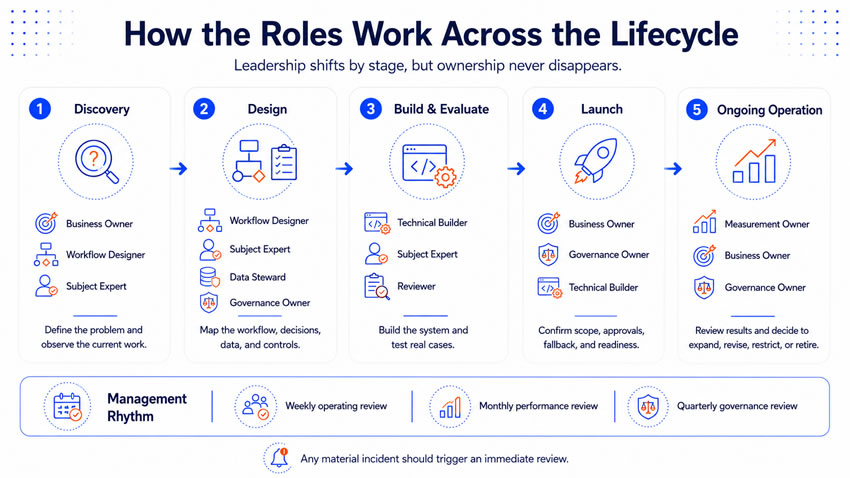
Watch how the roles work together across the lifecycle
During discovery, the business owner leads while the workflow designer observes the process and the subject expert explains the judgment inside it. During design, the workflow designer leads with the subject expert and technical builder. The data steward confirms information availability, and the governance owner names required controls before the design locks in. During build and evaluation, the technical builder leads while the subject expert supplies test cases and the reviewer applies the quality standard. During launch, the business owner resumes leadership, confirming scope and fallback procedures while the governance owner confirms approvals. During ongoing operation, the measurement owner coordinates the evidence. The business owner decides whether to expand, revise, restrict, or retire the workflow based on what that evidence shows.
Three recurring meetings can carry most of this without adding new bureaucracy. A weekly operating review covers demand, failures, and immediate corrections, with the business owner, designer, builder, and reviewer present. A monthly performance review examines business results, adoption, and cost, prepared by the measurement owner. A quarterly governance review examines changes to data, tools, models, and business purpose, coordinated by the governance owner. Higher-risk workflows earn more frequent attention, and any material incident should trigger an immediate review regardless of the calendar.
Run this 30-day plan to assign the eight roles
Week one. Choose one workflow with repeatable demand and an engaged business owner. Document the purpose, scope, and expected outcome, and name all eight role owners, including any overlaps.
Week two. Document the operating design: inputs, decision points, exceptions, and fallback process, plus the data inventory and risk classification.
Week three. Test the responsibilities directly. Run representative cases through the workflow and confirm every person knows when they act, what evidence they receive, and what authority they hold.
Week four. Establish the management rhythm. Build the scorecard, issue log, and review calendar, set thresholds for expansion and pause, and hold the first operating review before wider deployment.
What you tell them at the end
AI budgets tend to focus on software and infrastructure. Your operating model quietly needs real time from business owners, subject experts, reviewers, and measurement owners too. A subject expert needs time to build examples. A reviewer needs enough capacity to meet a real response deadline. A measurement owner needs reliable business data to work from.
None of this stays invisible for long once it is underfunded. It shows up as delay, weak controls, and disappointing results that get blamed on the technology instead of the missing role. An empty role rarely stays empty. The work falls to whoever is nearest, usually without the authority, training, or recognition the job needed. Naming the eight roles gives you a real starting point. Funding them gives the workflow an honest chance to become dependable operating capacity instead of a permanent improvisation.