
Summary
AI is not creating a strategy problem for most organizations. It is creating a decision system problem.
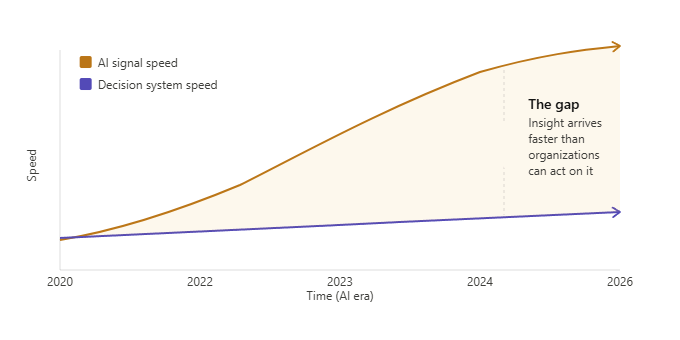
The speed at which AI generates insight has outpaced the speed at which most organizations can act on it. Analysis that once took days now takes minutes. But the decision infrastructure most companies operate on was built for a world where information moved slowly. That mismatch is now one of the most significant and least discussed constraints of the AI era.
The Bottleneck AI Just Made Visible
Walk into almost any senior leadership meeting and you will hear some version of the same frustration. The market is moving faster. Competitors are shipping faster. Customer expectations are shifting constantly. Inside the organization, however, the pace of decision-making has not changed.
Proposals circulate. Approvals are requested. Meetings are scheduled to gather more stakeholder input. By the time the organization commits to a direction, the opportunity it was chasing has evolved or disappeared entirely.
AI did not create this problem. It made the cost of it impossible to ignore. When insight arrives in real time and decisions still take weeks, the gap between organizational capability and organizational performance becomes visible in ways it never was before.
The False Diagnosis Most Leaders Accept
Leaders often attribute slow decision-making to culture, risk tolerance, or leadership style. These factors matter at the margin. They are not the governing constraint.
The governing constraint is structural. Most organizations are operating decision systems designed for environments that no longer exist. In slower markets, thorough deliberation and broad consensus were genuine assets. A well-analyzed decision delivered after three weeks of review was often the right outcome.
That logic does not survive contact with an AI-accelerated environment. A well-analyzed decision delivered three weeks late is not a quality decision. It is a missed opportunity with excellent documentation. The environment changed. The decision system did not.
Decision Architecture: The Governing Framework
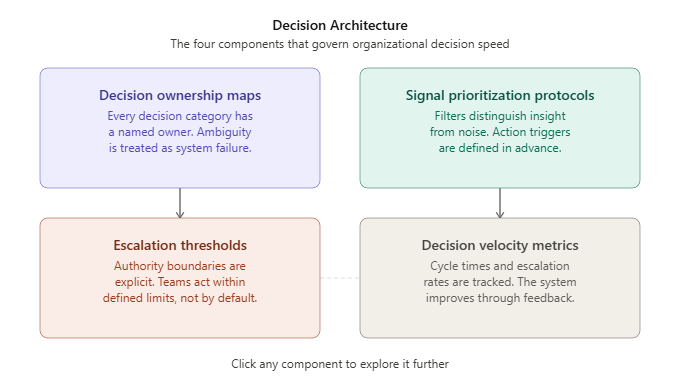
High-performing organizations in the AI era do not rely on informal decision processes. They build Decision Architecture, the structural system that determines who owns which decisions, what signals trigger action, when escalation is genuinely required, and when teams are authorized to move without approval.
Decision Architecture is the pillar that controls organizational speed in an AI environment. AI systems generate signal continuously. Coordination systems align effort across functions. But Decision Architecture determines whether any of that signal converts into movement. Without it, AI produces faster analysis that feeds the same slow system. The bottleneck does not disappear. It becomes more expensive.
The framework has four components.
Decision Ownership Maps. Every consequential decision category has a clearly identified owner. Ownership is documented, communicated, and reinforced at every level of the organization. Ambiguity in ownership is treated as a system failure. When teams do not know who owns a decision, they escalate by default, and escalation defaults to delay. In an AI environment where decisions surface faster and more frequently, unresolved ownership becomes a compounding drag on execution speed.
Signal Prioritization Protocols. AI dramatically increases the volume of available insight. Without explicit filters for prioritizing that signal, leaders cannot reliably distinguish what requires immediate action from what can wait. Decision-making slows not from lack of information but from excess of it. Signal prioritization protocols define which categories of insight trigger which decision pathways, so the organization responds to what matters rather than processing everything equally.
Escalation Thresholds Tied to Ownership. Most organizations have developed an escalation culture where teams defer upward not because a decision genuinely requires senior judgment, but because ownership boundaries were never clearly drawn. When teams do not know the precise edge of their authority, every significant decision becomes someone else’s responsibility. A small group of executives then absorbs decision volume that should be resolved one or two levels below them. Escalation thresholds work only when they are anchored to ownership maps. Authority without a defined boundary is not authority. It is ambiguity operating under a different label.
Decision Velocity Metrics. What gets measured gets managed. Organizations that track decision cycle times, escalation rates, and decision reversal frequency develop a feedback loop that continuously improves system performance. Speed comes from structure, not urgency. Metrics make the structure visible and create the accountability needed to sustain it.
What AI Deployment Gets Wrong
Most AI deployment strategies focus on tool adoption: which platforms to implement, which workflows to automate, which functions to augment. This framing misses the deeper organizational requirement.
AI increases the velocity of insight. It surfaces patterns faster, generates analysis faster, and flags signals faster than any human team operating manually. Companies that integrate AI into fast, structured decision systems gain compounding leverage from all of that speed. Companies that deploy AI without redesigning Decision Architecture simply produce more analysis flowing into the same slow decision infrastructure.
The pattern Gartner and McKinsey have both identified in their research on organizational agility is consistent: the organizations that extract the most value from AI investment are not the ones with the most sophisticated tools. They are the ones with the clearest decision systems underneath those tools. AI increases signal speed. Only Decision Architecture increases decision speed.
The Competitive Implication
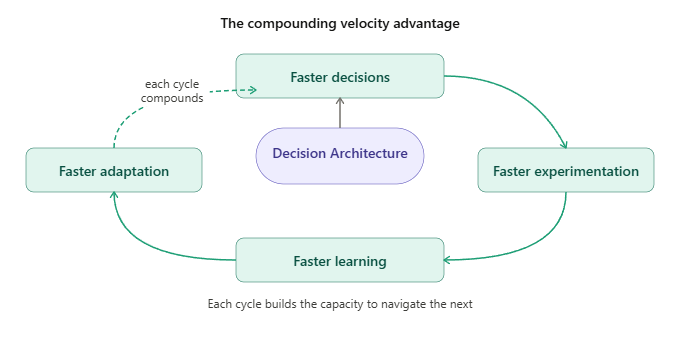
Organizations that consistently outperform competitors share a structural capability that rarely gets named as precisely as it deserves. They decide faster, and that speed compounds.
Faster decisions produce faster experimentation. Faster experimentation produces faster learning. Faster learning produces faster adaptation. Each cycle strengthens the organization’s capacity to navigate the next one. In markets where AI is accelerating competitive tempo across entire industries simultaneously, this compounding effect is not a minor advantage. It is the difference between organizations that shape their competitive environment and organizations that perpetually respond to it.
Strong Decision Architecture does not require a perfect strategy. It requires a clear enough strategy to act on, combined with the structural capacity to learn and adjust before competitors can respond.
Diagnostic Questions for Leaders
Leaders who want to assess their organization’s decision velocity in the context of AI adoption can begin with four observations.
Do teams regularly wait for executive approval before acting on decisions that fall clearly within their defined authority? Do proposals require multiple meetings before a direction is confirmed? Are senior leaders consistently overwhelmed by the volume of decisions requiring their personal involvement, even as AI is generating more insight than ever before? Do teams hesitate to act because ownership boundaries are genuinely unclear?
If the honest answer to any of these is yes, the organization is experiencing measurable decision friction. AI investment will not resolve it. The constraint is not leadership capability. The constraint is decision architecture, and redesigning it is a leadership responsibility that no tool can substitute for.
The Strategic Implication
AI is changing the operating conditions of leadership. It is accelerating the speed of insight, the volume of decisions, and the competitive tempo of entire markets simultaneously.
Organizations that respond by adopting AI without redesigning their decision systems are not transforming. They are accelerating into the same structural constraints they already had. The defining leadership capability of the AI era will not be strategic brilliance in isolation. It will be designing decision systems that allow organizations to act quickly and intelligently under sustained uncertainty.
The organizations that win will not simply think faster. They will decide faster.