
Summary
When leadership decisions fail, organizations tend to reach the same conclusion: the leaders were not good enough. The diagnosis feels logical. It is also frequently wrong.
The constraint showing up inside high-performing leadership teams is not competence. It is cognitive capacity.
Leaders are being asked to process more complexity than the human system was designed to absorb. When that limit is exceeded, decision quality declines regardless of how capable, experienced, or committed the leadership team is.
This is not a character problem. It is a structural one.
The Invisible Work at the Top
There is a persistent gap between how decisions look from the front line and how they function inside leadership.
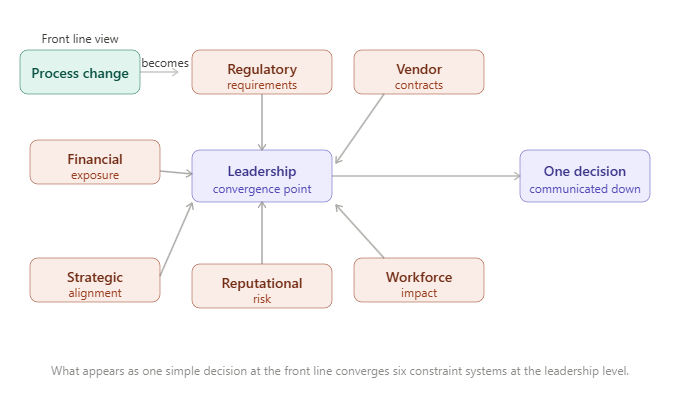
A frontline team member experiences a decision as a localized event: a process change, a vendor adjustment, a shift in staffing. The issue feels contained. The solution often seems obvious. Leadership, by contrast, experiences the same decision as an intersection point across multiple systems simultaneously.
A single operational change can carry implications across financial exposure, regulatory compliance, union agreements, vendor contracts, workforce morale, customer or patient safety, and long-term strategic alignment. What appears simple at the point of execution often represents the convergence of six or seven competing constraints at the leadership level.
In healthcare organizations, clinical staff frequently describe leadership as slow or disconnected. Decisions that seem urgent and obvious from the floor appear to stall inside leadership. What looks like indifference from one vantage point is often something more structural: leaders processing the same decision across cascading systems, many of which are invisible to the people most affected by the outcome.
Leaders function as complexity integrators. They absorb competing inputs from multiple domains and reconcile them into coherent organizational direction. Most of that work remains invisible to everyone outside the leadership layer.
Cognitive Throughput: The Constraint Leadership Has No Name For
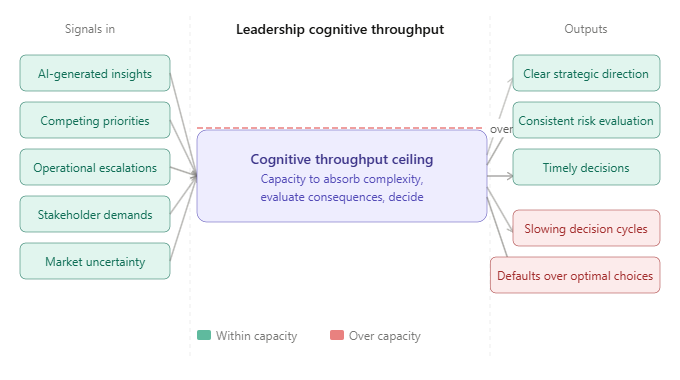
Every leadership team has a practical ceiling on the volume of complex decisions it can process while maintaining the quality of judgment required to lead effectively.
That ceiling defines the Cognitive Throughput of Leadership: the maximum rate at which leaders can absorb complexity, evaluate consequences, and produce sound decisions.
Organizational throughput defines the rate at which the organization can convert signals into coordinated action. Leadership cognitive throughput defines the human constraint inside that system. When leadership cognition becomes overloaded, the entire operating system slows regardless of how well the surrounding structures are designed.
Unlike operational throughput, cognitive throughput cannot be expanded indefinitely by adding hours, increasing headcount, or scheduling more meetings. Human judgment requires sustained attention, information synthesis across domains, and the cognitive space to weigh consequences before committing to a course of action.
When leadership teams push beyond their cognitive throughput threshold, a predictable set of symptoms appears:
- Decision cycles lengthen, even when strategic direction is clear.
- Risk evaluation becomes inconsistent, with some issues receiving deep scrutiny and others passing without adequate examination.
- Leaders begin defaulting to familiar options rather than evaluating optimal ones.
- Escalation volumes increase as decisions that should be resolved downstream surface repeatedly at the top.
- Meeting frequency rises while decision output slows.
These symptoms are regularly interpreted as evidence of weak leadership. In many cases, they are evidence of a structural overload condition. The system is placing more complexity on the leadership layer than the human processing architecture can sustain.
How AI Expands the Decision Surface
Artificial intelligence is most often described as a tool that reduces decision burden. Inside operating organizations, the reality is more complicated.
AI systems now generate insights, forecasts, risk assessments, optimization scenarios, and predictive models at a scale that did not exist several years ago. The analytical layer of the organization has become dramatically more powerful. Leaders are presented with a volume of intelligence about potential actions, emerging risks, and strategic alternatives that would have been unimaginable in a pre-AI operating environment.
The result is not fewer decisions. It is a larger decision surface.
As AI accelerates insight generation, organizations begin expecting leadership decisions to accelerate as well. The result is pressure to move faster at precisely the moment when the complexity of each decision is increasing.
Leaders must now determine which AI-generated signals carry strategic weight. They must evaluate which models are reliable and which carry hidden assumptions that distort their outputs. They must prioritize which opportunities merit organizational attention and which risks require mitigation versus monitoring. Each of these meta-decisions requires judgment, and each adds to the total cognitive load the leadership layer must carry.
McKinsey’s research on AI adoption consistently identifies a gap between the rate at which organizations generate AI-driven intelligence and the rate at which leadership can act on it effectively. The analytical capability of the organization accelerates. The human capacity to convert intelligence into sound decisions does not accelerate at the same rate.
This asymmetry is becoming one of the defining structural constraints of the AI era.
The Paradox of More Intelligence
There is a paradox embedded inside AI transformation that most organizations have not yet named clearly.
As the organization’s analytical capability increases, the cognitive load placed on leadership increases in proportion. More intelligence means more possibilities to evaluate. More possibilities require more judgment to prioritize. More judgment requires more cognitive capacity to sustain.
Organizations gain unprecedented visibility into their environment. At the same moment, the leadership layer faces growing difficulty converting that visibility into clear and timely strategic decisions.
Insight generation accelerates. Judgment capacity does not.
The gap between those two rates becomes a structural drag on organizational performance. The organization can see more clearly than it can move. Leadership becomes the bottleneck, not because leaders are failing, but because the architecture surrounding leadership was not designed for the volume of complexity now passing through it.
As AI scales analytical output, the gap between what organizations can see and what leaders can decide becomes the binding constraint.
Why Talent Alone Cannot Solve This
The instinctive response to a leadership performance problem is to upgrade the leadership. Hire stronger executives. Develop better decision-making skills. Invest in leadership training.
These interventions address individual capability. They do not address structural load.
Even highly capable leaders have cognitive throughput limits. A leadership team composed entirely of exceptional individuals will still encounter throughput constraints when the volume of complexity passing through them exceeds the collective processing architecture.
Talent is not a substitute for system design.
This is one of the central insights the Leadership Operating System is built to address. High-performing organizations do not simply recruit exceptional leaders and expect results. They design systems that protect and amplify leadership judgment across the full complexity range the organization must navigate.
The Leadership Operating System and Human Systems
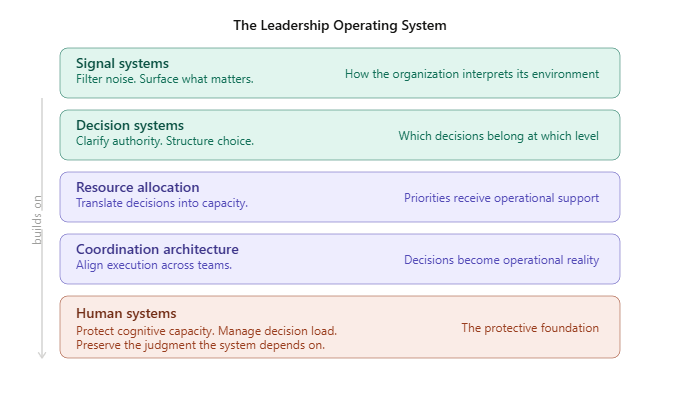
The Leadership Operating System describes the full architecture of systems leaders must build to sustain organizational performance under modern operating conditions. It comprises five layers.
Signal Systems govern how the organization interprets its environment. Effective signal systems filter noise, surface meaningful information, and ensure the right intelligence reaches the right leaders without overwhelming the layer with irrelevant inputs.
Decision Systems structure how choices are evaluated. They clarify which decisions require leadership attention, which decisions can be resolved at lower levels of the organization, and what process governs high-stakes choices.
Resource Allocation Architecture translates decisions into operational commitments. It ensures that strategic priorities receive the organizational capacity required to execute and that resources do not continue flowing toward outdated priorities.
Coordination Architecture aligns execution across teams. It prevents the organizational fragmentation that emerges when leaders make sound decisions that are never effectively implemented at the operational level.
Human Systems protect the cognitive capacity of leaders themselves. This layer manages decision load, preserves the attention required for high-quality judgment, and designs the operating conditions under which leadership thinking can function effectively.
Without the Human Systems layer, the rest of the architecture eventually collapses under the weight of the complexity it is designed to process. A well-designed decision system still fails if the leaders operating it are cognitively overloaded.
Diagnosing Cognitive Throughput Constraints in Your Organization
Organizations experiencing leadership cognitive overload tend to display a recognizable pattern.
Leadership teams spend increasing proportions of their time in meetings attempting to reconcile competing signals. Decision cycles lengthen even when the strategic direction is understood. Teams experience delays not because leadership is paralyzed by disagreement, but because the volume of issues requiring integration exceeds the available attention the leadership layer can sustain.
Escalation increases. Leaders who should be spending time on strategic priorities find themselves drawn back into operational complexity because the systems below them lack the authority or clarity to resolve issues independently.
Leaders in these environments often describe a sense of chronic behind-ness. They are never caught up. The volume of significant decisions requiring attention always exceeds the time available to address them with appropriate care.
These are not personality or motivation problems. They are signals of a cognitive throughput constraint that the operating system has not been designed to address.
What Leaders Must Do Differently
Addressing cognitive throughput requires deliberate system design in three areas.
Design signal systems that protect leadership attention. Not all information that reaches leadership should reach leadership. Effective signal architecture defines what constitutes a signal worth leadership time, at what threshold operational data should escalate, and how the organization distinguishes between noise and meaningful strategic intelligence. Leaders who receive everything make very few decisions well.
Distribute decision authority to its correct level. One of the most significant sources of cognitive overload in leadership is the accumulation of decisions that should be resolved further down the organization. A clear decision system defines which choices require the leadership team and which choices belong at operational levels. Each decision appropriately delegated reduces the cognitive burden on the layer that must carry the most complex ones.
Build governance around cognitive load, not calendar availability. Most organizations schedule leadership attention by meeting availability. High-complexity decisions are allocated whatever time remains after recurring commitments are filled. Organizations that sustain high decision quality build governance structures that allocate leadership attention according to the cognitive demands of the decisions at hand, not the patterns of existing calendars.
These are not leadership behaviors. They are system design decisions. They require intentional organizational architecture, not better personal habits.
The Strategic Implication
The defining challenge of leadership in the AI era is not simply choosing the right strategy. It is preserving the capacity of the people responsible for strategic decisions to make them well.
AI will continue expanding the analytical capability of organizations. The volume of signals, insights, and strategic possibilities will increase. The cognitive demands placed on leadership will increase in proportion.
Human judgment capacity will not expand at the same rate.
Organizations that design their systems to protect leadership cognitive throughput will maintain decision quality as complexity scales. Organizations that ignore this constraint will encounter an increasingly familiar outcome: more information, more analysis, more meetings, and slower strategic movement.
The organizations that succeed in this environment will not be the ones with the smartest leaders. They will be the ones that build operating systems designed to protect the cognitive capacity that leadership judgment requires.
That is not an insight about individual performance. It is an insight about organizational design.
The leaders who understand that distinction are already redesigning how their organizations operate.