Summary
Picture two vendor demos back to back this week. One is a specialized tool with a beautiful interface built for exactly your sales team’s workflow. The other is the platform your technology team already maintains, less polished but already connected to everything else you run. The specialized tool wins the room on looks. Nobody in the room has asked whether it earns the complexity it adds.
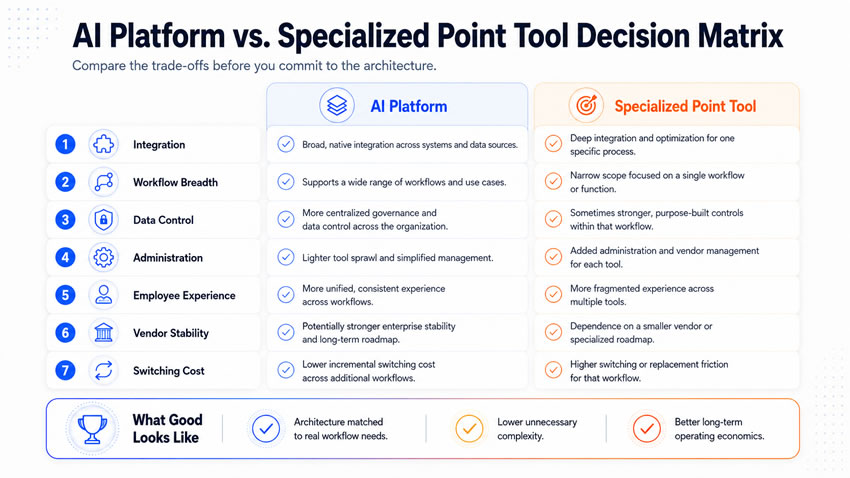
An artificial intelligence (AI) platform provides shared capabilities that can support several workflows, teams, and data sources at once. A specialized point tool solves a narrower business problem through a purpose-built product and user experience. Either choice can produce strong results. The operating consequences differ across integration, data ownership, administration, employee adoption, and vendor dependence.
Major enterprise platforms now combine model catalogs, evaluations, agent tools, and governance controls in one place. Amazon Bedrock and Microsoft Foundry show what this broader approach looks like in practice. Those shared capabilities can reduce repeated technical work across several use cases. They do not guarantee that employees receive a product suited to their daily responsibilities. A specialized tool earns its place only when it produces enough additional business value to justify the operational burden it adds.
Know that a shared foundation and a prepared application solve different problems
A platform gives you common services for building, connecting, and monitoring AI-supported workflows: model access, retrieval, identity controls, logging, and deployment management. It usually sits beneath the employee experience, so business teams interact with applications built on top of it while a technology team maintains the foundation. That reuse can create real long-term value, but it requires internal capacity to design and maintain the solutions employees need.
A point tool delivers an application built around a specific function or industry, sales call intelligence or contract review, for example. The vendor handles much of the workflow design, so you do not need to recreate every interface and evaluation standard from scratch. The tool still becomes part of your operating environment. It needs its own data controls, identity management, integration, and exit plan, exactly like anything else running inside the business.
Neither category carries an automatic advantage. You have to determine which operating model fits the current need and the future portfolio, not only this quarter’s project.
Use the Portfolio Fit Score as your core thesis
A defensible choice runs through three layers. Mandatory gates disqualify unsuitable options before scoring begins. A weighted scorecard compares what survives. A premium rule keeps a specialized tool honest about the complexity it adds.
Layer one: run it through mandatory gates
Some requirements should never trade off against a good demonstration. A solution should meet your company’s data requirements, support required identity controls, integrate with the system of record, and provide usable data export. It should meet the minimum workflow quality standard, support required review and audit records, fit the approved risk level, and have a workable continuity plan. A point tool that fails a mandatory gate has not earned its place, and a platform failing the same gate deserves the identical answer. The National Institute of Standards and Technology (NIST) recommends documenting controls for third-party AI technologies and building contingency processes for high-risk vendor failures. That is exactly what these gates exist to force before anyone gets attached to an interface.
Layer two: run the weighted scorecard
Once both options clear the gates, score each one from one to five against seven weighted criteria totaling 100 points. Workflow performance carries the most weight at 20 points. A solution that cannot complete representative work to the required standard fails regardless of everything else. Integration fit and workflow breadth each carry 15 points. Integration measures whether the process completes without manual transfers, and breadth measures whether you can reuse the capability across related workflows. Data control carries another 15 points, and a failure here should block approval outright rather than lower the score. Administration, employee experience, and vendor stability each carry 10 points. That covers identity and role management, real workflow fit and adoption, and the vendor’s financial and technical continuity. Portability and switching cost carry the remaining five points, reflecting data export, standard formats, and fallback options.
A specialized point tool may score lower on breadth without becoming unsuitable, since its workflow performance can justify the narrower reach. That tradeoff is the entire point of scoring the criteria separately instead of averaging them into one number.
Layer three: apply the point-tool premium rule
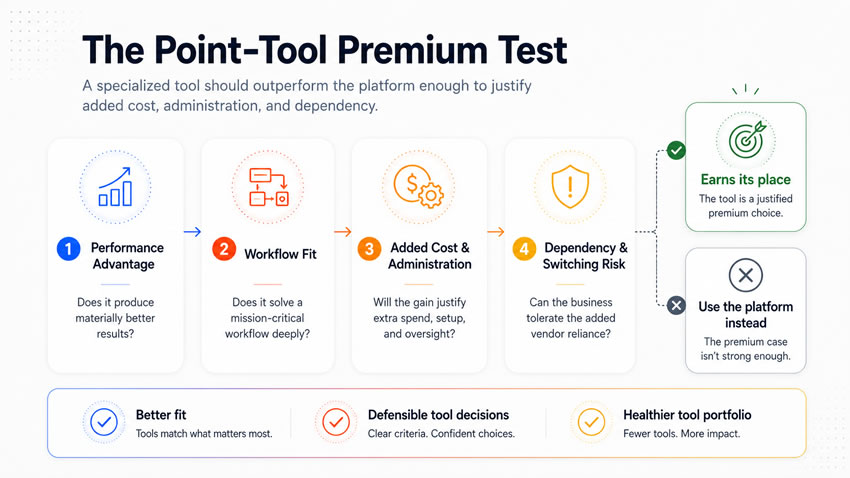
A specialized tool should demonstrate a clear advantage over the platform option, not only a preference. Three conditions should all hold before you approve it. First, the tool passes every mandatory gate. Second, it scores at least 10 points higher than the platform option on workflow performance and employee experience combined. Third, its complete annual value exceeds its additional operating cost by an agreed margin. This rule stops a department from buying another product over a modest interface preference. It also stops platform standardization from blocking a tool with a genuine domain advantage. Specialization should pay for the complexity it introduces, not excuse it.
Watch how the score plays out across your functions
Marketing can run research, retrieval, and workflow automation on a shared platform across several teams and content types. A specialized tool earns its place for technical search analysis or large-scale regulated content review. It should combine approved sources, brand rules, and publication review into one workflow, not only produce a similar draft through a nicer editor.
Sales can connect account data, engagement history, and public research through a shared intelligence layer that several workflows reuse. A conversation intelligence tool earns its place through call capture, coaching, and relationship management updates, provided it improves coaching or conversion and not only transcription.
Finance should favor control and traceability over polish. A shared platform can support extraction and variance analysis. A specialized finance tool may justify itself through deeper record matching, audit trails, and approval workflows. A well-designed assistant provides limited value when your finance team cannot trace the source and decision history behind a number.
Operations should compare repeatability against exception depth. A shared platform can handle classification and routing across several teams. A specialized tool earns its place when industry-specific scheduling or safety logic reduces implementation risk more than a platform-built alternative would.
Give a temporary point tool an explicit transition decision
Companies sometimes adopt a specialized tool because the central platform team cannot deliver fast enough. That can work, as long as leadership names the arrangement as temporary from the start. The approval should name the approved user group, the allowed data, the measurement period, the decision date, and the person responsible for the transition. A temporary product becomes permanent through inattention far more often than through a deliberate choice. Employees build habits and data accumulates while nobody revisits the original plan. The transition decision should happen before the renewal deadline, not after migration has quietly become too expensive to attempt.
Run this 30-day evaluation to produce a defensible decision
Week one. Map the current workflow from trigger through completion, and define the mandatory data and control requirements before looking at any vendor.
Week two. Select the existing platform approach and no more than three point-tool candidates, documenting the proposed architecture, integrations, and estimated cost for each.
Week three. Test representative work directly: normal cases, difficult cases, weak inputs, and known exceptions, with the employees who perform and manage the work.
Week four. Complete the scorecard and total cost estimate, then review vendor stability and exit requirements. Select the platform, the specialized tool, a temporary bridge, or a delayed decision, with an owner and reassessment date attached.
What you tell them at the end
A platform earns its place through reuse, common control, and dependable business delivery, not through the promise of future flexibility nobody has funded yet. A point tool earns its place through measurable workflow performance and responsible operating fit, not through a better demo. Integration, data ownership, administration, and vendor stability belong in the original decision. They should never surface as cleanup work months after the product already has users who depend on it.
The strongest technology portfolios in 2026 contain both models, governed by clear rules about why each product belongs and what evidence would end that decision.