
Summary
Picture the demo that wowed the room last quarter. Then picture that same workflow running against your actual intake this week. The demo used a clean account, a knowledgeable operator, and a hand-picked example. This week brings incomplete instructions, records with missing fields, and three requests hitting the workflow at once. If you cannot tell which of those two moments your pilot tested, you are not ready to expand it.
A useful artificial intelligence (AI) pilot should test whether a workflow can operate under normal business conditions. That means actual users, representative inputs, common exceptions, realistic volume, connected systems, and measurable outcomes. A polished demonstration tests whether the technology can produce an impressive result under selected conditions. Those are not the same test. The difference only shows up after the prepared sample disappears.
McKinsey found that nearly two-thirds of surveyed organizations had not begun scaling AI across the enterprise. Only 39 percent reported any enterprise-level earnings impact, with workflow redesign appearing more often among the organizations reporting stronger results. Stanford researchers examined 51 enterprise AI deployments and found substantial differences among companies using nearly identical technology. Those differences came from process, leadership, and organizational readiness, not the model itself. Both findings support the same practical rule: your pilot should resemble the future operating environment closely enough to reveal the work production will require.
Know that a demonstration proves possibility, not readiness
A demonstration shows what the technology can do with selected information and a knowledgeable operator running the interface directly. It has no system integration, no employee training, and no business baseline behind it. That is genuinely useful during early discovery, since it helps a team see what is possible and decide what deserves real investigation. It cannot establish that a workflow will perform dependably once normal users and normal business conditions enter the picture.
A demonstration can show that AI can summarize a customer account well. It cannot show that the system will find the correct records or respect permissions. It also cannot show whether the system flags missing evidence and delivers that summary before the sales follow-up window closes. Those requirements belong entirely to the operating workflow, and a demonstration was never designed to test them.
Use a pilot to test one specific operating hypothesis
A pilot should test a defined claim about how work will improve. “Test AI for sales research” gives you almost no direction to work from. “Reduce qualified-account research time while increasing timely sales follow-up” is a real hypothesis. It names the work changing, the people involved, and the result that has to move. The pilot then determines whether the proposed workflow can produce that result under conditions close to production. A successful one delivers evidence on value, usability, quality, risk, and cost, while exposing exactly what needs redesign before expansion.
Both a demonstration and a real pilot can belong inside the same development process. The mistake is calling the first one a successful pilot when it never tested the six conditions that determine production readiness.
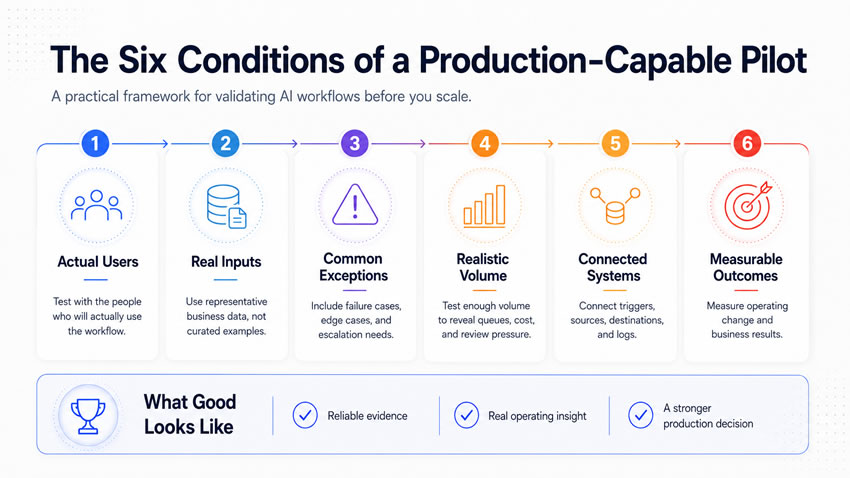
Use six conditions to determine whether a pilot reflects real work
- Have actual users operate it, not project members. People who built the system already now how to phrase strong instructions and spot weak output. Normal users write shorter prompts, trust polished answers too quickly, and sometimes reject a workflow outright because it adds a step to their day. NIST recommends testing prototypes with real end-user populations early and throughout the system’s life, documenting outcomes and correcting the design as they use it. Include experienced and newer employees, frequent and occasional users, and both supportive and skeptical ones in the pilot group. Have them perform actual work during real deadlines rather than a scheduled workshop. Cover behavior in your feedback, not only satisfaction. Which steps stayed manual, which output needed correction, and whether employees would keep using the workflow without the project team standing behind them.
- Let real inputs enter the workflow, not prepared examples. Pilot data curated for a clean demo hides missing records, inconsistent terminology, and weak source ownership. OpenAI recommends task-specific evaluations that reflect real-world distributions, warning specifically against test sets that fail to reproduce actual production traffic. Include complete and incomplete records, conflicting sources, and several file types. Retrieve all of it through the same approved permissions production will use, not copied manually into a test interface. Let sensitive information follow the future control model from day one. A later security review should not force you to rebuild the pilot’s entire architecture from scratch. Measure preparation time directly. If employees spend real hours correcting files before the AI ever sees them, that is the pilot result, not overhead to exclude from it.
- Test common exceptions, do not exclude them. An exception happens whenever the normal path cannot produce an approved result: missing information, conflicting records, unusual transaction values. Employees performing the current work can usually list these cases before the pilot even starts. Give each major exception at least one representative test, and give frequent ones several. Test whether the workflow can recognize uncertainty and escalate safely rather than produce a confident answer regardless. An answer for every case should never become the pilot’s definition of success. Safe escalation can be the correct output.
- Let realistic volume expose real operating pressure. A workflow performing beautifully across 20 cases can genuinely struggle across 2,000, since volume changes system behavior, review demand, and cost all at once. Test review capacity separately. Five cases a day supports full review easily, and 500 cases a day can create a queue nobody planned for. Test cost at real projected volume too. The least expensive individual request can produce the highest cost per accepted result once retries and corrections enter the picture. Watch behavior during genuinely busy periods specifically. Employees who follow the approved process during light demand often quietly bypass it once a deadline hits.
- Let connected systems complete the workflow, not only the model step. A separate AI interface can produce a great output while the employee still has to copy it into another system by hand. That tests a tool, not a workflow. NIST recommends evaluating systems within their intended operating context, or conditions close enough to it that the evaluation means something. Start the pilot from the real trigger, retrieve from approved sources, and return completed work to wherever employees need it. Test failed connections directly too: expired credentials, rate limits, duplicate retries. A project member quietly fixing the integration by hand provides zero evidence about who supports it after launch.
- Let measurable outcomes determine success, not usage or enthusiasm. Build a real baseline from the same type of work entering the pilot. A comparison between easy pilot cases and the full historical workload will always overstate the improvement. Choose one primary outcome to create focus, faster resolution, higher conversion, lower rework. Support it with a four-level scorecard: system performance, adoption, workflow performance, and business performance. High adoption with weak workflow performance points to a design problem. Strong workflow performance with unchanged business results points to a weak hypothesis or a constraint sitting somewhere else entirely. Agree on the decision thresholds before the results come in, since changing the success standard after launch quietly weakens the whole decision.
Watch two conditions beyond the six that determine whether the workflow survives launch
Start ownership during the pilot, not after it. A pilot commonly runs on project-team effort that disappears once the team moves on. The workflow needs a named business, technical, data, review, and support owner. Each one needs to perform their actual role during the pilot itself, not only sit on an org chart. Give support and recovery the same real test. Define how users report a problem, who receives it, and how quickly they respond. That response should never depend on emergency access to the vendor or the executive sponsor for an ordinary failure. A successful pilot’s normal support path should resolve normal problems on its own.
Assess pilot quality with a six-factor scorecard
Score each factor from one to five, then weight it. Actual users carry 15 points, real inputs 20, and common exceptions 15. Realistic volume and connected systems each carry 15, and measurable outcomes carries 20, for a total of 100. A one reflects demonstration-level conditions on that factor. A five reflects strong production evidence. Calculate each weighted score by dividing the rating by five and multiplying by the assigned weight.
- 80 to 100 points: a production-capable pilot. You can use the results to make a real expansion decision.
- 65 to 79 points: a pilot with operating gaps. Useful evidence exists, but named gaps need closing before anyone calls it production-ready.
- 50 to 64 points: a controlled workflow experiment. It tests real assumptions but cannot yet support a dependable production decision.
- Below 50 points: a demonstration or technical test. It can show capability, but you should not use it to estimate production value.
Let several conditions block production approval regardless of the total score. These include no actual end users, no tested exception path, or no measurable business outcome. The same holds for no named business owner, or a support model that depends entirely on the project team. A failed gate should send the pilot back for redesign. Never let it get compensated for through high ratings somewhere else on the scorecard.
Reduce avoidable exposure with a staged pilot
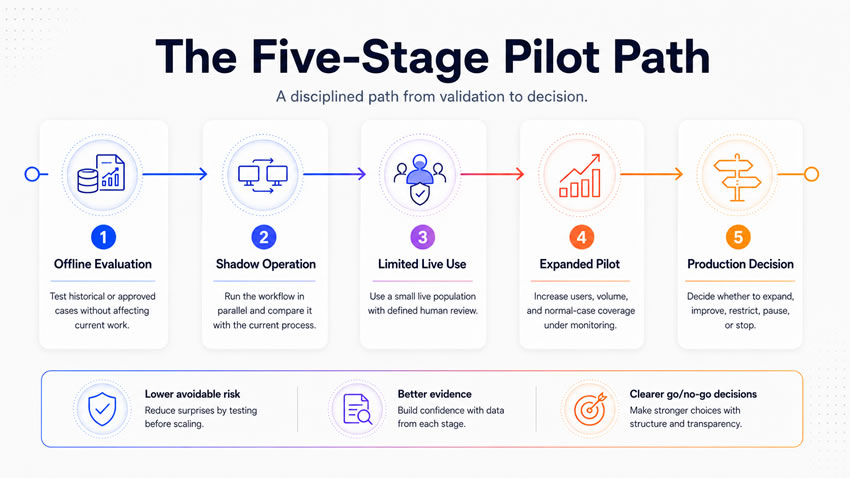
A production-capable pilot does not require immediate live action across every case from day one. Offline evaluation tests historical or approved cases without touching current work, establishing early quality and surfacing known failures. Shadow operation runs the AI workflow against current cases without giving it control of the result. It compares its proposed output against the actual human decision, while employees keep completing the previous process in parallel. Limited live operation applies the workflow to a narrow population with human review protecting every material output. Expanded pilot operation adds volume, users, and normal cases, with monitoring and support running through their actual intended owners rather than the original project team. Compare the accumulated evidence against your agreed thresholds and let the production decision result in exactly one outcome: expand, improve, restrict, pause, or stop. Never let a pilot drift into permanent production without someone making that call.
Watch for the transferred and duplicated work your pilot should also reveal
AI can reduce effort for one employee while quietly creating it for another. A writer drafts faster while editors absorb more review volume, and a salesperson gets better briefs while operations handles more data corrections. Measure work across every affected role, not only the one holding the AI tool. Transferred work can still be worthwhile as long as your business case describes it honestly instead of hiding it.
Duplicated work deserves the same attention. Employees sometimes run the AI workflow and quietly repeat the old process anyway. They rebuild an analysis before trusting the recommendation, or keep a private spreadsheet because the connected record still feels incomplete. That pattern usually reveals weak trust, poor source visibility, or unclear accountability, not laziness. It only shows up when the pilot observes actual behavior instead of relying on reported adoption. High usage can coexist with almost no real capacity gain.
Watch for the warning signs that a demonstration is disguised as a pilot
A handful of patterns should make you question the evidence directly:
- Vendor employees performing most of the work.
- Every input receiving preparation before processing.
- Only successful examples appearing in the final presentation.
- A process that still depends on copying information manually between systems.
- A pilot too small to ever create a real review queue.
- A project team resolving every failure personally.
- A scorecard with no baseline and no named production owner.
None of these require a large pilot to fix. The quality of the evidence depends on realism, not organizational scale.
Expect a strong pilot to reveal problems, and treat that as the point
A genuinely strong pilot will surface weaknesses: source data needing correction, review capacity running too low, one integration quietly creating duplicate records. These findings are not evidence the pilot failed. They are evidence the pilot made contact with real work, which is the entire reason to run one instead of trusting a demo. A pilot creates value the moment it supports the correct decision, whether that decision is expand, improve, narrow the scope, or stop the idea entirely.
Run this 30-day process to build a production-capable pilot plan
Week one. Map the workflow from trigger through business completion, identify every user, system, and exception involved, and establish the baseline and success thresholds.
Week two. Build the representative pilot set: normal cases, difficult cases, consequential cases, and known exceptions. Confirm data permissions and use a group reflecting real production roles.
Week three. Configure the operating environment. Connect the real trigger, sources, and output destination, assign owners and support responsibilities, and test permissions, failure handling, and manual fallback.
Week four. Begin controlled live work. Train users, process real business cases, and measure system, adoption, workflow, and business performance together, tracking failures, workarounds, and transferred labor as they appear.
What you tell them at the end
A pilot should make production uncertainty smaller, not only prove a capability exists. Actual users reveal training and trust problems. Real inputs reveal data quality gaps. Common exceptions reveal whether the workflow recognizes its own limits. Realistic volume reveals cost and queue pressure. Connected systems reveal whether the process runs end to end. Measurable outcomes reveal whether the result justifies the investment.
A demonstration can help you see a possibility. A production-capable pilot shows whether that possibility can become dependable work, and it earns expansion only after the complete operating evidence supports it.