
Summary
Three weeks into a leadership discussion about how to position a new artificial intelligence (AI)-powered offering, the market made the decision for them. Major platform announcements from two leading AI companies had shifted the competitive landscape entirely. The strategy the team had been refining was now a response to conditions that no longer existed.
AI had produced the initial positioning analysis in hours. The leadership review took three weeks. By the time the team was ready to act, the insight had expired. This is the Velocity Collapse, and it is happening inside organizations at every level and in every industry.
I’ve spent four years building AI systems inside real organizations. What I’ve watched consistently is this: AI removes one constraint while exposing another. The production constraint disappears, and the decision constraint becomes the most expensive problem in the building, unnamed and unaddressed.
What the Velocity Collapse Actually Is
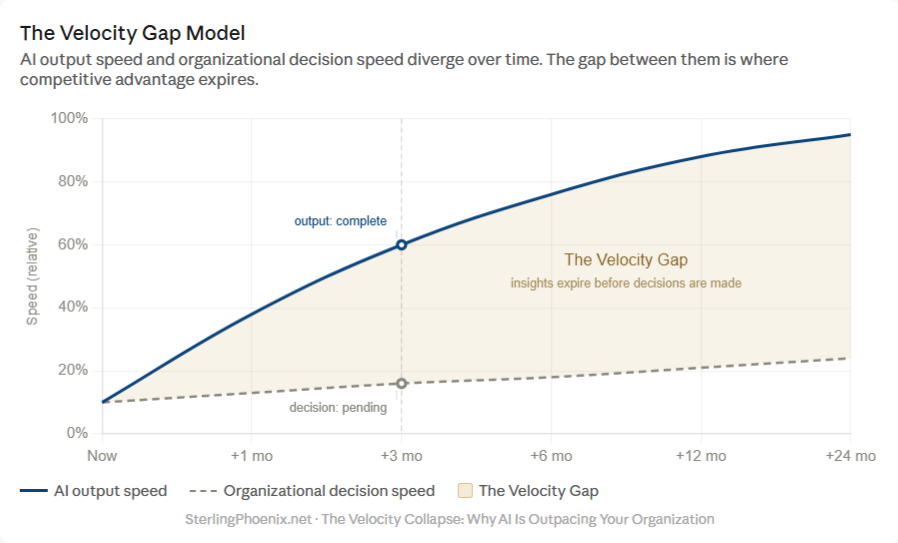
The Velocity Collapse is what happens when artificial intelligence (AI) accelerates output faster than an organization can absorb, decide on, and act on what it produces. The gap between AI output speed and organizational response speed is where competitive advantage goes to waste.
I think of this as the Velocity Gap Model: output speed increases while decision speed remains fixed. The result is a widening structural gap that grows more costly with every new AI deployment.
AI is working correctly; the organizational system around it is not. The production side has been transformed: insights that required teams and days now require one person and hours. The decision side, the approval side, and the execution side remain governed by structures built for a world where production was the limiting factor. When production was slow, slow decisions were survivable. AI removed that buffer.
How to Know Your Organization Is Already There
Output is no longer the scarcity; action is. Recognizing the Velocity Collapse requires examining what happens to artificial intelligence (AI) output after it is produced, not how fast it gets generated.
These are the indicators worth examining:
- A report, analysis, or content piece was completed with AI assistance but sat without action for four weeks or more.
- Leadership provided feedback on AI-generated work after the tool session had expired, requiring work to be reconstructed from scratch.
- A strategic positioning was in internal review while the market it addressed moved past the position being debated.
- The organization produces insights at a pace that exceeds its demonstrated capacity to review, decide on, or act on them.
- AI adoption is measured by output volume rather than by time elapsed between output and action.
If more than two of those describe your organization, the Velocity Collapse is already costing you advantage you may not be measuring yet.
Why This Is Happening Everywhere
Most organizations no longer have a production problem; they have a decision problem. Artificial intelligence (AI) changed one side of the operational equation without touching the other.
Organizations were designed around human-speed production and human-speed risk management. AI changed only the production side, making the gap between AI speed and decision speed visible and costly. Every bottleneck that was manageable when production was slow becomes acute when production runs at AI speed. Every approval layer, review cycle, and stakeholder alignment process that was calibrated for the old pace now creates friction at a scale it was never designed to handle.
McKinsey’s research on organizational agility consistently identifies decision velocity as the defining competitive variable between organizations that capture value from new capabilities and those that don’t. Artificial intelligence (AI) has made that finding operationally urgent for every organization now deploying it.
The Four Places Where Velocity Collapses
After four years of building and diagnosing artificial intelligence (AI) programs inside real organizations, the Velocity Collapse appears consistently across four specific failure points. Understanding each one is the prerequisite to addressing any of them.
The Output-to-Decision Gap. AI produces answers at a speed that human decision systems were not calibrated to match. When a leader receives an AI-generated analysis and takes four days to respond, the feedback cycle has already undermined the purpose of the speed that produced it. Sessions expire. Tool versions update. Context that was fresh becomes stale. Work must be reconstructed rather than refined, at a cost that rarely gets accounted for. The work accelerated; the decisions did not.
This is not a failure of the individuals providing feedback. It is a failure of the system around them. A feedback cycle of two weeks for work completed in two hours is a structural mismatch that consistently erodes the value of AI-assisted speed. Recalibrating those timelines requires explicit organizational decisions, not individual goodwill.
The Insight-to-Action Gap. Actioning insight has overtaken generating it as the primary organizational challenge. Artificial intelligence (AI) can surface an early signal, identify a market shift, or produce a strategic recommendation in the time it once took to schedule the meeting where that recommendation would be discussed.
I’ve built substantial analyses inside organizations that sat untouched for months while internal review processes ran their course. By the time those analyses were acted on, the conditions they described had changed and a new analysis was required. The organization spent the resource twice and captured the advantage zero times. Insight without action is inventory, and inventory that does not move is waste. Without clear ownership of what happens to AI output after it’s produced, that inventory compounds quietly.
The Production-to-Review Gap. Artificial intelligence (AI) created an absorption problem, not a production problem. Teams that have adopted AI can produce content, reports, and recommendations faster than existing review systems were designed to process them. The outcome was not scaled output; it was an overwhelmed review system. Review becomes the constraint, and a constrained review function under volume pressure produces delays or shortcuts, neither of which serves the organization.
This gap compounds as AI adoption scales. Every increase in production volume without a corresponding redesign of the review system increases the backlog of unreviewed, unactioned output. At sufficient volume, that backlog becomes an organizational argument against continuing to use AI, even when AI itself is functioning correctly.
The System Stability Gap. Artificial intelligence (AI) tools are not static infrastructure. Models update, capabilities shift, interfaces change, and sessions expire on timelines faster than most organizational review cycles. An organization taking three weeks to provide feedback on AI-generated work may return to find the tool changed, the session unrestorable, and the work requiring reconstruction in a context that no longer matches the original.
If your feedback cycle is longer than the tool lifecycle, you have already lost continuity. An organization that debated a market positioning for three weeks recently found that two major AI platform announcements during that window had made the position they were refining obsolete. The original insight was correct when generated. The review cycle made it wrong.
The Real Cost: Lost Timing
In fast-moving markets, timing is often the only advantage that cannot be replicated quickly. Artificial intelligence (AI) creates earlier signals, and only organizations with sufficient decision velocity turn them into advantage. Organizations that produce faster without deciding faster generate more inventory and capture less value with each cycle.
The Velocity Collapse rarely appears as a line item. It shows up as deals not closed because the insight arrived after the window, as positioning that was right three weeks ago and wrong today, and as AI programs with impressive output dashboards and unchanged competitive standing. The organizations that win with AI have already answered the production question. They are focused entirely on the decision side, the review side, and the execution side, because that is where competitive value is either captured or lost.
How to Fix the Velocity Collapse
If you don’t redesign decision systems, artificial intelligence (AI) will only make your delays more expensive. Fixing the Velocity Collapse does not require slowing AI down; it requires redesigning the organizational systems that determine what happens after AI produces something.
Assign named ownership to every AI output before it is generated. Every output AI produces must have a named owner, a defined authority level, and a clear path to action established before the output is created. Without that structure, decisions about AI output default to whoever is available when someone finally has time. That is a delay system, not a decision system.
Define response time standards for AI-assisted work cycles. The feedback cycle for AI-assisted work must be calibrated to the speed at which that work was produced. Define how quickly feedback must be given, how long decisions may remain open, and at what point work moves forward without reaching perfection. Without those standards, delay becomes the organizational default.
Align production volume with demonstrated review and execution capacity. The volume of AI output should be calibrated to what the organization can actually absorb, review, and act on within a competitive timeframe. Producing more than the downstream system can absorb does not create leverage; it creates backlog. Match output targets to the demonstrated capacity of the review and execution systems that receive them.
Design for continuity across tool updates and session expiry. AI-assisted work should be documented with sufficient context to be resumed, refined, or reconstructed after a tool update or session change. Key outputs must be preserved outside the tool environment. Treat the certainty of tool change as a design requirement, not an edge case.
Measure time-to-action, not output volume. The metric that matters in a Velocity Collapse environment is not how much AI produced. It is how long the organization took to move from AI output to decision and action. Establish that baseline, track it consistently, and design explicitly for its improvement.
The Leadership Shift This Requires
The Velocity Collapse is a leadership problem, not a technology problem. Artificial intelligence (AI) will continue to accelerate. Platform capabilities that seem fast today will look slow within twelve months. The organizations that build decision velocity, review capacity, and execution speed now will be positioned to capture that acceleration. Those that do not will produce more and capture less with each cycle.
Speed without decision is just noise. The competitive question is no longer whether your team can produce fast enough; AI has answered that question. The question is whether your organization can keep pace with what your team can now produce, consistently and faster than the competitors addressing the same markets.
The Question That Actually Matters
Most organizations think they’re competing on output when the actual competition is on response time. If you lead artificial intelligence (AI) adoption inside your organization, ask yourself not how fast your team is generating, but how fast your organization is deciding and acting on what the team generates.
That gap is where your competitive advantage is either building or eroding. Identify where your system is slowing down what AI is speeding up, and address it before your competitors close the same gap.