
Summary
Many marketing teams began using artificial intelligence (AI) through individual experimentation. People tried tools such as ChatGPT, Claude, Microsoft Copilot, automation platforms, and browser extensions. Some of that experimentation created real, measurable gains.
The trouble begins when those gains become invisible to the wider organization. AI tool sprawl starts when the team gains individual speed and loses operational visibility.
I have seen this pattern inside real marketing teams. The early wins were genuine, and nobody could see or reuse them.
What AI Tool Sprawl Means
Artificial intelligence (AI) tool sprawl is the uncontrolled spread of tools, accounts, prompts, and workflows across a team. It spreads when teams lack shared ownership, documentation, and access rules. The team also lacks data standards, review practices, and a place to store what works.
It shows up in several recognizable ways.
- Different people use separate AI accounts and subscriptions.
- Successful prompts live in private chats.
- Different people rebuild similar workflows from scratch.
- Team members upload source material without clear rules.
- Output quality varies by person, tool, and prompt.
- No shared repository holds the approved workflows.
- No clear standard governs the review of AI-assisted work.
- No one can see which tools support which processes.
The problem is operational rather than technical.
Why Marketing Teams Are Especially Exposed
Marketing teams carry unusual exposure to artificial intelligence (AI) risk. They work across content, campaigns, customer data, analytics, brand voice, and public communication.
AI usage in marketing can affect many sensitive areas.
- Customer-facing claims can reach the public quickly.
- Brand voice can drift across writers and tools.
- Campaign analysis can shape budget decisions.
- Account research can guide sales outreach.
- Executive reporting can influence strategy.
- Customer and prospect data can carry privacy obligations.
- Competitive positioning can create legal exposure.
Marketing output travels fast, so weak governance can become public fast.
The Seven Symptoms of AI Tool Sprawl
Artificial intelligence (AI) tool sprawl shows seven common symptoms. Each symptom points to a specific operational gap.
Symptom One: Scattered Accounts
Different people use different tools, accounts, plugins, and settings. The organization cannot see where work happens or what data enters each system.
Symptom Two: Duplicated Prompts
People solve the same problem again because good prompts stay private. The team wastes time recreating work that already exists.
Symptom Three: Inconsistent Outputs
Output quality varies because prompts, sources, and brand rules differ by person. Readers receive uneven work from the same team.
Symptom Four: Unclear Data Handling
People lack clear rules about which data they may upload, store, or reuse. This gap creates privacy, security, contractual, and reputational risk.
Symptom Five: Unmanaged Experiments
Pilots happen inside teams without intake, scoring, ownership, or measurement. Leaders cannot tell which experiments should scale, stop, or be governed.
Symptom Six: No Shared Repository
Prompts, workflows, and standards live in scattered chats and folders. Useful capability cannot compound across the team.
Symptom Seven: No Review Standard
AI output reaches audiences without consistent checks. No one verifies accuracy, source grounding, brand fit, or approval.
A short example makes the pattern concrete. Consider a common case. One person uses a private AI account to summarize campaign performance. Another builds a separate prompt for sales follow-up. A third uploads the same campaign data into a different tool for an executive summary. Each person may produce useful work. The team now has three undocumented workflows and three output standards. No one holds a shared view of the data, prompts, review rules, or reusable lessons.
How Sprawl Weakens Performance
Artificial intelligence (AI) sprawl weakens performance as well as governance. The costs show up in everyday marketing work.
- Teams repeat work that someone already finished.
- Review queues back up and slow delivery.
- Brand output becomes inconsistent across channels.
- Sales handoffs weaken because briefs vary in quality.
- Campaign analysis becomes hard to compare.
- Executive summaries lose reliability.
- Knowledge leaves when employees leave.
- Tool costs rise without clear value.
- Adoption slows because people distrust the system.
Strong governance becomes a performance enabler rather than a compliance burden. McKinsey reports that AI use is now widespread, while few organizations embed it deeply into workflows.¹
The Governance Questions Leaders Should Ask
Useful governance moves past whether the team may use artificial intelligence (AI). Better questions focus on control, value, and ownership.
- Which tools are approved for which work?
- Which data can each tool access?
- Which workflows are worth scaling?
- Which outputs require human review?
- Which prompts and examples are reusable?
- Who owns each workflow?
- Where does the team store what works?
- How does the team retire weak or risky workflows?
The Framework: The AI Tool Sprawl Risk Map
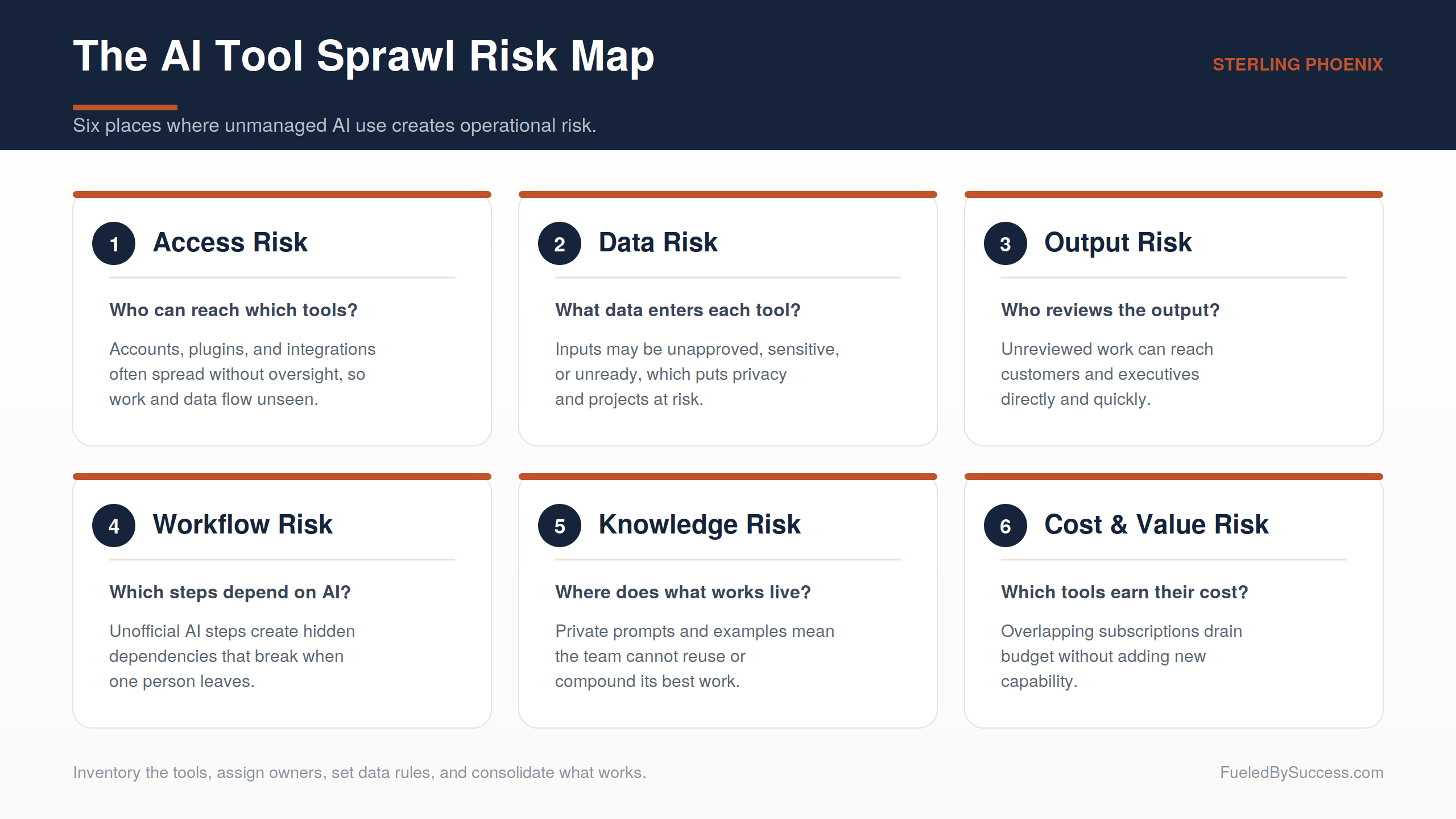
Leaders need a clear map of where artificial intelligence (AI) creates risk. The AI Tool Sprawl Risk Map covers six risk areas. Each area names a question the team must answer.
Access Risk
Access risk asks who can reach which tools, accounts, and integrations. Unmanaged access hides where work and data actually flow. Plugins, browser extensions, and connected applications deserve special attention, because they may touch more systems than the user realizes.
Data Risk
Data risk asks what data enters each tool and whether that use is approved. Data risk is often where tool sprawl becomes expensive. Gartner has predicted that organizations will abandon 60 percent of AI projects without AI-ready data through 2026.² That risk makes data visibility and approved-use rules essential.
Output Risk
Output risk asks where AI outputs go and who reviews them first. Unreviewed output can reach customers and executives directly.
Workflow Risk
Workflow risk asks which processes now depend on unofficial AI steps. Hidden dependencies break when one person leaves.
Knowledge Risk
Knowledge risk asks where prompts, examples, and improvements live. Private storage means the team cannot reuse what works.
Cost and Value Risk
Cost and value risk asks which tools cost money, create value, or overlap. Overlapping tools drain budget without adding capability.
The Operating Model That Controls Sprawl
A practical operating model keeps artificial intelligence (AI) use visible and governed. The model includes 10 connected parts.
- A tool inventory lists every AI tool in use.
- Approved tool categories define what teams may adopt.
- Data handling rules state what each tool may process.
- Use case intake and scoring prioritize new ideas.
- Named owners hold responsibility for each workflow.
- Human review standards match the risk of each output.
- A central AI capability repository stores what works.
- Training and enablement help people use the workflows.
- Measurement and feedback show what to improve.
- A quarterly review checks tools and workflows.
This model connects to the capability repository and the 30-day roadmap from earlier articles.
What Belongs in the Tool Inventory
The tool inventory gives leaders a clear view of artificial intelligence (AI) use. Each record should capture the essentials.
Each record should list the tool name, the vendor, and the business owner. It should also list the users, the use cases, the data types, and the data sensitivity. It should record the authentication method, the integration points, the cost, and the contract status. It should note the review requirements, the approval status, and any overlap with other tools. It should also record the renewal date, the security review status, and the approved data categories.
How to Decide Which Tools Stay
Leaders need a simple test for each artificial intelligence (AI) tool. A clear lens prevents both chaos and an overzealous purge.
A tool should stay when it meets clear conditions.
- It serves a clear business use case.
- It has an accountable owner.
- It handles data within approved rules.
- It has repeat users and measurable value.
- It carries manageable risk.
- It holds a clear place in the workflow.
- It avoids unacceptable overlap with another approved tool.
A tool should be restricted or retired under the opposite conditions.
- It has no clear owner.
- It has no repeat use case.
- It handles data in unclear ways.
- It carries high risk without review.
- It duplicates another tool’s function.
- It shows weak adoption.
- It produces output that no one controls.
The Role of the AI Capability Repository
A central artificial intelligence (AI) capability repository solves the visibility problem. It turns scattered use into reusable team capability.
The repository should store the team’s working knowledge.
- It stores approved use cases and workflow documentation.
- It stores prompt assets and approved source materials.
- It stores governance rules and training notes.
- It stores example outputs and known failure points.
- It records owners and review dates.
The repository lets a team build on yesterday rather than repeat it.
Match Human Review to Output Risk
Review effort should match the risk of each artificial intelligence (AI) output. Three levels keep review proportionate.
Level One: Low-Risk Internal Drafting
This level covers brainstorms, outlines, meeting summaries, and internal notes. The user reviews the output before use.
Level Two: Business-Influencing Internal Outputs
This level covers campaign analysis, account research, sales briefs, and executive summaries. The owner reviews the output and verifies the sources.
Level Three: Customer-Facing or High-Stakes Outputs
This level covers website copy, customer claims, pricing language, and regulated content. A formal approval precedes any publication or distribution.
The goal is proportional review rather than the same approval burden for every AI-assisted output.
The First 30 Days of Reducing AI Tool Sprawl
A focused month brings artificial intelligence (AI) sprawl under control. The work moves from discovery to governance.
- In week one, the team inventories tools, accounts, plugins, and unofficial use cases.
- In week two, the team maps tools to use cases, data types, owners, and risk.
- In week three, the team defines approved categories, review rules, and restricted use cases.
- In week four, the team builds the repository, migrates key assets, and shares the rules.
Common Mistakes
A few predictable mistakes undermine artificial intelligence (AI) governance. Naming them in advance prevents most of them.
- Teams try to ban all unofficial AI use.
- Teams ignore the tools people already use.
- Teams write governance rules without workflow owners.
- Teams treat prompt storage as enough.
- Teams skip data rules for each tool type.
- Teams let every group choose tools alone.
- Teams skip review standards for external content.
- Teams measure adoption without measuring value.
- Teams keep outdated prompts and workflows active.
- Teams treat governance as a one-time document.
The Strategic Implication
Artificial intelligence (AI) tool sprawl shows that people are experimenting. That experimentation is healthy and worth protecting.
The risk lies in leaving experimentation invisible, unmanaged, and unreusable. The goal is AI use the organization can trust, reuse, improve, and govern.
Key Takeaways
- AI tool sprawl begins when individual experimentation outpaces operational visibility.
- Marketing teams face higher risk because AI output reaches customers, sales, data, and brand.
- Sprawl causes rework, duplicated prompts, inconsistent output, and lost knowledge.
- Governance should define approved tools, data rules, ownership, review standards, and a repository.
- The goal is AI use the organization can trust, reuse, improve, and govern.
Frequently Asked Questions
What is AI tool sprawl? AI tool sprawl is the uncontrolled spread of AI tools, accounts, prompts, and workflows without shared governance.
Why is AI tool sprawl a marketing operations problem? It affects campaign quality, brand consistency, customer-facing content, data handling, and team productivity.
How can marketing teams reduce AI tool sprawl? They can inventory tools, map use cases, set data rules, assign owners, and build a shared repository.
Should marketing teams ban unapproved AI tools? Teams should manage risk through visibility, clear boundaries, and approved workflows rather than blanket bans.
What should an AI tool inventory include? It should include the tool name, owner, users, use cases, data types, sensitivity, cost, and approval status.
Framework Reference: The AI Tool Sprawl Risk Map
Definition. The AI Tool Sprawl Risk Map helps marketing teams find where unmanaged AI use creates risk.
Risk Areas. Access Risk, Data Risk, Output Risk, Workflow Risk, Knowledge Risk, and Cost and Value Risk.
Application. Teams apply the map by inventorying tools, assigning owners, clarifying data rules, defining review standards, and consolidating reusable assets into a shared repository.
References
- McKinsey & Company. The State of AI in 2025: Agents, Innovation, and Transformation (November 2025). https://www.mckinsey.com/capabilities/quantumblack/our-insights/the-state-of-ai
- Gartner. Lack of AI-Ready Data Puts AI Projects at Risk (February 2025). https://www.gartner.com/en/newsroom/press-releases/2025-02-26-lack-of-ai-ready-data-puts-ai-projects-at-risk