
Summary
AI Has Changed What Companies Can Acquire
Artificial Intelligence (AI) is creating a new kind of mergers and acquisitions (M&A) strategy inside the labor market. A company does not always need to buy a competitor to gain some of its competitive capability. It can hire the experienced leaders that the competitor released while funding its own AI transformation.
The target is company memory, not a company, a product, or a customer list. It includes the buying patterns, operational bottlenecks, customer objections, service failures, pricing logic, and decision history that a tool rollout cannot reconstruct.
Talent-led M&A works because it is built on lawful experience, pattern recognition, customer understanding, operational judgment, and market memory. It is not a loophole or a license to take confidential information.
Stanford’s 2026 AI Index found that private AI investment grew 127.5% in 2025, and investment in generative AI alone grew more than 200%. That capital shift is forcing harder budget choices, and some companies are making those choices through workforce reductions.
Why Budget Cuts Are Creating a Talent-Led M&A Market
Reuters has documented a growing pattern of companies reducing headcount while increasing AI investment. Allianz’s travel insurance division plans to cut up to 1,800 jobs due to growing AI use. Oracle’s total workforce fell 13%, about 21,000 employees, in fiscal 2026. The company spent $1.84 billion on severance and exit costs and plans roughly $70 billion in capital expenditures. Some of those reductions will release experienced operators who carry knowledge their companies have not fully documented.
McKinsey’s 2025 State of AI research shows why trading experienced people for AI budget is risky. AI use has reached 88% of organizations in at least one business function. Only about one-third have begun scaling AI programs across the enterprise. About 39% report any enterprise-level earnings before interest and taxes (EBIT) impact from AI, and most of that impact sits below 5%.
AI can process information, but it does not automatically understand why a decision was made, which customer promise failed, or where internal friction slowed execution. Companies cutting experienced people to fund that gap may be solving a budget problem while creating a knowledge problem.
What Senior Operators Know That AI Cannot Rebuild
AI cannot rebuild what a senior operator carries in their head. Senior operators know which customers are profitable but difficult to serve, and which processes look clean on paper but fail in execution. They also know which product claims sales teams make that service teams cannot support.
That knowledge tends to fall into six categories.
- Market memory captures how buyers and category expectations have changed over time.
- Customer memory holds the objections, expectations, and risks that shape real deals.
- Operational memory shows which processes work on paper and which fail in execution.
- Failure memory records what the company already tried and why it did not work.
- Decision memory explains why specific tradeoffs were made and what they cost.
- Talent memory identifies which roles, skills, and leadership behaviors build execution strength.
Consider a business-to-business software company that hires a former competitor’s customer success leader after a restructuring. That leader cannot bring renewal files, customer lists, or internal pricing documents. They can bring lawful experience instead. That experience includes where implementations usually fail and why mid-market customers expand more slowly than enterprise customers. It also includes which handoff patterns create churn risk and how service promises break under pressure. That experience can reshape onboarding, sales qualification, customer health scoring, and AI-assisted account reviews.
PwC’s 2026 Global AI Jobs Barometer compared the most and least AI-exposed junior roles. It found the most exposed roles are seven times more likely to require traditionally senior skills, including leadership. Employers are pricing senior judgment into junior roles even as some companies cut senior headcount to fund AI.
The Bureau of Labor Statistics reported that median employee tenure fell to 3.9 years in January 2024, the lowest level since January 2002. Company memory already moves between employers more often than it once did. AI-linked restructuring may make that movement more strategically important.

The Legal Boundary Leaders Cannot Ignore
AI budget pressure creates the opportunity, but it does not remove the legal boundary around it. Hiring a competitor’s former leader is legitimate when a company hires for judgment, experience, and pattern recognition. It becomes a legal liability when a company asks for confidential files, pricing models, customer lists, proprietary processes, or unpublished strategy documents.
Noncompete law is uneven, not absent. The Federal Trade Commission voted in September 2025 to drop its appeals and accept the vacatur of its national noncompete rule. No federal noncompete ban is currently in effect. Noncompete enforcement still depends on state law, the specific agreement, and the facts of each hire, and several states, including California, restrict or ban noncompetes.
Trade secret exposure is rising at the same time. Lex Machina’s 2026 report, covered by Reuters, found more than 1,500 new federal trade secret cases in 2025, the highest total ever recorded. Cases that reached trial between 2023 and 2025 took a median of 1,124 days. Juries in those cases awarded more than $716 million in actual damages and $510 million in punitive damages.
That legal exposure is why the boundary has to stay clean. A protected file, list, or pricing model is never part of the hire.
The Company Memory Acquisition Model
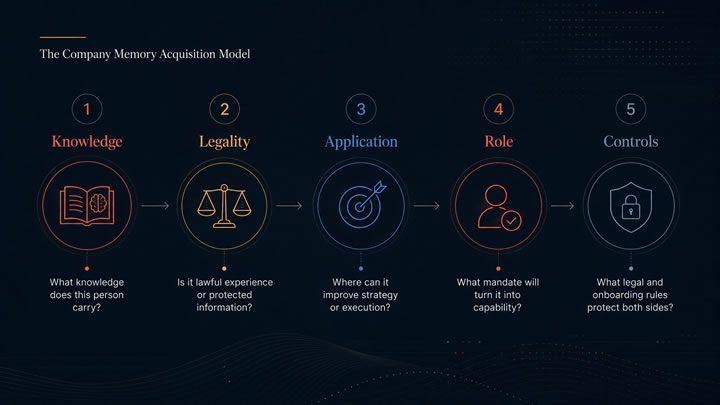
This kind of hire is becoming more common as AI reshapes hiring, which means leaders need a repeatable model instead of ad hoc judgment calls. The Company Memory Acquisition Model gives leaders five questions to answer before making an offer.
- Knowledge. What does this person know about the market, customers, operations, product, sales, or service delivery?
- Legality. Is that knowledge lawful general experience, or does it depend on confidential material?
- Application. Where in the business could this knowledge improve strategy, AI workflow redesign, retention, or execution?
- Role. What mandate will convert this knowledge into capability instead of letting it sit unused?
- Controls. What legal review, onboarding rules, and documentation will protect both companies?
How to Build a Clean Talent-Led M&A Process
Budget cuts tied to AI move fast, and a clean hiring process needs the same discipline.
- Map competitor pressure. Track layoffs, restructuring announcements, AI investment shifts, and leadership departures.
- Identify knowledge-rich roles. Prioritize leaders from sales, operations, customer success, product, and service delivery.
- Define the capability gap. Decide what knowledge the company needs before approaching candidates.
- Screen for experience, not secrets. Ask about patterns, lessons, and market context rather than confidential details.
- Build a clean onboarding process. Document in writing that no confidential materials may be shared or used.
- Assign a strategic mandate. Place the hire in a role where judgment can improve systems.
- Convert knowledge into operating assets. Build playbooks, training, process maps, and decision criteria from what the hire knows.
When Hiring Beats Buying
AI is not the only factor in a build-versus-buy decision, but it is changing the calculation leaders use. Talent-led hiring works well when a company wants market context, customer knowledge, operational judgment, leadership capability, or AI transformation experience.
A full acquisition is still the better path when a company needs contracts, intellectual property, proprietary technology, customer accounts, licenses, data rights, brand equity, or recurring revenue.
McKinsey’s research on merger integration found that a lack of cultural fit is among the most common reasons deals fail to meet value expectations. So is integration friction. A clean, well-scoped hire can sometimes deliver similar capability with less integration risk than a full transaction.
Why AI Makes Experienced Judgment More Valuable
AI increases the value of senior judgment when companies use it to redesign work rather than automate existing processes. McKinsey found that companies seeing the most value from AI are more likely to redesign workflows and place senior leaders in critical AI governance roles.
Experienced leaders decide where AI should assist, where humans must validate output, and where automation would create risk the company cannot see yet. Companies cutting senior people to fund AI may be removing the layer of judgment their AI programs need most.
The Strategic Risk for Companies Cutting Too Deep
AI is changing what companies can acquire, and the leaders who see that first will move fastest. Competitors that release experienced people to fund AI transformation may believe they are cutting cost. They may also be releasing company memory into the open market.
Companies that understand this shift can acquire capability faster and with less integration risk than a traditional acquisition requires. The opportunity belongs to leaders who hire ethically, protect legal boundaries, and convert experience into operating capability.