
Summary
The visit is the smallest part of the signal
Most revenue teams have never had more visibility into buyer behavior. They can watch which company visited, which page held attention, and which email earned a click. Detection has become cheap and constant. Interpretation has stayed slow and manual.
That gap is the real problem. The activity arrives in fragments scattered across a website tool, an outbound platform, an ad account, and a Customer Relationship Management (CRM) system. No single person sees the full account story fast enough to act on it.
Consider a sequence that plays out constantly inside long sales cycles. A target company first appeared through service-page visits three months ago. It matched our Ideal Customer Profile (ICP), so we placed it in a cold-warming funnel. A Business Development Representative (BDR) emailed several buying group contacts through Apollo over the next two months. Nobody filled out a form, booked a meeting, or replied in any obvious way.
Then the company returned to the website on its own. That return carried weight only because the history gave it meaning. Read in isolation, the visit looked anonymous. Read against the account record, it marked the moment a quiet account started moving again.
This article gives you a system for telling those two situations apart. The goal is to convert raw activity into timing you can defend, before the moment cools.
Why timing broke at the moment data got cheap
Artificial Intelligence (AI) and modern tracking tools made one thing nearly free, and that thing is detection. Visitor identification, intent data, and engagement tracking now record almost every move an account makes. The volume of signal has climbed far faster than any team’s ability to read it.
Buyer behavior moved in the opposite direction at the same time. Gartner found that business-to-business (B2B) buyers spend only 17 percent of their total buying time meeting with potential suppliers. When buyers compare several vendors, any single sales representative may get 5 to 6 percent of that time. Gartner’s 2025 research also shows that a majority of B2B buyers now prefer to buy with little or no sales involvement.
The decision itself grew more crowded and less linear. Gartner reports that buyers work through six recurring jobs, including problem identification, solution exploration, requirements building, supplier selection, validation, and consensus creation. Most buyers revisit at least one of those jobs, so they loop, pause, and return rather than move in a straight line.
The group making that decision keeps growing. Forrester’s The State Of Business Buying, 2024, found that, on average, 13 people are involved in a single buying decision. The same survey found that 89 percent of purchases pull in two or more departments.
That complexity carries a cost. Forrester’s research found that 86 percent of B2B purchases stall during the buying process. The same report found that 81 percent of buyers end up dissatisfied with the provider they finally chose.
The constraint moved upstream as a result. Seeing activity is now easy. Interpreting that activity before the moment passes is where teams struggle. AI matters here because it can close that interpretation gap. McKinsey’s 2025 analysis shows leading teams already using generative AI to prioritize accounts and surface the next best action.
Timing is an operating capability
Strong sales teams appear to have a sense for timing. In practice, the system around them surfaces the right moment, and the best reps simply trust it. When timing depends on memory and intuition alone, it disappears the day a strong rep leaves or the signal volume doubles.
Timing intelligence is the discipline of connecting every signal to account memory before anyone decides to act. A signal tells you something happened. Account memory tells you whether that something matters. The decision belongs to a person, and the preparation for that decision belongs to a system.
This reframes the work for leaders. Most teams already drown in alerts, so more speed on alerts solves nothing. What they need is a repeatable way to turn activity into a defensible timing decision. That system is the Signal-to-Action Ladder.
The framework: the Signal-to-Action Ladder
Artificial Intelligence (AI) earns its place in timing by climbing a simple ladder of five rungs. Each rung depends on the rung beneath it. AI climbs the first four quickly, and a person owns the fifth.
- Signal. A recorded action sits at the base, such as a page view, an email open, an ad click, or a return visit. On its own, a signal proves only that activity occurred.
- Context. The account memory gives the signal meaning. Context answers whether the company fits the ICP, when interest first appeared, which pages drew it, where it sits in the funnel, who received outreach, and which buying group roles are involved.
- Pattern. The system compares today against the account’s own history. The activity reads as new interest, returning interest, or intensifying interest, and that classification changes everything downstream.
- Trigger. A trigger is the threshold where the pattern earns a human response. A single blog visit rarely clears it. A return to a key service page after weeks of buying group outreach usually does.
- Action. A person assigns the account to a timing lane and chooses the right touch. The human owns relevance, judgment, and the relationship.
The ladder works because it refuses to skip rungs. Teams that jump from signal straight to action chase noise and burn buyer trust. Teams that climb every rung act with evidence behind them.
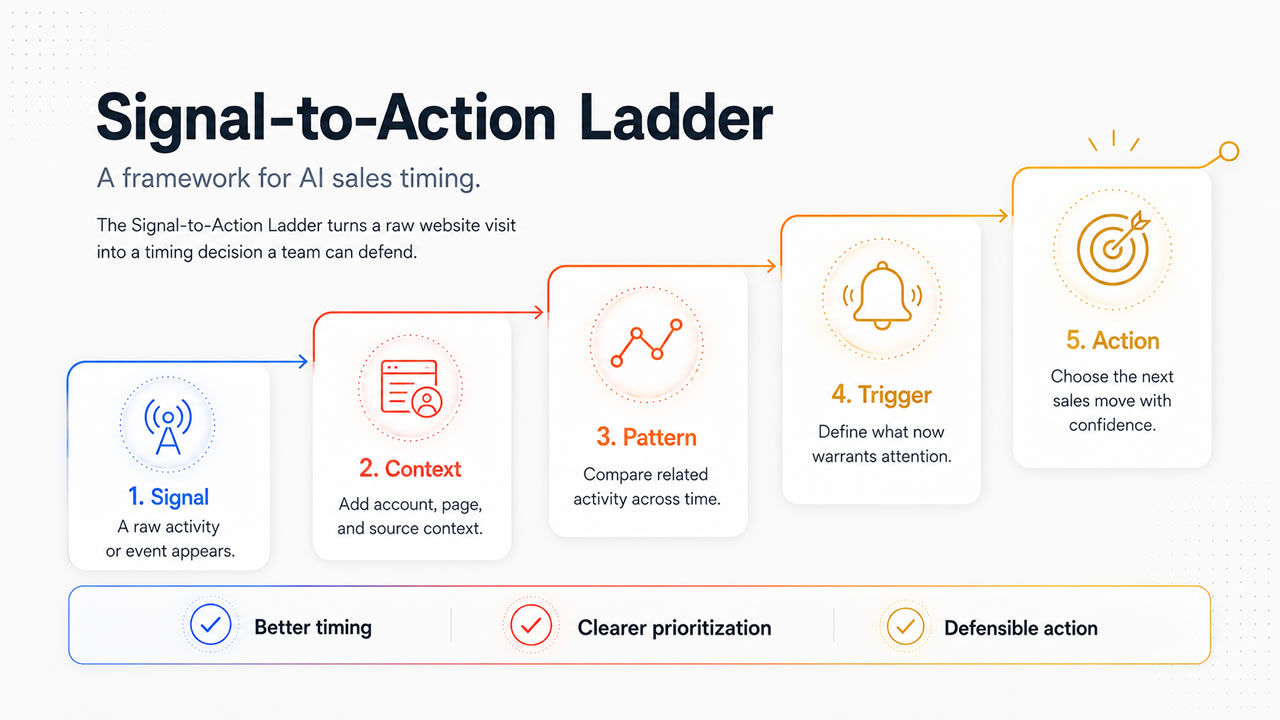
The Signal-to-Action Ladder turns a raw website visit into a timing decision a team can defend.
What changes inside sales and marketing
The Signal-to-Action Ladder changes how two functions operate together. Marketing stops celebrating raw activity counts as if volume were progress. Both teams work from one shared account memory rather than separate, partial views.
The buying group reality sets the bar for what counts as a trigger. With a dozen or more people often involved across departments, a single contact’s activity stays weak on its own. Several roles engaging across outreach and the website signals real internal movement, and that movement deserves attention.
Artificial Intelligence sits in a specific, bounded place in this model. The system summarizes the account, classifies the pattern, and recommends a lane. People decide whether the moment deserves a personal note, whether the timing feels respectful, and how to shape the message to the account’s likely context. This division matters most with long-cycle accounts, where a clumsy touch can stall a deal that was quietly warming.
The difference shows up in the outreach itself. A message that names a website visit reads like surveillance and earns silence. A message that connects to the account’s prior research and offers a useful next step reads like relevance and earns a reply.
Execution: build the timing workflow
A timing system built on Artificial Intelligence (AI) should run as a defined workflow, not a vague intention. The workflow can begin as a clear review process and tighten into automation over time.
- The website visit alert fires when a target company returns to the site.
- The reviewer checks account context, including ICP fit and when interest first appeared.
- The reviewer examines the activity pattern across visits, email, ads, campaigns, and outreach.
- The reviewer assesses buying group movement, looking for multiple contacts and role diversity.
- The system classifies the timing based on fit, strength, and recency.
- The system assigns a next action and routes the account to a lane.
- The team records whether the timing call proved useful, premature, or missed.
That final step builds the feedback loop that improves the model. The team teaches the system what a real trigger looks like in its own market.
Use timing lanes instead of urgency labels
Hot, warm, and cold tell a team almost nothing about what to do next. Timing lanes describe the action the account has earned, so they remove guesswork.
- Watch. The activity is real, yet too weak for outreach. The account stays visible, and future moves get measured against this one.
- Warm. The account fits the ICP and should keep receiving relevant content. Direct sales outreach would still feel early.
- BDR Review. The account shows enough movement for a human to assess contact coverage, outreach history, and current messaging.
- Sales Touch. The account shows timely activity tied to prior outreach, high-intent pages, or buying group movement, so a relevant touch should happen soon.
- Account Brief Needed. Several signals connect across time, people, and channels, and the account deserves a deeper intelligence summary.
Give the seller a brief, not another alert
A salesperson does not need a research report every time an account visits. The account timing brief should answer five questions in plain language.
- Why is this account showing activity now?
- What happened on the account before today?
- Which contacts or roles have been touched?
- What makes this signal stronger or weaker than past activity?
- What should the team do next?
The brief should stay short enough to act on, and it should carry the evidence behind its recommendation. A useful brief reads like an informed sales operations partner, and it ends with a recommended lane.
Govern the system with a checklist
Before any account moves to sales action, the team should confirm it against clear criteria. This protects sales attention, buyer trust, and marketing credibility at the same time.
- The company fits the Ideal Customer Profile.
- The company visited a meaningful page.
- The activity is recent enough to affect timing.
- The company has prior engagement or outreach history.
- More than one signal supports the interpretation.
- The buying group activity suggests internal movement.
- The next action can stay relevant without feeling intrusive.
- The team can explain the timing decision from the record.
The last criterion governs the whole model. When no one can explain why an account deserves attention today, the account is probably not ready.
The strategic implication
In long sales cycles, the moment is easy to lose. A target account can go quiet for months, a buying group can debate a vendor without ever replying, and a stakeholder can revisit a service page long before anyone is ready to talk. None of those moments announces itself.
A team that relies on memory and instinct will miss most of them. A team that builds account memory and the Signal-to-Action Ladder into its system will catch them, and the capability will survive volume, turnover, and time. Timing becomes a property of the operating model rather than a trait of a few talented people.
The reward is relevance at the right moment. When a message lands while an account is already in motion, it reads as useful rather than intrusive, and that is the entire difference between cold outreach and informed timing.
So the diagnostic question for any revenue leader is simple. Can your team explain, from the record, why an account deserves attention today? When the honest answer is no, the system is missing its memory, and the timing was always going to be luck.
Key takeaways
- Website visitor alerts gain meaning only when connected to account history, fit, and prior outreach.
- The real constraint in modern revenue teams is interpretation speed.
- The Signal-to-Action Ladder moves an account from raw activity to a defensible timing decision in five rungs.
- Artificial Intelligence should climb the first four rungs, and a person should own the fifth.
- Timing becomes durable when teams build it into the system rather than relying on instinct.
Frequently asked questions
What is AI sales timing?
AI sales timing is the practice of connecting each buyer signal to account history before deciding to act. It uses Artificial Intelligence to interpret activity quickly, so outreach lands when an account is already moving.
Why are website visitor alerts not enough on their own?
A single visit proves only that activity happened. The visit gains meaning when the system reads it against fit, first touch, funnel stage, prior outreach, and buying group movement.
What is the difference between a signal and a trigger?
A signal records that something happened, such as a page view or an email open. A trigger is the threshold where the account’s pattern earns a human response.
Sources: Gartner, The B2B Buying Journey. Forrester, The State Of Business Buying, 2024. McKinsey & Company, Unlocking gen AI in B2B sales, 2025.