
Summary
Most artificial intelligence (AI) strategies fail in the same place, and it is never where anyone looks first. Teams review the prompts, evaluate the tools, and experiment with different models. The conversation stays at the surface, which is precisely where the failure didn’t happen.
I’ve spent four years building, governing, and diagnosing AI programs inside real organizations. The failure almost never lives where the diagnosis goes first. The diagnosis goes to the outputs while the failure lives in the organizational systems underneath them. Most AI strategies fail below the surface, not at it.
I’ve come to think about this as a stack: five interdependent layers that either support AI success or quietly undermine it. I call it the AI Reality Stack. Once you see it, the reason most AI strategies fail becomes obvious: they are optimizing at the top of the stack while the real problems compound at the bottom.
What the AI Reality Stack Actually Is
The artificial intelligence (AI) Reality Stack is a five-layer model for understanding where AI success is actually determined. Most organizations operate almost entirely at Layer 1, the visible layer of outputs, prompts, tools, and model selection.
AI is a diagnostic as much as it is a tool. It exposes problems rather than creating them. The technology is almost never the problem; the work system underneath it is. AI creates leverage when that work system is redesigned around it, and AI creates failure when it is layered on top of unchanged processes, unclear workflows, and undocumented standards.
You don’t implement AI at Layer 1; you earn it at Layers 2 through 5.
The AI Reality Stack at a Glance
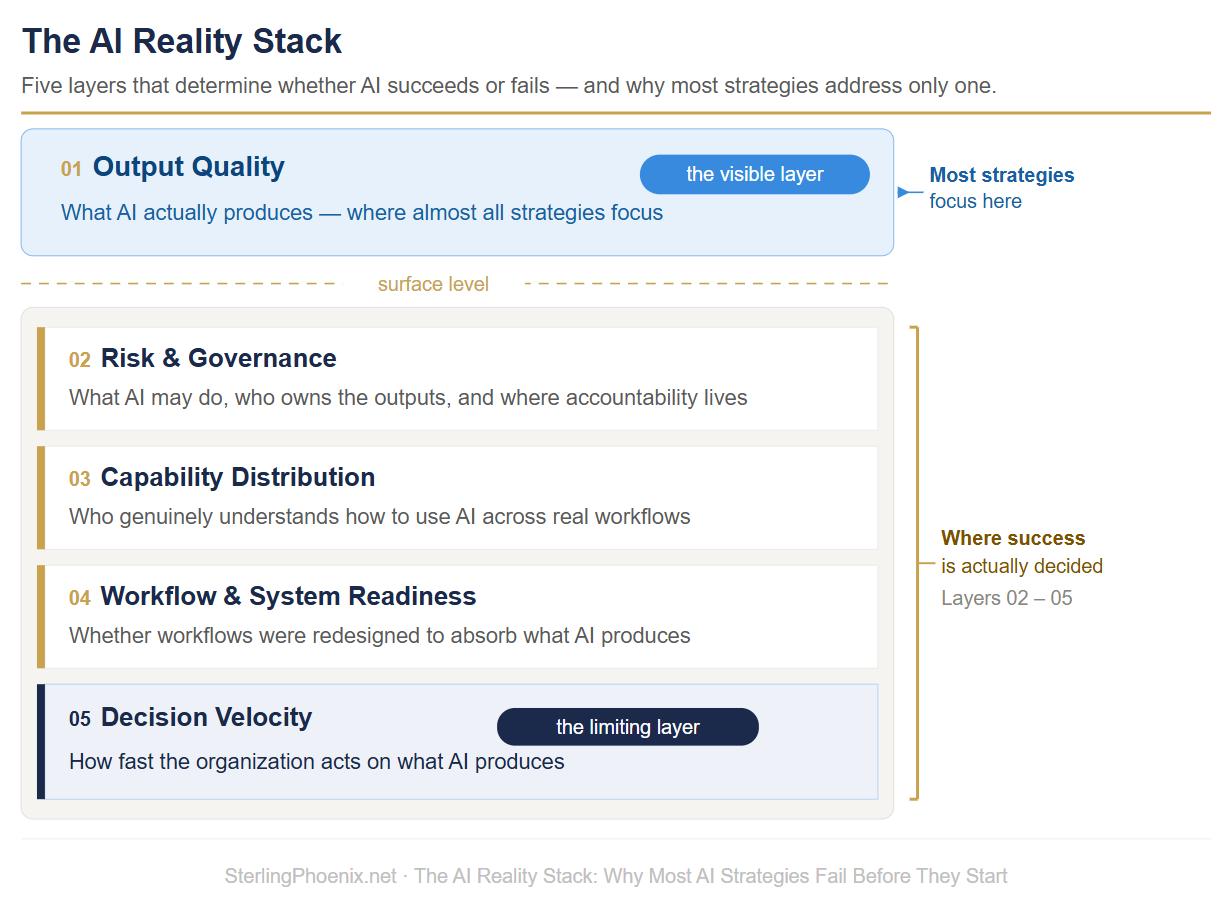
Most organizations operate at the top. Every critical success factor lives below it.
- Layer 1, Output Quality: This layer determines what artificial intelligence (AI) actually produces and whether those outputs are accurate, differentiated, and aligned to the organization.
- Layer 2, Risk and Governance: This layer determines what AI is permitted to do and who is accountable for what it produces.
- Layer 3, Capability Distribution: This layer determines who in the organization genuinely understands how to use AI effectively across real workflows.
- Layer 4, Workflow Readiness: This layer determines whether the organization’s systems were redesigned to absorb and use what AI produces.
- Layer 5, Decision Velocity: This layer determines how fast the organization acts on what AI produces.
Layer 1: Output Quality
The first layer is output quality: whether artificial intelligence (AI) produces work that is accurate, strategically sound, and specifically aligned to the organization rather than to general market patterns.
This is where almost all AI investment goes and where almost all improvement effort is focused. The investment is not wasted; better outputs serve the organization better than worse ones. The layer most organizations spend the most time on is, however, the layer that matters least in isolation. Outputs rarely fail on their own; the systems around them fail them.
The Mediocre Middle is a Layer 1 failure that originates in the absence of internal context, point of view, and output constraints. The outputs look polished. What they’re missing is everything that lives beneath the surface.
Output quality is rarely where failures start; they start one layer down.
Layer 2: Risk and Governance
The second layer is risk and governance: the systems that determine what artificial intelligence (AI) may and may not do, who is accountable for what it produces, and how those decisions are enforced at the moment of use rather than in a policy document outside it.
AI costs don’t disappear with adoption; they relocate into categories that are harder to measure and more expensive to recover from. When Layer 2 is undesigned, those costs appear later as decision errors, brand erosion, data exposure, and budget overruns that leadership never anticipated. Governance built before deployment is infrastructure; governance assembled after an incident is damage control.
Several organizations discovered this through their customer-facing teams, where employees were using AI to respond at scale without any governance defining what the tool could say, what it couldn’t, or who was accountable for the result. The brand was eroding because promises were being made that delivery couldn’t support. Some of those organizations eventually banned AI use entirely, not because the technology failed, but because Layer 2 was never built. The Hidden Cost Myth is a Layer 2 failure: the belief that visible outputs are the product and invisible governance is optional.
If the system isn’t designed for AI, AI will stress it until it breaks. Governance is how you design it.
Layer 3: Capability Distribution
The third layer is capability distribution: how broadly and how durably artificial intelligence (AI) capability is embedded across the organization rather than concentrated in individuals.
In most organizations, AI capability lives in one person or one small group. Everything depends on their availability, their continued employment, and their willingness to remain the organization’s de facto AI expert. This is not a personnel risk; it is a systems risk, and the solution is entirely different from retention. You cannot solve a systems risk by trying to retain a person.
In one organization I’ve observed closely, most of the AI program’s value depended on one person’s working knowledge of how the tools operated. Every prompt library, every governance shortcut, and every undocumented process decision lived inside that individual’s expertise rather than the organization’s documented systems. The program was not an organizational asset; it was a dependency with an unknown departure date.
When Layer 3 is fragile, every other layer becomes less stable. Output quality degrades when the one person who understood the prompting approach is unavailable. Workflow redesigns stall because the institutional knowledge required to execute them is no longer accessible. A broken Layer 3 is a cascade failure waiting for a trigger.
Layer 4: Workflow and System Readiness
The fourth layer is workflow and system readiness: whether the organization’s processes were redesigned to absorb and act on what artificial intelligence (AI) now produces at the speed it now produces it.
Most organizations deploy AI without redesigning the workflows that receive its output. Layering AI onto an unchanged workflow doesn’t improve it; it accelerates the pace at which the workflow’s existing constraints become visible and costly. The correct question before any deployment is not which tool to use. The correct question is: if we were designing this workflow from scratch today, what would it look like?
Reports get completed in hours and sit in review queues for weeks. Analysis gets generated and waits months for a decision that arrives after the conditions it described have changed. The Velocity Collapse begins here, not because AI failed but because the workflow receiving AI output was never redesigned to keep pace with it. Layer 4 is where the Velocity Collapse originates, and it is also where it is most preventable.
Layer 5: Decision Velocity
The fifth layer is decision velocity, and it is the limiting layer. Artificial intelligence (AI) can produce an answer faster than most organizations can decide what to do with it, and the gap between those two speeds is where competitive advantage either accumulates or evaporates.
AI removes one constraint while exposing another. The production constraint disappears, and the decision constraint becomes the most expensive problem in the building, unnamed and unaddressed. Three weeks into a leadership discussion about market positioning, one organization discovered that the market had made the decision for them. The AI analysis had been completed in hours. The decision cycle took three weeks, and the insight expired before it could be used. When it fails, Layer 5 makes every other layer operate under pressure that system design cannot fully compensate for.
Speed without decision is wasted advantage. You can’t fix a Layer 5 problem with better prompts, more sophisticated models, or faster content creation. Decision velocity is a leadership and organizational design problem, and it requires a leadership and organizational design solution.
How the Layers Compound
The five layers of the artificial intelligence (AI) Reality Stack don’t fail independently. Each layer’s failure amplifies the layers adjacent to it, and the compounding is where the real cost accumulates.
A broken Layer 5 makes Layer 4 worse. When decisions slow down, review backlogs grow and the production-to-review gap widens until the organization generates insights it has no capacity to act on. A broken Layer 3 makes every other layer unstable; when capability is concentrated in one person, that person becomes the constraint across all five layers simultaneously. A broken Layer 2 makes Layer 1 untrustworthy: when governance is absent, even high-quality outputs create risk because no one is accountable for their accuracy or downstream consequences.
Most AI improvement strategies focus exclusively on Layer 1 because it is visible, measurable, and responsive to effort. Improving outputs while leaving the underlying layers unchanged is the most common and most costly AI strategy mistake. The investment lands on a foundation that cannot support it, and results plateau or regress without anyone being able to identify why.
How to Know You’re Already Seeing This
The artificial intelligence (AI) Reality Stack failure is visible before it becomes a crisis. These are the signs worth looking for honestly:
- Your outputs are improving but business results are not tracking with them.
- AI usage is increasing but decision speed has not changed.
- One or two people carry the entire AI capability for the organization.
- Insights are produced faster than they’re used.
If more than two of those describe your organization, the stack is already breaking below the layer where you’re spending your attention.
Using the Stack as a Diagnostic
The artificial intelligence (AI) Reality Stack is most useful as a diagnostic tool. The question for each layer is specific, and the answer tells you where the next investment should go.
At Layer 1, the question is whether outputs are accurate and specifically aligned to the organization. Generic outputs that look polished but aren’t grounded in actual business context are a Layer 1 failure. At Layer 2, the question is whether governance decisions were made before deployment or are being assembled in response to something that went wrong. Most organizations discover a Layer 2 failure through an incident rather than a review.
At Layer 3, the question is whether more than one or two people genuinely understand how the AI program operates across real workflows. A Layer 3 failure is visible when a key person’s departure would significantly degrade the organization’s AI capability. At Layer 4, the question is whether workflows downstream of AI production were redesigned to handle increased volume and speed. A Layer 4 failure is visible in review backlogs, unused analyses, and content that was completed but never actioned. At Layer 5, the question is whether decision cycles were recalibrated to match AI output speed. A Layer 5 failure is visible when insights expire before decisions are made.
The Question That Changes Everything
If you lead artificial intelligence (AI) adoption inside your organization, most of the conversations happening around you are happening at Layer 1. The tools, the prompts, the outputs, and the model comparisons are real topics that deserve attention. They are also incomplete ones.
Most organizations think they have an AI strategy when what they actually have is Layer 1 activity on top of Layer 2 through 5 neglect.
Which layer of the stack is actually breaking for your organization? That is where the next investment should go.