
Summary
Picture the pilot demo that impressed everyone last month. Your team tested 50 examples and got 42 acceptable results. Everyone in the room called it a success. Now picture launching that same workflow to your whole team next Monday. It arrives with real customer records, no prepared examples, and nobody standing by to fix what breaks. That is a different test entirely, and most companies never notice the switch.
An artificial intelligence (AI) pilot proves that a capability can produce a useful result under controlled conditions. A production AI workflow must produce that result repeatedly, across normal demand, imperfect inputs, system changes, and employee turnover. Those are different goals, and most companies evaluate them with the same evidence.
A pilot team can choose strong examples, limit users, watch every output, and repair problems by hand. Production introduces ordinary employees, real customer records, unstable integrations, and cases nobody included during development. A pilot succeeds because the project team protects it from operating reality. Production succeeds when the workflow can handle that reality without constant rescue.
Deloitte’s 2026 enterprise research names governance as a deciding factor between successful deployment and stalled expansion. It also connects active leadership involvement with greater reported business value. McKinsey found that only 21 percent of organizations using generative AI had fundamentally redesigned at least some workflows. Workflow redesign still showed the strongest relationship with earnings impact among the 25 factors it studied. MIT Sloan researchers report that companies stall between pilots and broader use because of cost, training, and governance challenges, not the underlying model.
The technology can be capable while your organization remains unprepared to depend on it. That gap, not the model, is what a production standard has to close.
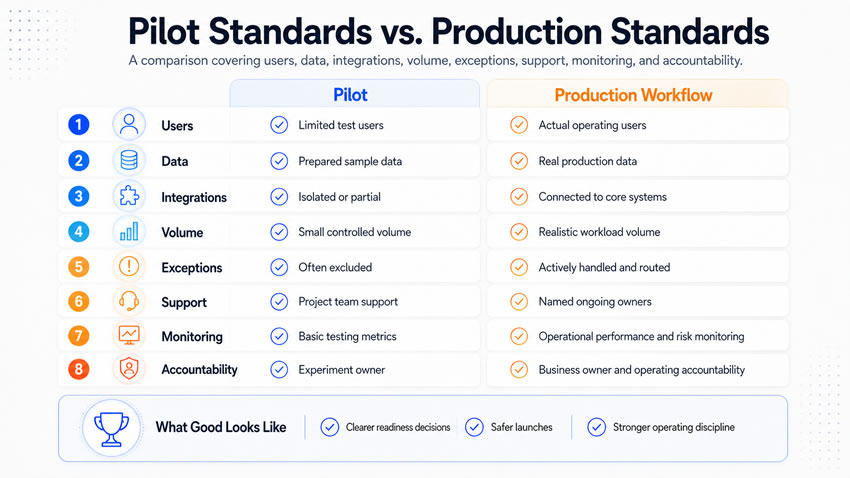
Know that two different goals produce two different tests
A pilot answers a narrow question. Can the model summarize these documents, prepare this research, or classify these requests? A team might test 50 examples and get 42 acceptable results. That evidence justifies continued investment. It does not establish production readiness. A pilot usually runs under conditions your company built for success: prepared inputs, cooperative users, and a builder ready to fix anything that breaks.
Production removes those protections. Employees plan their day around the workflow’s availability. Other systems depend on its records and classifications. A poor pilot output becomes a test finding. A poor production output can become a customer commitment, a financial error, or a missed business action. A delayed pilot run creates inconvenience. A delayed production run can create a backlog across several teams.
That difference in consequence is why production approval needs stronger evidence than a promising demo. You have to understand the workflow’s data, ownership, quality, review, exceptions, integrations, and support before you let it carry real business weight.
Use the Production Readiness Framework as your core thesis
Every workflow eventually asks your organization to depend on it. The Production Readiness Framework turns that dependence into a deliberate decision instead of an accident of momentum. It sorts the evidence you need into three layers. One layer proves the work rests on solid evidence. Another proves you control it in operation. A third proves you can govern it as conditions change.
Layer one: build the evidence foundation
Production needs proof in three areas before it earns your organization’s trust.
- The data must represent normal conditions, not the clean examples a pilot selected. The workflow needs a defined response when information arrives missing, stale, conflicting, or unsupported. Test strong, typical, weak, and adverse inputs separately, since one blended accuracy score hides where the real weakness sits.
- Quality must be defined by business consequence, not by whether an output looks useful. A practical classification separates minor, moderate, major, and critical errors, and the acceptable rate should differ sharply between them. A workflow may tolerate several minor formatting errors while requiring a critical error rate of zero across the evaluated set.
- A measured baseline must exist before launch. Record the previous process’s cycle time, throughput, corrections, and cost, using the same acceptance standard the new workflow will be judged against. A generated draft cannot be compared with a completed business action.
Layer two: build operating control
Production needs control built into the workflow, not supplied by a person watching over it.
- Review must operate as a designed control. Every review point needs a defined trigger, reviewer role, required expertise, acceptance criteria, response time, and escalation authority. A general instruction to check the output provides no dependable protection.
- Exceptions need a destination before launch, including an owner, a response time, and an escalation route for every known exception category. Unknown conditions need a safe default, so the workflow pauses or escalates rather than guessing.
- Integrations must fail visibly and recover predictably. The workflow should know whether to retry, pause, alert, or route a case when a connection fails. It should preserve enough information to continue without creating duplicate records.
- Support must survive competing priorities. A defined model should cover access, data problems, quality concerns, escalations, and incident recovery. The workflow should never depend on attention a project receives only while leadership is watching.
Layer three: build governance and continuity
Production needs to survive people leaving, priorities shifting, and the system changing underneath it.
- Ownership must extend beyond the project sponsor. A named business owner, workflow owner, subject expert, data steward, reviewer, technical owner, governance owner, and measurement owner all need to exist. One person can hold several roles, but every responsibility still needs a name, authority, and a backup.
- Documentation must let someone outside the original team operate, review, and recover the workflow. The National Institute of Standards and Technology (NIST) recommends organized records covering risk, performance, controls, monitoring, and lifecycle decisions. A simple test proves whether documentation works: ask an employee outside the project to run the workflow from the written record alone.
- Training must prepare employees for ordinary conditions, not a polished demonstration. Measure adoption directly, since a required workflow can produce high usage and low trust if employees quietly repeat the old process alongside it.
- Change control must apply to material changes: a new model, a new source system, a broader user group, or reduced human review. NIST notes that deployed AI performance shifts as systems and data change. Give the first production cases after a material change stronger review, since prior evidence applied to the earlier configuration.
Know why promising pilots stall
Pilots usually stall for reasons that have nothing to do with the model. The team keeps adjusting prompts while the source data remains unreliable. The project chases better output quality while nobody has accepted workflow ownership. The prototype improves while the company has never funded review capacity to match it.
A pilot budget often covers a short vendor contract and limited project labor. Production requires integrations, monitoring, support, review, and training that only show up in the cost calculation later. Subject experts may contribute during testing because leadership is watching, then disappear from daily review once the project loses that attention. The pilot may also have quietly excluded the hardest cases, the exceptions that make up a large share of real production volume. That gap leaves the workflow needing redesign before it can carry real load. Most often, several leaders support the project, but nobody owns the complete business result. The decision to scale never gets made by anyone in particular.
OpenAI’s 2026 enterprise guidance names the same pattern from a different angle. It identifies workflow ownership, early governance involvement, defined quality standards, and protected human judgment as the conditions that separate scaling successes from stalled pilots. These conditions sit outside the model. They require leadership decisions and continued resources, not a better prompt.
Answer the questions a production-readiness review has to answer
Seven questions expose most of the gap between a promising pilot and a workflow you can depend on.
- Does repeatable demand justify production, in frequency or value? A rare, low-value task rarely earns the investment.
- Does one business owner accept accountability for scope, resources, and continued investment? Shared ownership usually means no ownership.
- Are quality limits tied to business consequence, with a defined response for major and critical errors? Average performance cannot excuse an unmanaged high-impact failure.
- Can the review model handle expected volume, given realistic response times and available expertise? A workflow producing hundreds of daily outputs cannot depend on one manager’s spare time.
- Do known exceptions have an owner, a response time, and an escalation path? An exception without a destination becomes invisible, unresolved work.
- Can integrations fail without losing control of the records, and can you recover predictably? A demo connection succeeding once proves little about production failure behavior.
- Can employees other than the pilot team operate, review, and recover the workflow from documentation and training alone? If not, the workflow still depends on people who may not stay.
One unresolved answer does not always block a launch. A serious gap involving data integrity, accountability, security, or high-impact decisions should.
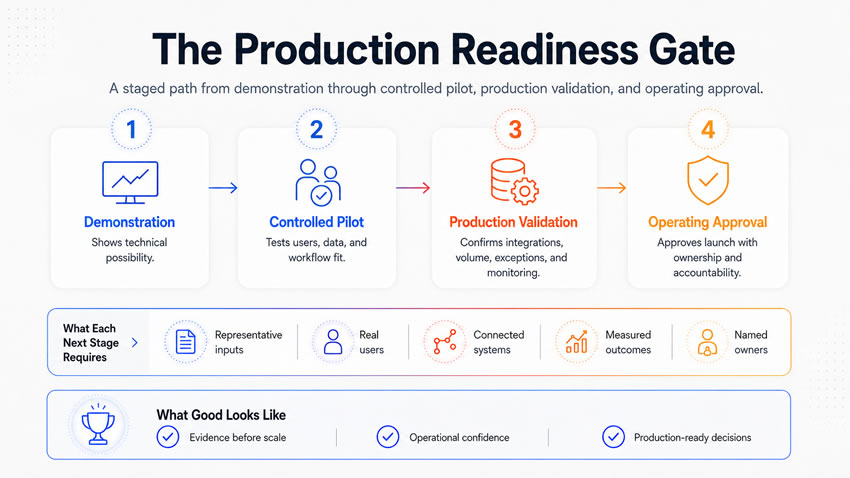
Let four decisions follow the review
A readiness review should end in one of four management decisions, not a vague sense of progress.
The workflow can enter controlled production when the evidence is strong, ownership is clear, and exposure is manageable. The first release should still limit users, volume, or customer impact while monitoring stays high. The pilot may need specific additional evidence. In that case, give the team named gaps, an owner for each one, and a decision date, rather than permission to keep testing indefinitely. The workflow may need redesign when the underlying capability works but the surrounding process, data, or integrations remain weak. The use case may need to stop when its operating cost, risk, or complexity outweighs the benefit. Technical success does not guarantee a sound business investment.
Run this 60-day path from pilot to controlled production
Days one through 15. Document the pilot’s evidence: the cases tested, the errors, the corrections, and every manual action the pilot team performed by hand. Those actions often reveal the work production will have to absorb on its own.
Days 16 through 30. Design the operating workflow. Map the trigger, inputs, decisions, reviews, exceptions, and fallback. Assign the business, technical, data, governance, and measurement owners, then build the documentation and training guide.
Days 31 through 45. Test production conditions directly, using typical users, normal volume, weak inputs, known exceptions, and simulated system failures. Measure cycle time, corrections, review load, support demand, and operating cost against the earlier baseline.
Days 46 through 60. Launch within defined boundaries, to a limited group, with monitoring and review held higher than the steady-state target during stabilization. Compare results against the baseline, then decide whether to expand, revise, restrict, or stop the workflow.
What you tell them at the end
Stronger production standards need enough operating clarity for your organization to depend on the result, not endless committees and paperwork. A low-risk internal assistant may need a short workflow record and sampled review. A customer-facing agent with system permissions needs deeper testing, stronger controls, and active monitoring. Match the standard to the consequence, and proportionate standards help teams move faster, because everyone understands the boundary they are building toward.
A successful pilot proves that a capability deserves consideration. It does not prove that you have done the work of depending on it. The data has to support normal conditions. The owners have to accept continuing responsibility. Review has to protect real consequences without creating an unmanageable queue. Documentation has to survive the people who built it moving on. These standards explain why a genuinely strong demonstration can still be unready for production. Closing that gap is a leadership decision, not a technical one.