
Summary
Why AI Feels Free at First, and Becomes Expensive at Scale
Most artificial intelligence (AI) cost problems aren’t discovered; they’re revealed when the bill arrives. By then, the usage is already embedded, the cost is already committed, and the conversation nobody wanted is now unavoidable.
I think of this as the AI Budget Illusion.
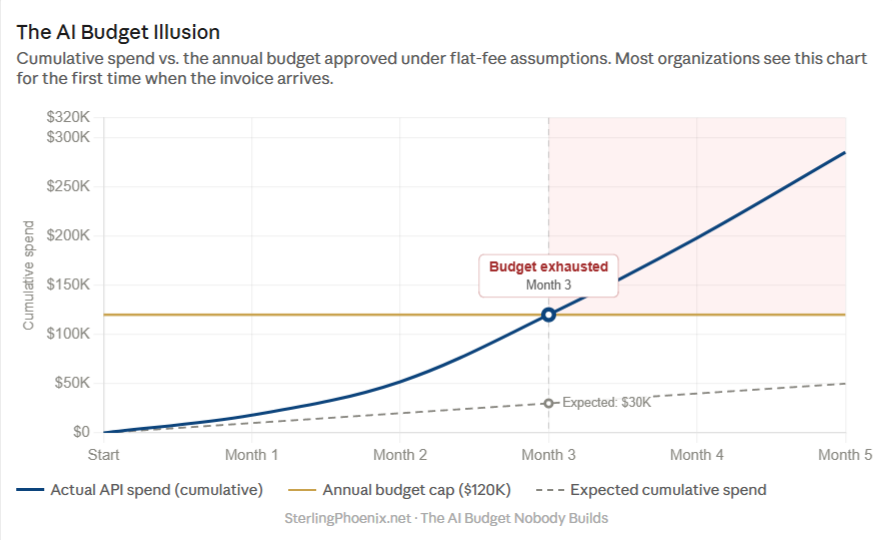
The AI Budget Illusion is what happens when organizations treat usage-based AI like flat-cost software. The gap between those two pricing models only becomes visible after usage has already scaled. AI didn’t break your budget; your model for measuring it did.
The Psychology of “Free”
Flat AI subscriptions don’t just reduce friction; they remove cost awareness entirely. When a team pays a fixed monthly fee, counting individual uses feels pointless. The mental model becomes: this is paid for, so use it freely.
That model holds until the organization moves to an application programming interface (API)-based deployment. APIs are billed by the token: every prompt, every output, every automated workflow carries a measurable cost. The economics of “use it freely” do not transfer. When usage feels unlimited, behavior becomes unbounded, and unbounded behavior inside a usage-based billing system produces a predictable outcome.
What feels free at the interface becomes expensive at scale. This gap is consistently underestimated because the people making AI procurement decisions often carry flat-subscription mental models into usage-based environments. Those two models require fundamentally different governance, and most organizations discover that difference on an invoice rather than in planning.
What the Explosion Actually Looks Like
The pattern is consistent. An organization runs an enthusiastic rollout. Teams adopt the tools faster than leadership anticipated. High-volume use cases emerge organically: content generation at scale, automated research workflows, API calls embedded in sales processes. No one planned for scale, but scale happened anyway.
Then the quarterly bill arrives.
By the time finance asks for numbers, the system is already in use across teams, integrated into workflows, and embedded in daily operations. The ROI math that should have been done before deployment is now being done in a meeting nobody wanted, using numbers nobody tracked. What nobody tracked: cost-per-output, high-volume use case volumes, API calls per workflow, and total spend rate against what was budgeted annually.
Organizations routinely discover they have consumed what leadership approved as an annual AI budget within three or four months. You didn’t overspend so much as fail to define what spending meant in this environment.
Why It Keeps Happening
Organizations approve AI like software while consuming it like infrastructure. Software procurement follows a predictable model: negotiate a license, approve the annual fee, track the renewal. Infrastructure requires ongoing usage management, cost-per-unit visibility, and consumption governance. Those are different disciplines, and most organizations haven’t recognized that AI moved into the second category.
Usage governance is treated as an afterthought rather than a prerequisite. Nobody owns “cost of AI output” as a real operational metric. Nobody has defined what a single unit of AI work costs, at what volume that cost becomes material, or who is responsible when spending crosses a threshold. If usage isn’t governed, cost isn’t controlled.
This is one layer of a broader pattern I think of as the AI Reality Stack: where cost, governance, and decision systems determine whether AI creates leverage or exposure. The budget explosion is always a governance failure before it becomes a spending problem.
The AI Cost Control Model
If AI is usage-based, your cost model has to be usage-based too. The governance framework that prevents the budget explosion is not complicated, but it must be built before deployment scales, not after the invoice arrives.
Define cost-per-output before you scale. Identify what a single unit of AI work costs in your environment: per prompt, per workflow run, per output generated. If you don’t know what a single unit of AI work costs, you don’t have a budget; you have exposure. This number exists whether or not you have calculated it yet.
Set approval thresholds for high-volume use cases. High-volume AI usage is a financial decision, not a tool decision. When a team wants to automate a workflow generating thousands of API calls monthly, that request requires financial review the same way any significant operational spend does. Build the approval path before the use case goes live.
Establish budget review triggers. Define the spending level that kicks off a conversation before that number appears on a bill. The real mistake is not knowing when spending changed, not the overspending itself. A monthly review trigger at 60% of budgeted AI spend gives leadership time to respond rather than react.
Answer three questions before scaling access. Every organization expanding AI access should be able to answer these clearly: What does one unit of AI output cost? At what volume does that cost become material to the budget? Who is responsible when it does? If these questions don’t have documented answers, the AI program doesn’t have a cost model.
The Counterintuitive Truth
You don’t have a cost problem; you have a visibility problem. Cost follows usage, and usage follows visibility. The organizations that measure AI costs do not use AI less; they use it with intent, focusing resources on the use cases that generate real return rather than the ones that generate volume without value.
You don’t need to slow down AI adoption; you need to make it visible. That distinction matters because visibility does not constrain adoption. It redirects it.
AI doesn’t reduce cost; it reduces visibility, and what you cannot see is what grows the fastest. Build the accounting model before you build the use cases. The organizations that do will spend less, capture more value, and avoid the meeting nobody wants to have when month three’s bill arrives.