
Summary
Artificial intelligence (AI) assistants help a person complete work. AI agents receive authority to pursue a goal across several steps, often without a person present for each one. Most companies treat that difference as a vendor label rather than an operating decision, and the confusion shows up fast.
You have probably seen both mistakes already. Some teams hand agent autonomy to work that only needed a helpful assistant, and the organization inherits actions nobody approved. Other teams force employees through manual steps a bounded agent could complete safely, and the organization pays in coordination time it never needed to spend. Both mistakes come from the same root cause: skipping the decision about which model the work requires.
Start with the work itself. Examine the task, the consequences, the system access, and the judgment required, before you choose between an assistant and an agent.
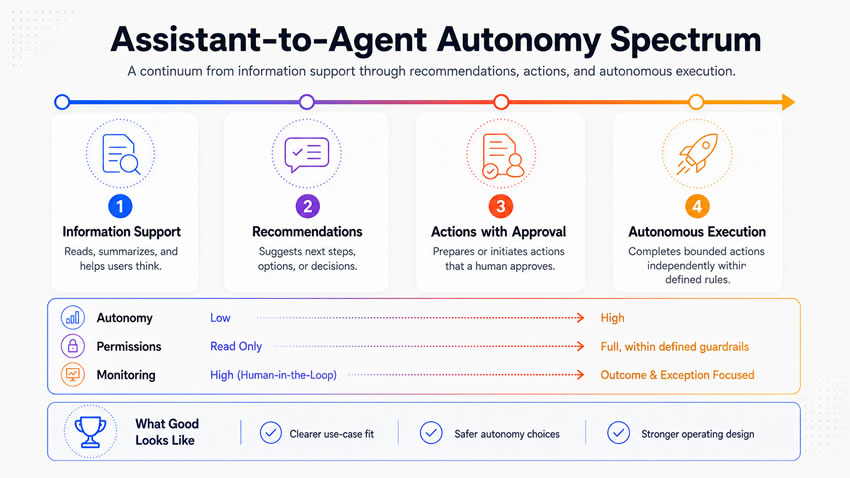
Recognize the two different operating models
An assistant usually waits for a person to ask a question or give an instruction. The person stays close to the work and controls what happens next. An agent can select tools, retrieve information, adjust its plan, and complete approved actions, often continuing after the original request ends.
MIT Sloan describes AI agents as semi-autonomous or autonomous systems that can perceive, reason, act, and interact with other software. Anthropic distinguishes predefined workflows from agents that dynamically direct their own process and tool use. It recommends adding complexity only when a simpler approach cannot meet the need. OpenAI describes agents as systems that reason through ambiguity, use tools, and complete multistep workflows, with evaluations, guardrails, and human intervention built into the design.
Those three definitions point you toward one practical decision. An assistant should support a person’s judgment. An agent should carry delegated responsibility inside boundaries you set on purpose.
Use the Autonomy Assignment Framework as your core thesis
Every AI deployment assigns autonomy, whether you designed that assignment or not. The Autonomy Assignment Framework makes the assignment deliberate. It sorts work into three layers. One layer covers work that belongs close to a person’s judgment. Another covers work you can safely delegate. A third is the governance layer that keeps the delegation honest as conditions change.
Layer one: proximity, the assistant candidates
Give work an assistant when most of the following hold true.
- A person needs to shape the work continuously, adding context, changing the goal, or challenging the result as the task develops.
- The work involves professional judgment, such as strategy, negotiation preparation, sensitive messaging, or complex analysis.
- The completion condition depends on interpretation rather than a fixed rule the system can check on its own.
- The user can identify a poor response during the interaction, before it reaches a customer, a record, or a decision.
- Permissions can stay narrow, since the person completes the resulting action separately.
- The task fits inside one working session or a visible conversation, without needing to persist across days or systems.
- Occasional or judgment-heavy system actions remain appropriate, rather than repeated transfers at real volume.
Strategic research, content development, high-value sales preparation, financial interpretation, employee communication, policy questions, and exploratory data work all fit this layer well. An assistant can gather sources, compare options, and prepare a draft. You still own the conclusion.
Layer two: delegation, the agent candidates
Give work an agent when most of the following hold true.
- The goal is stable and repeatable, with a completion condition you can define in advance.
- The workflow needs several connected actions, such as retrieval, routing, updating, and follow-up, rather than one response.
- An observable event, such as a new case, a threshold, or a schedule, can start the work reliably.
- Permissions can stay narrow enough to match the approved outcome, without requiring broad access to sensitive systems.
- Errors can be detected through monitoring before they cause serious harm, even without continuous human attention.
- Unusual cases have a clear destination, so the agent escalates conditions its design cannot safely resolve.
- You can reconstruct every action later, and reverse or contain the ones that go wrong.
Structured service triage, invoice exception routing, sales research operations, content production coordination, onboarding administration, account monitoring, and compliance preparation all fit this layer well. The agent removes repeated coordination. You still own the consequential decision inside the workflow.
Layer three: control, the governance discipline you cannot skip
Delegated authority needs a graduated permission model, active monitoring, and named ownership, or the delegation drifts past what anyone approved.
Build permissions in stages. Read-only retrieval comes first, followed by draft creation with human approval, then bounded updates to selected fields. Bounded external actions, such as sending an approved message, come next. Full workflow execution stays reserved for mature, monitored cases. Most workflows never need the highest level, and a narrow, well-monitored agent still creates real value.
Track valid triggers, completed and failed runs, and tools selected. Track actions attempted and completed, the exception and escalation rate, duplicate actions, recovery time, and total operating cost too. The National Institute of Standards and Technology (NIST) recommends postdeployment monitoring, user feedback, appeals, overrides, incident response, and change management for exactly this reason. NIST launched its AI Agent Standards Initiative in February 2026 to address secure agent actions, interoperability, identity, and authorization. The timing reflects how much authority agents now carry.
Name a business owner, a workflow designer, a subject expert, and a data steward. Name a reviewer, a technical builder, a governance owner, and a measurement owner too. One person can hold several roles, but every responsibility still needs a name and available time. Give agent memory the same discipline. Define what the agent remembers, where that memory lives, and how long it remains, and define which facts belong in an authoritative business system instead.
Watch how the framework works inside one workflow
Consider a sales opportunity that needs both models. An agent detects that an account meets an approved research threshold, then gathers public information and recent engagement. It creates a structured record assigned to the account owner. That work carries delegated authority.
An assistant then helps the account owner interpret the signals and prepare meeting questions. That work stays close to judgment. The account owner approves the outreach strategy, and the agent records the approved action and creates follow-up tasks. Each participant owns the work suited to its strengths, and the relationship decision never leaves the person accountable for it.
Apply the framework across your functions
Research and strategy. Give an assistant market analysis, competitive comparison, and strategic option development, since the conclusion needs your judgment. An agent can later handle repeatable research retrieval once you define the criteria.
Content. Give an assistant drafting, structure, and editing, since positioning and argument need a subject expert’s review. An agent can coordinate production tasks, channel formatting, and status updates once an article receives approval.
Sales. Give an assistant account interpretation and meeting preparation, since relationship strategy stays with the salesperson. An agent can trigger research at an approved threshold, compile the brief, and assign follow-up tasks.
Finance. Give an assistant variance interpretation and forecast scenarios, since a finance professional confirms the business effect. An agent can match invoices to purchase orders and route discrepancies, without payment authority unless stronger controls justify it.
Customer service. Give an assistant drafting a context-appropriate response, since sensitive commitments need employee approval. An agent can classify incoming cases, retrieve approved account context, and route work to the right queue.
Human resources. Give an assistant feedback preparation and difficult conversations, since accountability stays with the manager. An agent can handle onboarding tasks, equipment requests, and training reminders across a predictable checklist.
Run this decision sequence in one meeting
Seven questions will sort most of your workflows correctly.
- Does a person need to shape the work continuously? If yes, favor an assistant.
- Can you define a clear completion condition in advance? If not, redesign the process before delegating it.
- Does the work need several connected actions across systems? If yes, an agent likely adds more value than an assistant.
- Can permissions stay narrow and still deliver the outcome? If not, reconsider the use case before expanding access.
- Can errors be detected before serious consequences occur? If not, keep a person inside the approval path.
- Do unusual cases have a safe, named destination? If not, the workflow needs assistant support until that gap closes.
- Can you maintain the agent after launch, with named ownership and funded monitoring? A “no” keeps the work in pilot status.
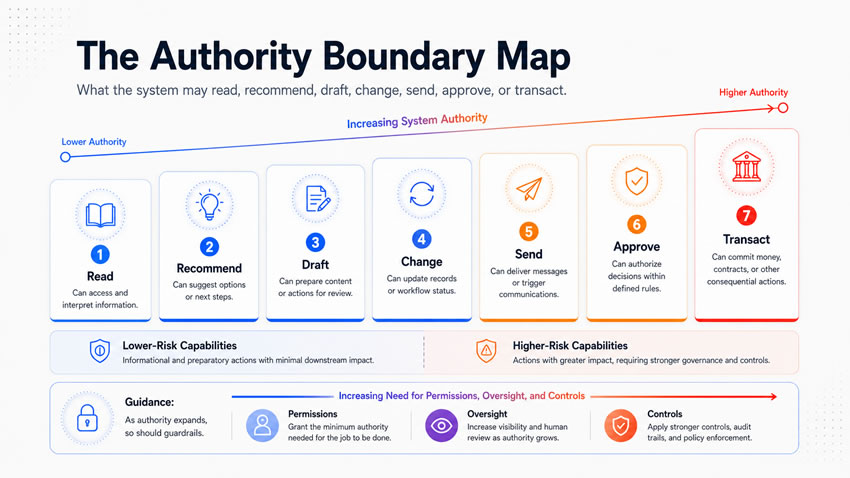
Start with the lowest autonomy that solves the problem
Anthropic recommends starting with the simplest approach and adding agent complexity only when necessary. An assistant-first approach gives you evidence about inputs, decisions, exceptions, and outputs before you delegate authority based on assumptions.
Starting with an agent can hide unresolved decisions inside technical logic. You may grant permissions before you understand which actions the work requires, or automate a process employees have never defined consistently. An assistant-first approach means earning delegation with evidence, one workflow at a time, rather than committing to permanent manual work.
Run this 30-day evaluation for one workflow
Week one. Observe the current work. Follow representative cases from request through completion, and document the decisions, systems, handoffs, and exceptions involved.
Week two. Test an assistant. Use it to support research, drafting, or analysis, and record where human judgment changed the direction of the work.
Week three. Identify delegable steps. Find the repeated actions with stable rules and clear completion conditions, and define the permissions and exception paths an agent would need.
Week four. Test bounded autonomy. Let an agent complete a narrow portion of the workflow with active monitoring, then compare cycle time, corrections, and business outcomes against the assistant-supported approach.
Watch for the mistakes that undermine the decision
Choosing a model based on a vendor’s label, rather than what the system does after receiving a request, produces the wrong assignment most often. Granting broad permissions before you define the required actions creates exposure the workflow never needed. Treating a conversational interface as proof of low autonomy misses that an agent can use a chat interface while still holding authority to act. Skipping monitoring until after launch leaves failures invisible exactly when they matter most. Assigning an agent to a workflow with unresolved policy questions encodes those unresolved questions into automated behavior nobody reviewed.
What you tell them at the end
An assistant makes an employee more capable. An agent makes a workflow more independent. Once you understand this difference, stop asking whether artificial intelligence can do a task. Start asking who, or what, should hold authority over it, and under what conditions.
The organizations building durable value from artificial intelligence in 2026 are assigning autonomy on purpose, one workflow at a time. The strongest design gives each model the problem it is equipped to solve.