
Summary
Many marketing teams already have access to artificial intelligence (AI) tools. They often have prompts, licenses, a training session or two, and clear encouragement from leadership. On paper, the team is ready.
In practice, access does not equal adoption. People try a tool once, use it privately, or avoid it because they do not trust the output, understand the workflow, or know what is acceptable.
The anchor idea is human rather than technical. AI adoption becomes real when people trust the workflow enough to use it during actual work.
I have watched capable teams stall at exactly this point. The tools worked, and the behavior never changed, because the organization skipped the hidden work that makes a workflow usable.
What AI Adoption Really Means Inside Marketing
Adoption is not the number of people with tool access. It is the degree to which AI becomes part of approved, repeatable, useful work.
Real adoption is visible in behavior. People know which workflows are approved, and they understand when AI should assist. They know which inputs they can use, they trust the review process, and they reach for shared prompts and examples. They improve outputs with sound judgment, store what works for the team, and ask better questions when an output fails.
That is a different standard from usage. A person can use a tool privately every day while the team gains no shared, durable capability from it.
Why AI Adoption Feels Harder Than Tool Rollout
Tool rollout is visible, and adoption work is behavioral. A leader can buy licenses, announce access, and host a training session in a week. None of that teaches the team how to use AI inside campaign deadlines, content reviews, reporting cycles, and executive pressure.
The reasons adoption stalls are consistent across teams.
- People do not know where AI fits into existing work.
- People worry about being judged for using it.
- People worry about being replaced by it.
- People do not trust the output.
- People do not know which data is safe to use.
- Managers send mixed signals about whether to use it.
- Training is too generic to change behavior.
- Documentation is scattered across chats and folders.
- Quality standards are unclear.
- Early workflows create more review work than they save.
This pattern is not a local failure. McKinsey’s 2025 State of AI report found that nearly nine in 10 respondents report regular AI use, while most organizations have not embedded AI deeply enough into workflows and processes to realize enterprise-level benefits.¹ The gap between access and embedded use is the adoption problem.
The Framework: The AI Adoption Enablement Layer
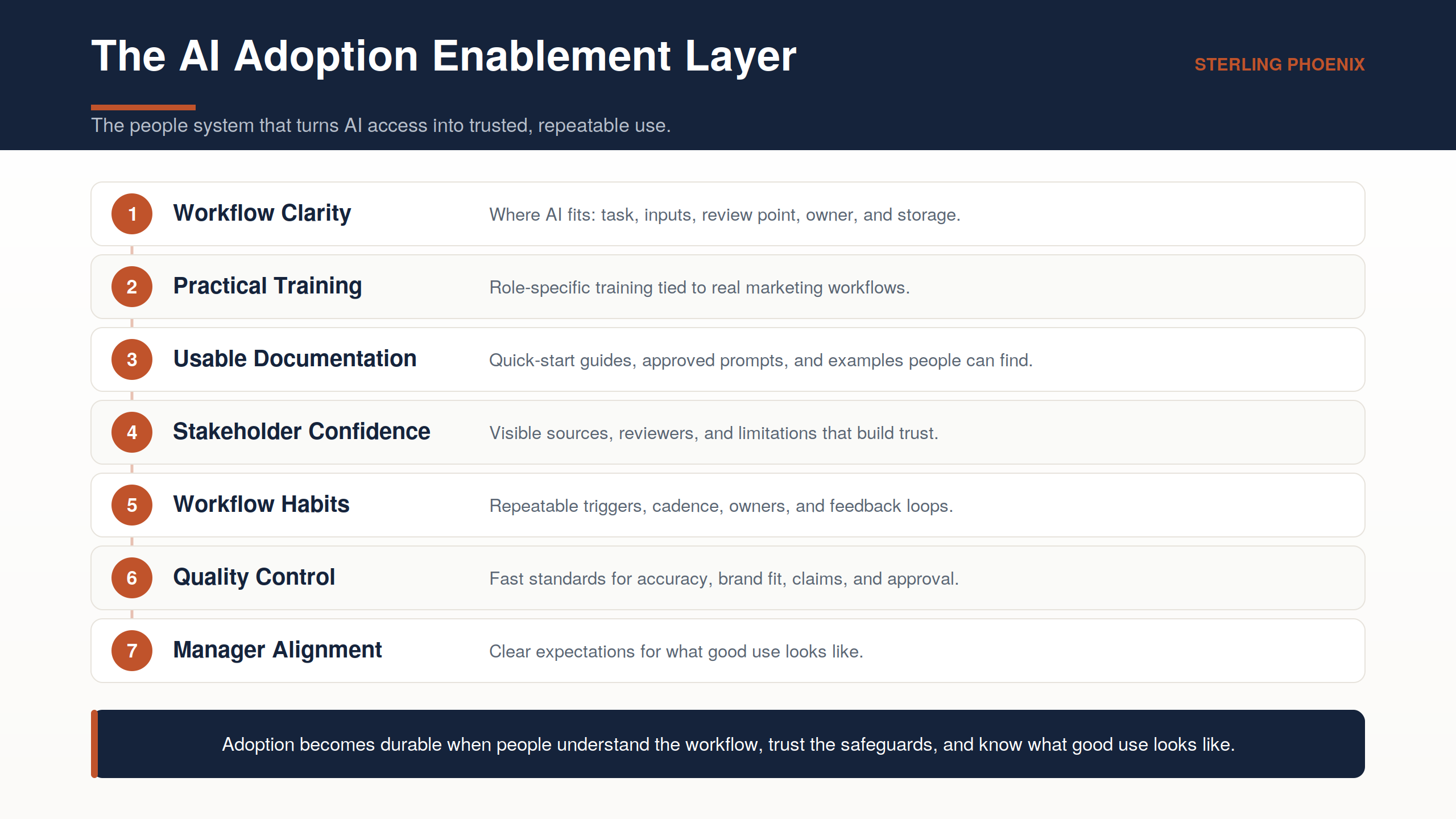
The AI Adoption Enablement Layer is the people system that turns AI access into trusted, repeatable use. It has seven parts, and a team needs all of them working together.
Layer One: Workflow Clarity
People need to know exactly where AI fits into the work. Workflow clarity defines the task, the trigger, the inputs, the AI step, the human review point, the output, the owner, and the storage location. Without it, people experiment privately or avoid the tool entirely.
Layer Two: Practical Training
Training should teach people to use AI inside real marketing work. Useful training draws on examples from campaign planning, content repurposing, reporting summaries, account research, and sales enablement. Generic prompting lessons rarely change team behavior on their own.
Layer Three: Usable Documentation
Documentation should help people act quickly during real work. It includes quick-start guides, approved prompts, example inputs and outputs, review standards, known failure points, and escalation paths. It should live where people already work or inside a clearly maintained repository.
Layer Four: Stakeholder Confidence
Stakeholders need to trust the system before they trust the output. Confidence grows when people understand where the data came from, how the workflow runs, who reviewed the result, and what the tool was not allowed to decide. This matters for leadership, sales, content reviewers, legal teams, and managers.
Layer Five: Workflow Habits
Adoption becomes durable when workflows become habits. The team needs repeatable triggers, a recurring cadence, standard templates, named owners, and feedback loops. A workflow that runs once is a test, while a workflow that runs every week with review and improvement becomes capability.
Layer Six: Quality Control
Quality control protects trust. The team needs clear standards for accuracy, brand fit, source grounding, claims, customer sensitivity, and final approval. Quality control also tells people what to do when an output is weak, generic, incomplete, or risky.
Layer Seven: Manager Alignment
Managers shape adoption more than tool access does. When managers reward only speed, people skip review, and when managers distrust all AI output, people hide their usage. Manager alignment defines what good use looks like, where review is required, and how AI-supported work will be evaluated.
A concrete case shows how the layers work together. A team may introduce an AI-assisted campaign summary workflow. Adoption improves when users know when to run it, which campaign data to use, which prompt is approved, who reviews the summary, where the final version is stored, and how sales or leadership will use it. Without those details, the workflow feels like another experiment rather than part of the team’s operating rhythm.
The Training Model Marketing Teams Actually Need
Effective enablement avoids long, abstract sessions in favor of short, role-specific training tied to real workflows. The format should lower the cost of the first attempt.
A strong training set includes a 20-minute workflow demo and a one-page quick-start guide. It also includes a before-and-after example, a live practice session using real inputs, a review checklist, and a failure example that shows what weak output looks like. A short follow-up session after the first use locks in the habit.
Training should also fit the role. Content teams need examples for briefs, drafts, repurposing, and editorial review, while demand generation teams need examples for campaign analysis, audience segmentation, and follow-up planning. Sales enablement teams need examples for account briefs, call preparation, and message adaptation, and managers need examples for review, approval, and expectation setting.
Documentation Should Reduce Hesitation
Documentation earns its place when it answers the questions people ask before they act. The right page lowers the cost of trying a workflow for the first time.
- What is this workflow for?
- When should I use it?
- What inputs do I need?
- Which source materials are approved?
- Which prompt should I use?
- What should the output look like?
- What should I review before using it?
- What mistakes should I watch for?
- Who owns this workflow?
- Where do I send feedback?
Stakeholder Confidence Depends on Visible Safeguards
Stakeholders do not need every technical detail. They need enough clarity to trust the process, especially when AI feels like a black box.
Visible safeguards build that trust. They include approved data sources, human review points, clear ownership, and output notes or labels. They also include confidence levels, source links, escalation rules, version history, known limitations, and review dates.
Data readiness is one of the visible safeguards stakeholders can understand, because it shows that the workflow has reliable inputs before the output is trusted. The concern is well founded, since Gartner has predicted that organizations will abandon 60 percent of AI projects unsupported by AI-ready data through 2026.²
Resistance Is Information, Not Failure
Resistance usually signals a real concern rather than a lack of willingness. People resist because a workflow is unclear, an output is weak, the review burden is too high, or the perceived threat feels personal. A Marketing AI Operations lead should diagnose resistance rather than dismiss it.
The signals each point to a specific fix.
- People keep using private prompts, which signals that the shared workflow is hard to find or trust.
- People avoid approved workflows, which signals unclear value or fit.
- Reviewers reject most outputs, which signals weak inputs or prompts.
- Managers ask for manual work again, which signals low confidence in the result.
- Sales ignores AI-generated briefs, which signals that the briefs miss what sellers need.
- Content teams rewrite everything from scratch, which signals a brand or quality gap.
- People ask for approval every time, which signals that the review rules are unclear or too risky to interpret alone.
Manager Expectations Must Be Explicit
Managers often create the friction that stalls adoption, so their expectations need to be stated plainly. Clarity here removes the ambiguity that pushes usage underground. Employees should not have to guess whether AI-supported work will be praised, questioned, hidden, or penalized.
Managers should define which workflows should use AI, which workflows may use it, and which should not use it yet. They should also define the level of human review required, how time savings should be used, and how quality will be evaluated. They should make clear how mistakes should be reported, how employees should disclose AI use internally, how reusable workflows should be documented, and how success will be measured.
Quality Control Is the Trust Engine
Quality control is what protects adoption over time, because one bad output in front of a customer or executive can undo months of progress. A practical quality system checks the output against a clear set of standards.
It checks accuracy, source grounding, brand alignment, and strategic relevance. It also checks completeness, claims and evidence, audience fit, data sensitivity, fair framing, and any required approvals. The system must be fast enough to use, because a review process that feels too heavy is one that people quietly work around.
What Leaders Should Measure
Measurement should focus on adoption and confidence rather than vanity metrics like logins. Treat the following as operating measures rather than guaranteed outcomes.
- The number of approved workflows in active use shows real adoption.
- The repeat usage rate by workflow shows whether habits are forming.
- The number of trained users shows enablement reach.
- The share of outputs passing review shows quality.
- The average revision burden shows whether the workflow saves time.
- Manager and user confidence ratings show trust.
- Stakeholder acceptance of outputs shows downstream value.
- The number of reusable assets added to the repository shows compounding capability.
- The time from training to first real workflow use shows whether enablement turns into behavior.
- The share of workflows with updated examples after feedback shows whether the system improves.
A 30-Day Enablement Plan
Enablement starts small and improves through real use. A focused month builds more durable behavior than a broad launch.
- In week one, the lead identifies current adoption patterns, interviews managers and users, and finds where people already use AI privately.
- In week two, the lead chooses one or two workflows for focused enablement, creates quick-start documentation, and defines review rules.
- In week three, the lead runs role-specific training, shows before-and-after examples, and supports the first real workflow run.
- In week four, the lead collects feedback, improves the workflow, updates the repository, and clarifies manager expectations for continued use.
Common Mistakes
A few predictable mistakes undermine adoption, and naming them prevents most of them.
- Teams treat tool access as adoption.
- Teams deliver generic training without workflow context.
- Teams assume resistance means people are unwilling.
- Teams skip manager alignment.
- Teams create documentation that people cannot find.
- Teams measure logins instead of useful workflow use.
- Teams ignore the review burden their workflows create.
- Teams let private prompt systems compete with shared workflows.
- Teams fail to show both strong and weak examples.
- Teams expect confidence before people can see the safeguards.
The Strategic Implication
AI adoption is not a communications campaign or a single training event. It is the steady work of making workflows understandable, safe, useful, and repeatable for the people who do the work.
The hidden work of adoption is what turns AI access into trusted marketing capability. A team that does this work owns a durable advantage, because its capability lives in shared habits rather than in a few private chats.
Key Takeaways
- AI adoption becomes real when people use approved workflows during actual work.
- Training works best when it is role-specific and tied to real marketing workflows.
- Documentation should reduce hesitation by making inputs, prompts, review rules, and owners clear.
- Stakeholder confidence grows when safeguards, sources, reviewers, and limitations are visible.
- Manager expectations determine whether AI use becomes trusted, hidden, or inconsistent.
Frequently Asked Questions
What does AI adoption mean in marketing? AI adoption in marketing means approved AI workflows become part of repeatable work across planning, content, campaigns, reporting, sales enablement, and review.
Why do marketing teams struggle with AI adoption? Marketing teams struggle when training is generic, documentation is scattered, review rules are unclear, and managers send mixed expectations.
How should marketing teams train people on AI? Marketing teams should train people on specific workflows using real examples, approved prompts, review checklists, and short practice sessions.
How can leaders reduce resistance to AI adoption? Leaders can reduce resistance by clarifying expectations, showing safeguards, addressing workload concerns, and improving workflows based on user feedback.
What should teams measure during AI adoption? Teams should measure repeat workflow usage, review quality, user confidence, manager confidence, time saved, reusable assets, and stakeholder acceptance.
Framework Reference: The AI Adoption Enablement Layer
Definition. The AI Adoption Enablement Layer is the people system that helps marketing teams turn AI access into trusted, repeatable use.
Components. Workflow Clarity, Practical Training, Usable Documentation, Stakeholder Confidence, Workflow Habits, Quality Control, and Manager Alignment.
Application. Teams apply the framework by clarifying workflows, training users in context, documenting reusable assets, making safeguards visible, managing resistance, aligning managers, and measuring repeat use.
References
- McKinsey & Company. The State of AI in 2025: Agents, Innovation, and Transformation (November 2025). https://www.mckinsey.com/capabilities/quantumblack/our-insights/the-state-of-ai
- Gartner. Lack of AI-Ready Data Puts AI Projects at Risk (February 2025). https://www.gartner.com/en/newsroom/press-releases/2025-02-26-lack-of-ai-ready-data-puts-ai-projects-at-risk