
Summary
Picture two workflows you have probably already lived through. One buries a manager under hundreds of approvals a day until the queue forces rushed decisions. The other releases everything automatically until a customer, an employee, or a regulator finds the error first. Neither failure comes from bad intentions. Both come from picking a review model before anyone scored what the work required.
Let human review follow the consequence of the work, the strength of the evidence, and your company’s ability to detect mistakes. Reviewing every artificial intelligence (AI) output can create delays, approval fatigue, and expensive queues. Releasing every output automatically can expose customers, employees, finances, and your company’s reputation to preventable harm. The right model sits between those extremes, and it changes by workflow rather than staying fixed company-wide.
The National Institute of Standards and Technology (NIST) recommends defining human oversight according to each system’s context, risk, and organizational tolerance. It also recommends documenting the oversight provided and measuring whether it still works. The European Union’s Artificial Intelligence Act applies a similar risk-based logic. High-risk systems must support human oversight matched to their intended purpose and potential effects. Both frameworks point at the same practical conclusion. Design human review around the work, not as one universal approval requirement stapled onto everything.
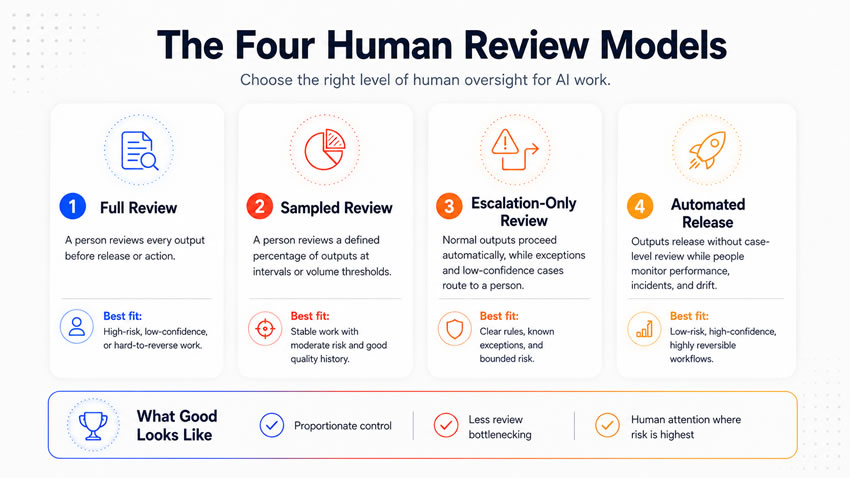
Cover most workflows with four models
Full review puts a qualified person in front of every output before the workflow continues. It fits work with serious consequences, weak confidence, or real regulatory exposure. Sampled review examines a defined portion of outputs, combining random cases with higher-risk and near-threshold cases, and it fits established workflows with manageable consequences. Escalation-only review lets the system complete normal cases while routing defined exceptions to people, who also monitor performance and recurring incidents. It fits mature workflows with dependable exception detection. Automated release lets the system complete normal outputs without case-level review at all. Accountability shifts from approving individual outputs to governing system permissions and performance.
Know that reviewing everything fails on its own terms
Universal review looks cautious and often is not. A workflow producing hundreds of outputs a day can outgrow one reviewer’s available time within weeks of launch. The backlog that follows pushes employees toward approving work quickly to clear the queue. Familiarity compounds the problem. MIT Sloan’s research with Accenture found that people consistently overestimate their own ability to catch generative AI errors. It recommends deliberate friction targeted by risk rather than relying on human presence alone. NIST names the related failure automation bias, excessive deference to a polished, confident-sounding output. That deference can amplify the exact errors a reviewer was supposed to catch.
Beyond attention, review can fail on structure. A manager may approve a financial recommendation without understanding the calculation behind it. A reviewer may see only the final output, without the sources, assumptions, or confidence indicators that would let them evaluate it. A person may spot a real problem and still lack the authority to reject, pause, or escalate it. Reviewing everything equally spends human attention without protecting the cases where judgment changes the result. That is the entire point a proportional model exists to fix.
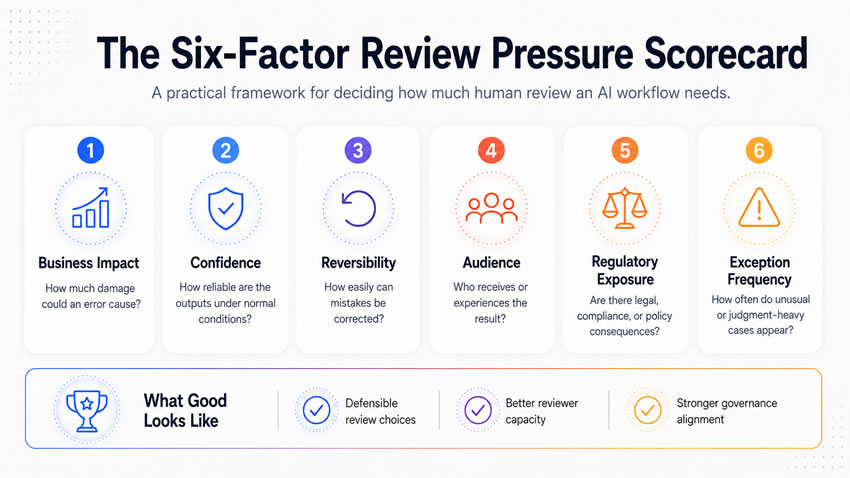
Use the Review Pressure Score as your core thesis
Six factors determine how much review pressure a workflow genuinely carries. Score each from one to five, weight them, and total them out of 100 points.
Business impact, worth 25 points, covers revenue, customers, employees, contracts, reputation, and safety. A one describes minor internal inconvenience. A five describes an error that can affect rights, safety, legal obligations, or major finances. A five here usually requires full review regardless of how the rest of the score looks.
Regulatory exposure, worth 20 points, covers privacy, employment, financial reporting, advertising, and professional obligations, not only laws that mention artificial intelligence by name. A five means the workflow requires human approval or explanation under an existing obligation. That creates a full-review gate no score can override without qualified counsel signing off on an exception.
Output confidence, worth 15 points, comes from representative testing and production history, never from fluent language or the model’s own stated certainty. A workflow can perform well on common cases and poorly on new document types. Confidence has to apply to the specific operating range being scored, not the technology in general.
Reversibility, worth 15 points, asks whether you can restore the complete situation after an error, not only the database record. A recalled message does not un-read itself in someone’s inbox. A five-point rating here, meaning the action is difficult or impossible to reverse, usually requires full review before release rather than after.
Audience, worth 15 points, separates an internal draft seen by a qualified employee from a public statement. It also covers a decision affecting an identifiable person’s rights or employment. A member of the public cannot inspect a workflow’s sources or limitations the way an internal expert can. That asymmetry is itself a reason for stronger review.
Exception frequency, worth 10 points, measures how often work leaves the normal path. Frequent, hard-to-detect exceptions usually mean the underlying process is still immature. Fix that by narrowing or redesigning the workflow, not by adding more review on top of an unstable process.
Turn the total score into a review model
A total of 75 to 100 points calls for full review before release or action. The workflow can still automate research, preparation, and routing underneath that final approval. A total of 50 to 74 calls for sampled review, with every higher-risk case still receiving individual attention. A total of 30 to 49 calls for escalation-only review, where normal cases run independently and defined exceptions reach a person. A total below 30 supports automated release, provided the operating boundary stays narrow, observable, and reversible.
Let hard gates override the total score entirely. A workflow needs full review whenever it makes an employment decision, creates a material financial commitment, or publishes a regulated public claim. The same is true when it changes contractual rights, affects safety, or remains new enough to lack representative production evidence. Finance, human resources, and legal can layer their own function-specific gates on top, and your scorecard should operate inside those rules rather than around them.
Give reviewers four things, or the review is ceremonial
Adding a person to a workflow diagram does not create real oversight. A reviewer needs evidence: the sources, assumptions, and confidence indicators behind the output, not only the polished final version. They need training on the acceptance criteria and common failure patterns specific to this workflow. They need enough time to examine the case before the deadline forces a decision. They need authority to approve, correct, reject, pause, or escalate what they see. NIST recommends defining human roles and proficiency standards for exactly this reason. A review step missing any one of these four conditions provides the appearance of oversight without the substance of it.
Watch the same output need a different model depending on where it lands
Consider a summary of a new employment policy. An internal draft prepared for a qualified human resources leader can use sampled review during development. The version distributed to every employee may need full approval before release. A chatbot answer based on that same policy can use escalation-only review for routine questions. An answer touching an employee’s pay or eligibility needs full review regardless of how routine the underlying text looks. The words barely change across these four cases. The audience and the business action do, and your review model should follow that, not the format of the output.
This is also why one workflow rarely needs one review label. A customer support process can route incoming cases through automated release and answer routine questions through escalation-only review. It can also sample continuing quality across agents and request types. Full review still applies before any employee approves a refund or a contract interpretation. Assigning one label to the whole product hides four genuinely different consequences behind a single word.
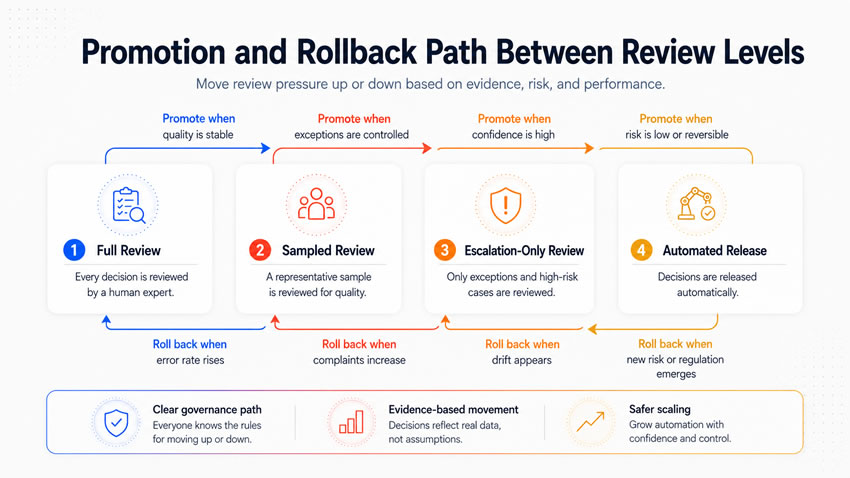
Earn and revoke autonomy on evidence, not schedule
A workflow moves from full review toward lighter review only after evidence supports the change. That evidence means stable performance across representative cases, low major-correction rates, reliable exception detection, successful recovery testing, and sign-off from the accountable owners. Keep the first reduction narrow, with one case group moving to sampled review while a related group stays under full review. Attach a stabilization period and a review date to that change.
The same logic runs in reverse. A model change, a new data source, expanded permissions, rising complaints, or an unresolved incident should trigger a return to stronger review immediately. That reversal is a normal management action, not a failure to admit to, and treating it as routine is what keeps the whole system credible.
Run this 30-day process to set the review model for one workflow
Week one. Map every output and action in the workflow, following representative work from the original trigger through the completed business result.
Week two. Score the six factors with evidence beside every rating, then apply the hard gates before anyone discusses convenience.
Week three. Design the operating controls for each meaningful action: reviewers, sampling rules, escalation triggers, and shutdown authority.
Week four. Test the design against normal cases, weak inputs, known exceptions, and simulated system failures. Approve the review model only after it holds up under realistic conditions, with a reassessment date and rollback triggers attached.
What you tell them at the end
Full review protects decisions where qualified judgment genuinely changes the result. Sampled review tests whether an established workflow keeps meeting its own standard. Escalation-only review points people at the exceptions and the declining performance that deserve attention. Automated release stays limited to narrow, low-consequence work with real operating evidence behind it. None of these choices should be a technology decision made through convenience, and the six-factor score exists precisely so it never has to be.