
Summary
Most organizations that invest in artificial intelligence (AI) cannot confidently answer one question: what is the return on that investment? Their teams report usage statistics: how many people are accessing the tools, how frequently, which features are being used. None of that answers the question.
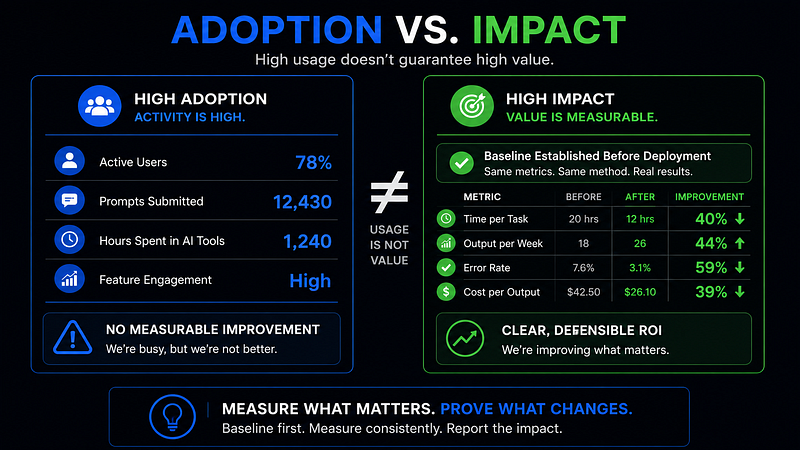
These metrics tell you whether people are using the tools. Whether the tools are producing value is a different measurement entirely. An organization can have high AI adoption and zero measurable improvement in the outcomes that matter. The confusion between adoption and impact is where most AI measurement goes wrong, and that confusion takes root long before the tools are deployed.
The Activity Measurement Trap
Most AI measurement programs begin after deployment. Teams track logins, prompts submitted, and time spent inside AI interfaces. Leaders receive dashboards showing active users and feature engagement. Usage data is not meaningless. It tells you whether people are using the tools. It tells you nothing about whether the work is better, faster, or less expensive as a result.
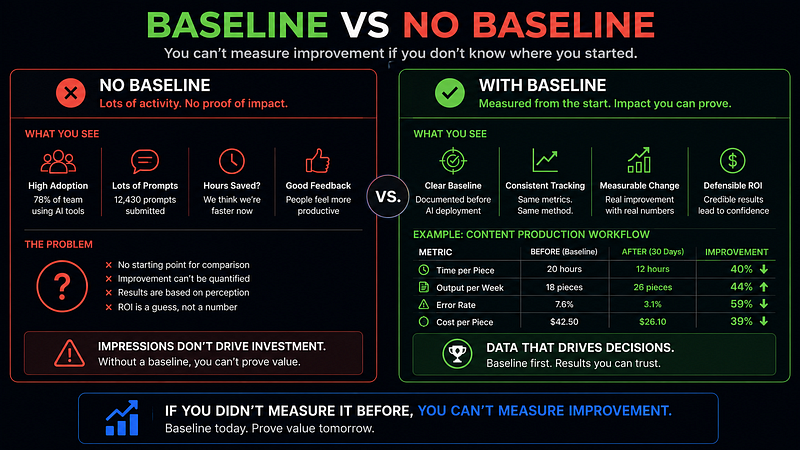
Impact measurement requires something different. It requires knowing what performance looked like before the tool arrived. The improvement percentage is meaningless without the starting point that makes the percentage real. A team that reduces content production time from 20 hours to 12 hours per piece has a 40% reduction to report. A team that only knows it is faster now has an impression.
The gap between those two positions is a baseline measurement taken before deployment.
What a Baseline Actually Is
A baseline is a documented, time-stamped record of how a workflow performs before AI enters it. It captures the specific metrics the deployment is intended to improve. It is taken as close to the deployment date as possible. The measurement method used before deployment must match the method used afterward.
Three conditions make a baseline credible. First, the metrics must match what the deployment is actually trying to change. Second, the measurement method before deployment must be the same method used after. Third, the baseline must be documented formally, with a date stamp and a clear description of what was measured.
Baselines established after a deployment are reconstructions, and reconstructions carry the bias of the person constructing them. That bias is rarely intentional. It is simply the natural result of measuring backward with the knowledge of what the outcome was.
What to Measure Before Common AI Deployments
The right baseline metrics depend on the specific workflow being improved. Four deployment types cover most organizational AI programs.
Content production deployments: Capture time from brief to draft completion and revision cycles before approval. Also capture output volume per team member per week and time spent on research versus writing. These are the numbers that will tell you whether AI actually changed the production economics, or whether it only changed the feel of the work.
Sales and customer-facing deployments: Capture time from inquiry to first meaningful response, follow-up touchpoints per deal, and proposal production time. Also capture close rates on AI-supported versus unsupported opportunities. The sales function has many variables. Tighter measurement windows and like-for-like comparisons are essential here to isolate what AI contributed.
Operations and process deployments: Capture task completion time for the specific task AI is entering, error rates, and the number of manual review steps required. Cycle time from intake to completion is the summary metric. Process deployments are often the clearest to measure because the inputs and outputs are well-defined before AI arrives.
Research and analysis deployments: Capture the time required to complete a standard research task and the number of sources reviewed per output. Turnaround time from question to usable answer is the primary metric. These deployments often show the most dramatic time reductions, which makes having a pre-deployment baseline especially important for credibility when reporting results.
How to Take a Baseline
A baseline does not require a lengthy measurement program. It requires three to four weeks of consistent tracking before the AI tool goes live. The tracking tools and methods must match what the team will use for ongoing measurement afterward. Changing the measurement method after deployment invalidates the comparison.
In week one, identify the specific metrics tied to the workflow being improved. Confirm that these metrics are measurable with available tools and that the measurement method will remain consistent after deployment. In weeks two and three, track the metrics as a team for the workflow being targeted. Capture individual and team-level data, not just aggregates.
In week four, document the baseline formally. That documentation should include the metrics, the values, the measurement method, the sample size, and the date range. That document is what makes every subsequent measurement meaningful. The after is only an improvement if you can show what it improved from.
Using Measurement to Track Impact and Detect Drift
The baseline enables two things that matter equally: impact demonstration and drift detection.
Impact demonstration is the obvious use. At 30 days, 60 days, and 90 days post-deployment, measure the same metrics using the same method. Calculate the change against the baseline. Report the actual numbers alongside the percentages. Actual numbers anchor the percentages in reality and survive scrutiny in a way that percentage-only reporting does not. A 40% reduction from 20 hours to 12 hours is a different claim from a 40% reduction with no starting point attached to it.
Drift detection is the less discussed use, and it is equally important. AI systems degrade over time as models update and as the volume and nature of requests changes. An organization that tracks impact consistently will notice quality degradation before it becomes a program-level problem. Production times that were improving and then begin to lengthen are visible in the data. Error rates that were declining and then begin to climb are detectable before they compound.
Those numbers carry weight because they are calculated against documented baselines. The 30% productivity improvement had a starting point. The 40% reduction in manual production time had a starting point. The tripled content output per team member had a starting point. Without those starting points, none of those numbers would be reportable with confidence. When model updates affected output quality in our program, the measurement system made those changes visible early. Drift was detectable before it compounded into a program-level problem.
The Before-and-After Measurement Template
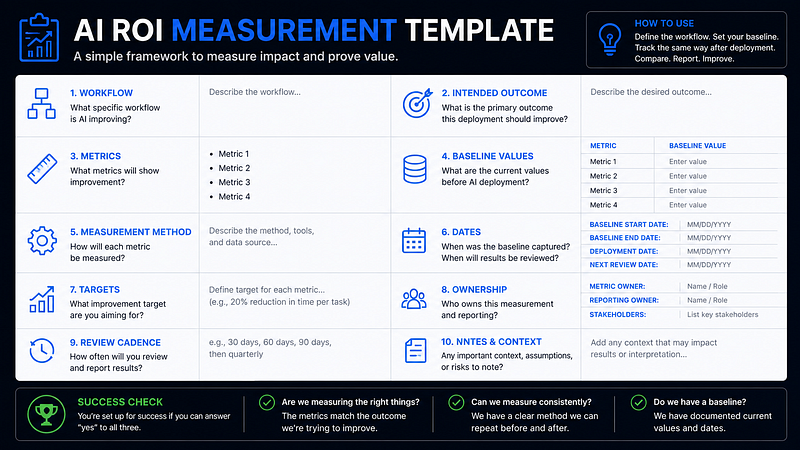
Before each AI deployment, complete this template with the team responsible for the workflow. A completed template takes less than two hours to produce. An organization that cannot complete one does not yet have the measurement infrastructure to evaluate whether the deployment worked.
Workflow being improved: Name the specific workflow, not the department or function.
Intended outcome: State what the deployment is expected to change, in specific and measurable terms.
Baseline metrics: List three to five specific, measurable metrics tied to the intended outcome.
Baseline values: Document the actual numbers for each metric during the baseline period.
Measurement method: Describe precisely how each metric is tracked, including the tools used.
Baseline date range: Record the start and end dates of the baseline measurement period.
Target improvement: State the expected improvement range for each metric at 30, 60, and 90 days post-deployment.
Review schedule: Assign specific dates for the first, second, and third post-deployment measurements and name who is responsible for each.
Every field must have a specific answer before the deployment proceeds. Unanswered fields are measurement gaps that will make the program’s results unverifiable.
What This Changes at the Leadership Level
The measurement discipline that makes AI return on investment provable also changes what leadership conversations look like. When board-level stakeholders ask what return the AI investment is generating, the answer has three specific parts: what changed, what it changed from, and how the difference was measured.
That is a fundamentally different conversation from the one most organizations are having. Most AI reporting still presents activity metrics dressed up as results. Executive audiences are practiced at distinguishing between the two. Teams that arrive with real before-and-after data earn credibility for the next investment request. Teams that arrive with usage dashboards leave the credibility question unanswered.
McKinsey & Company research on AI and business performance shows a consistent pattern. Organizations that measure AI impact against specific pre-deployment baselines are more likely to scale successfully and capture sustainable value. The measurement discipline is a prerequisite for the scaling conversation, not a reporting formality that happens afterward.
The Measurement Comes First
The reason most organizations cannot answer the AI return on investment question confidently is straightforward. They did not establish what they were starting from before the tool arrived. The improvement percentage they want to claim has no starting point to be calculated from. The baseline that would make every number credible was never taken.
Taking that baseline requires discipline, not complexity. It requires deciding what to measure before the deployment, measuring it, and documenting what was found. Every number reported after that point means something. Every improvement percentage has a real number behind it. Every instance of drift is visible rather than invisible until it becomes serious.
The measurement comes first. Everything the organization wants to say about its AI program depends on whether it was taken.