
Summary
Why Most AI Implementations Fail Before the Tool Even Matters
Artificial intelligence (AI) doesn’t fix broken workflows; it exposes them and then accelerates them.
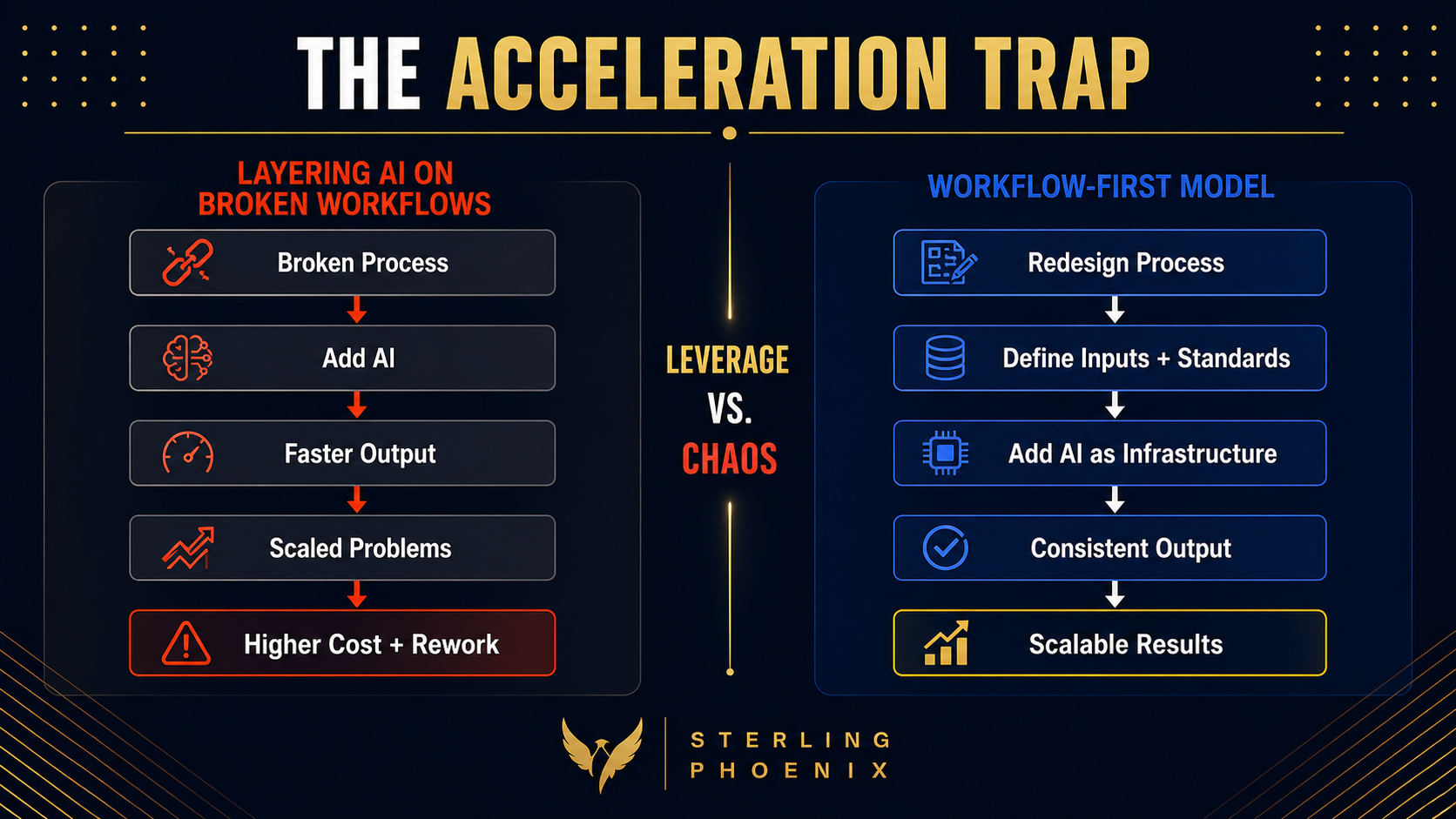
That’s the Acceleration Trap: when organizations use AI to speed up a process that was never designed to work well in the first place. The result is not transformation. It is a faster version of the same dysfunction, now operating at a scale that makes it harder to ignore and more expensive to fix. Most AI failures are workflow failures with better tools.
The Deployment Mistake
The pattern is consistent. A team identifies a painful process. Someone finds an AI tool that seems to address it. The tool gets deployed. Results disappoint. The conclusion most organizations reach is that AI isn’t ready, or the tool wasn’t the right fit, or the team needs more training.
The actual conclusion is harder to accept: AI doesn’t remove friction; it removes the time it used to take to notice it. The friction that surfaced as a slow, manageable problem before deployment surfaces as a fast, visible, and expensive one after it. The tool didn’t fail; the process did.
You didn’t improve the workflow; you increased the speed of the problem.
Five Signs Your Workflow Isn’t Ready for AI
Before deploying artificial intelligence (AI) into any workflow, five conditions are worth examining honestly. Each one is a failure point that AI will find and amplify.
Inconsistent inputs. AI is only as good as what enters the system. If your inputs vary because data isn’t standardized, sources aren’t consistent, or the upstream process isn’t stable, AI will produce variable output by design. If your inputs vary, your outputs will too. AI doesn’t normalize chaos; it reflects it.
Unclear decision criteria. If humans can’t define “good,” AI will settle for “acceptable.” This is how the Acceleration Trap connects to output quality: AI cannot resolve a disagreement that humans haven’t resolved first. The absence of clear criteria doesn’t get fixed by the tool; it gets embedded in the tool’s output and scaled.
Ambiguous handoffs. Every AI-assisted workflow produces output that has to go somewhere. If the next step isn’t clearly defined, the output doesn’t go anywhere. An AI output without a next step is just backlog. If no one owns the next step, nothing moves.
Undefined quality standards. Most teams don’t realize they’ve never defined quality until AI forces them to. When a human produces output, reviewer judgment fills the gap where standards are absent. When AI produces output at volume, that gap becomes a compounding problem. Judgment doesn’t scale; standards do.
No feedback loop. Without a systematic review of AI outputs against real business results, errors don’t get caught. Without feedback, mistakes don’t get fixed; they get repeated. Every uncaught error establishes a pattern the next output will follow, and the compounding happens faster than most teams anticipate.
The Workflow-First Model
If you wouldn’t build the process this way today, AI won’t save it.
That single question drives the Workflow-First Model: before any AI tool enters the conversation, ask what this process would look like if designed from scratch today. The goal is not an improved version of the current process. The goal is the process as it would be designed by someone with no attachment to how it currently works.
AI works best as infrastructure, not as an addition layered on top. That requires designing the system around AI’s capabilities from the start, not dropping AI into what already exists and hoping the outputs improve. The difference between those two approaches is the difference between leverage and volume without structure.
Volume without structure is just faster chaos. This is the system readiness layer of the AI Reality Stack: where most implementations break before they ever scale. The Workflow-First Model takes more time at the design stage. It takes dramatically less time in rework, correction, and the trust rebuilding that follows a failed deployment.
What This Looks Like in Practice
Three workflow types illustrate this pattern clearly.
Content creation. The organizations that get AI-assisted content working well did not deploy AI and then figure out quality standards. They documented their positioning, defined their brand voice, established editorial criteria, and redesigned the review workflow before AI entered the process. AI didn’t fix content workflows; it forced teams to define them. The teams that defined them first got leverage. The teams that didn’t got volume and inconsistency.
Lead qualification. AI-powered lead scoring requires clean, consistent, standardized input data. Most CRM environments have none of those things before the AI deployment conversation begins. AI doesn’t fix bad data; it scales it. The organizations that get accurate lead scoring from AI are the ones that fixed their data taxonomy and their lead definitions before asking AI to evaluate against them.
Customer communications. AI can maintain a consistent brand voice only if that brand voice is documented, specific, and consistently applied before AI enters the workflow. AI can’t maintain a voice that doesn’t exist. Organizations that have built real brand voice documentation with concrete examples get consistent AI-assisted communications. Organizations that haven’t get outputs that sound like the industry average, because that is the only reference the tool has.
The Principle Underneath It All
AI creates leverage when the system around it is clear; without that, it just creates volume. AI doesn’t fix bad processes; it scales them. The Acceleration Trap is what happens when organizations skip the system design and deploy directly into the dysfunction.
The bottleneck was never the tool; it was always the workflow. The organizations getting genuine, sustained results from AI spent significant time on workflow design before they touched a single AI tool. That investment is invisible in the output. It is the reason the output works.
The Question That Changes Everything
Before you ask how to use artificial intelligence (AI) here, ask a better question: would we design this process this way today?
AI should be built into that answer, not layered onto what you already know doesn’t work.