
Summary
The most expensive artificial intelligence (AI) governance decision is the one you delay. After an incident, you’re not designing a system; you’re reacting to damage. The incident defines the framework rather than the framework preventing the incident, and that inversion is precisely what makes reactive governance so costly.
I think of deliberate AI governance as the Defensible AI Framework: the set of decisions that allows an organization to explain, justify, and stand behind how it uses AI. Not as a legal exercise, but as an operational one. Governance delayed becomes damage control. The organizations that get this right are not the most cautious ones; they’re the ones that made these decisions deliberately, before they were forced to.
Why Governance Gets Skipped
Most teams skip governance not because they don’t care, but because they believe they’ll have time to fix it later. The pressure to deploy quickly is real, and the mental model most teams carry into AI deployment is borrowed from software adoption: move fast, iterate, and fix problems as they arise. That model breaks with AI because the failures that governance prevents are far more expensive to clean up than they are to prevent.
Speed without governance is exposure, not agility. Most governance failures are absences, not violations. Nobody made a reckless decision; they simply never made the decision at all. If you don’t define AI boundaries, the tool will define them for you, and it will define them at the moment of highest-risk behavior rather than at the moment of deliberate organizational design.
I’ve watched organizations move quickly with AI, only to pull back just as quickly when something didn’t align with how they actually operate. Not because the tool failed, but because the system around it wasn’t defined. Every one of those pullbacks was more expensive than the governance that would have prevented it.
The Five Decisions That Make AI Defensible
The Defensible AI Framework rests on five explicit decisions. Governance is Layer 2 of the AI Reality Stack: where success depends less on the tools and more on the decisions underneath them. These five decisions are what Layer 2 requires, and most organizations skip all five in the rush to deploy.
Decision 1: Data Handling. Define what may and may not enter any AI tool, organized by data type and sensitivity level, before any team member uses one. Most data exposure comes not from bad actors but from normal employees doing useful work without clear boundaries. A sales team that pastes a client contract into a public AI tool to draft a summary is not being reckless; they’re being efficient inside a system that gave them no guidance. The absence of a data handling decision is itself a decision, and it defaults to the highest-risk behavior every time.
Decision 2: Consent Management. If your AI system touches real people’s data, you already have a consent problem whether you’ve acknowledged it or not. Any AI tool that generates content about clients, processes employee information, or handles personal data requires explicit consent architecture built into the workflow before deployment. When I built the testimonial generation tool at my organization, legal consent management was built into the tool’s structure before a single user touched it. Retrofitting consent architecture into a live system is far harder and more disruptive than designing it in from the beginning.
Decision 3: Human-in-the-Loop Design. This is where most organizations lose control without realizing it. If you haven’t explicitly decided what AI is allowed to decide, you’ve implicitly allowed it to decide more than you intended. Every AI-assisted workflow requires a documented decision about which outputs are autonomous, which require human review before moving forward, and which cannot be delegated to AI at any level of confidence. The moment AI output becomes “good enough,” oversight disappears, and the gap between what the tool produced and what the organization actually intended grows quietly until it doesn’t.
In one instance at my organization, a colleague used AI to review AI-generated content rather than reading it personally. The content was published sounding correct for the industry but not true for the business. That failure was a human-in-the-loop failure: nobody had explicitly decided that content review required a human reader. The decision was made by default rather than by design.
Decision 4: Access Control. Not every team member should access every AI tool, and not every tool should carry the same access architecture. AI access without role definition is one of the fastest ways to create uneven risk across an organization. Sales tools carry different data exposure profiles than HR tools. Client-facing tools carry different accountability requirements than internal analysis tools. Appropriate access built into the system architecture is governance. Access managed through individual judgment at the point of use is exposure.
Decision 5: Output Review. Define what quality and accuracy standards apply to AI-generated content before it reaches customers, leadership, or the market. AI outputs can be logically correct and operationally wrong, and that gap is where brand and customer damage happens. The standard for AI-assisted content must be explicit: who reviews it, against what criteria, before it moves. Without that standard, the review happens by default, which usually means it doesn’t happen at all.
The Governance Documents You Actually Need
These are operational controls, not compliance artifacts. If they don’t change behavior, they don’t count. Four documents form the practical foundation of the Defensible AI Framework.
The AI Usage Policy defines what AI may and may not be used for across the organization, which tools are authorized, and what standards govern outputs before they’re used. It is not a list of prohibited activities. It is a decision record that makes expectations explicit and gives teams a reference at the moment of uncertainty.
The Data Classification Guide is the one-page reference that prevents most exposure incidents. It defines which data categories are high-sensitivity and may not enter any AI tool, which require specific handling conditions, and which can be used without restriction. One page, maintained actively, available at the moment of use.
The Human-in-the-Loop Decision Map documents which workflows in the organization require which oversight levels. It answers the question “who is responsible for this output before it moves?” for every major AI-assisted workflow. Without this map, that question gets answered by default rather than by design.
The Incident Response Protocol defines what happens when AI produces something wrong, harmful, or inconsistent with how the organization operates. Most organizations discover they need this document during an incident. Building it in advance is what makes the response organized rather than improvised.
The Point of Temptation Principle
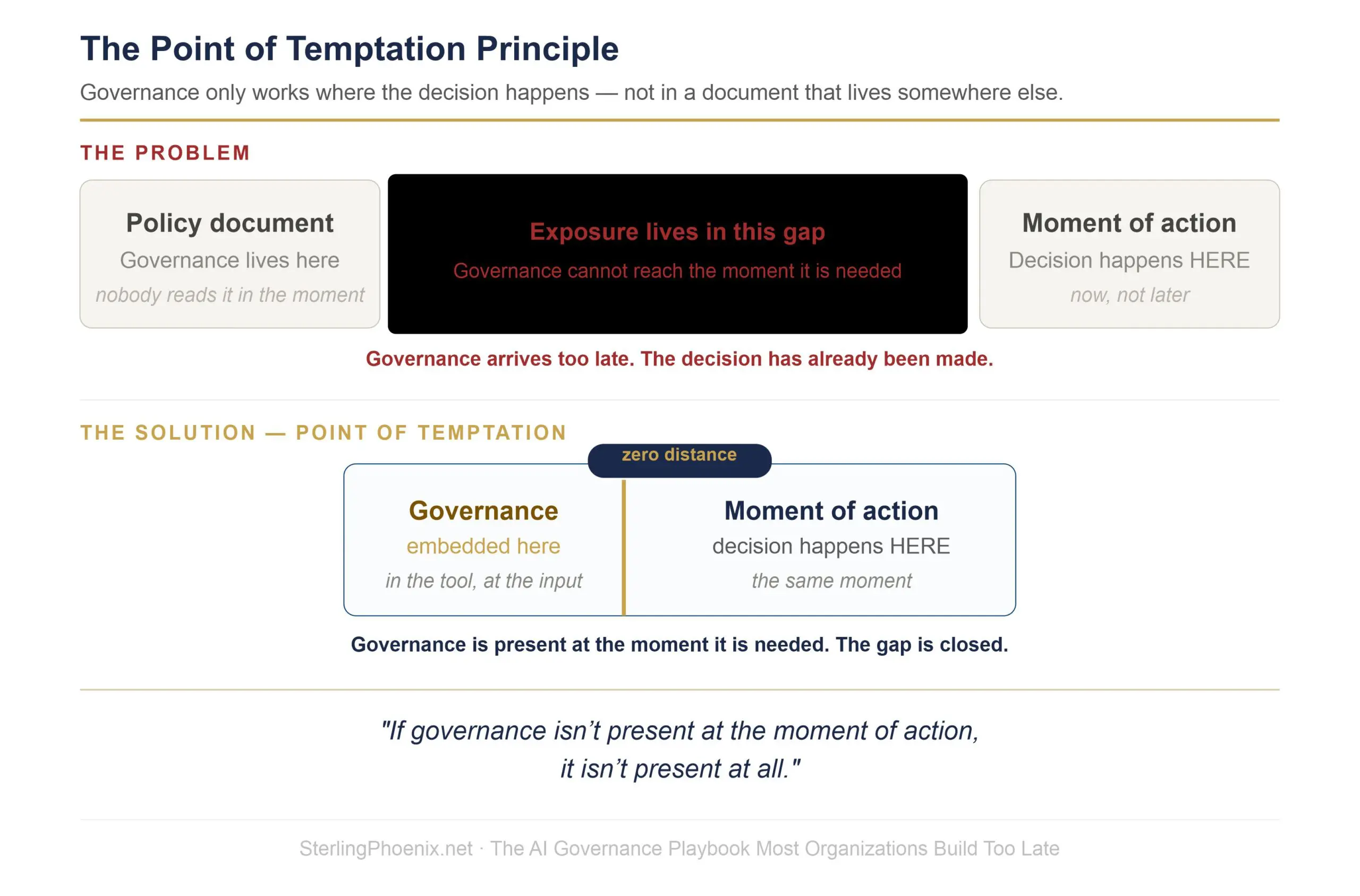
Governance built into tool design is more effective than governance enforced through policy. This is the insight I think of as the Point of Temptation Principle.
Governance only works at the point of temptation: where someone is about to paste data, generate output, or make a decision. If governance isn’t present at the moment of action, it isn’t present at all. A policy document that lives in a shared folder does not reach that moment. A data sensitivity reminder embedded in the tool interface, a required confirmation step before sensitive data is submitted, or a workflow gate that routes output to a human reviewer: these reach the moment where the decision actually gets made.
Governance doesn’t require a six-month committee process. It requires identifying the highest-risk use cases, making the decisions explicitly, and building those decisions into the system architecture rather than around it. Start with the riskiest deployments, decide deliberately, then work backward.
The Mindset Shift That Makes This Work
Governance doesn’t slow AI down; it keeps speed from turning into damage. The organizations that skip governance in the name of deployment speed eventually face a harder constraint: rebuilding trust after an incident rather than building systems before one. Governance is not the obstacle to AI adoption. The framework is what makes AI adoption defensible at scale.
The organizations that build the Defensible AI Framework before they need it are not the most cautious organizations. They’re the most confident ones. They deploy faster at scale because they’ve answered the hard questions once deliberately, rather than answering them repeatedly in the form of incident responses.
You Will Be Asked to Defend These Decisions
Every AI system will be questioned eventually. A leadership team will ask. A client will ask. A regulator might ask. The question is whether you will be explaining a system you designed or a set of decisions that happened by accident.
The organizations that can answer those questions clearly, because they made the decisions deliberately before they were forced to, are the ones that earn the right to keep deploying. Build it before you need to defend it.